
Elevated activity, increased sulfur dioxide output at Nyamulagira volcano, DR Congo
Effusive eruption at Nyamulagira volcano, Democratic Republic of the Congo, continues at elevated levels. Sentinel-2 imagery from November 12, 2025, shows lava overflowing the northern rim of the caldera and extending about 6.5 km (4 miles) along the northwestern flank. On November 14, TROPOMI detected a high SO2 plume at approximately 15 km (49 200 feet) altitude, confirming intensified degassing linked to sustained magma supply.
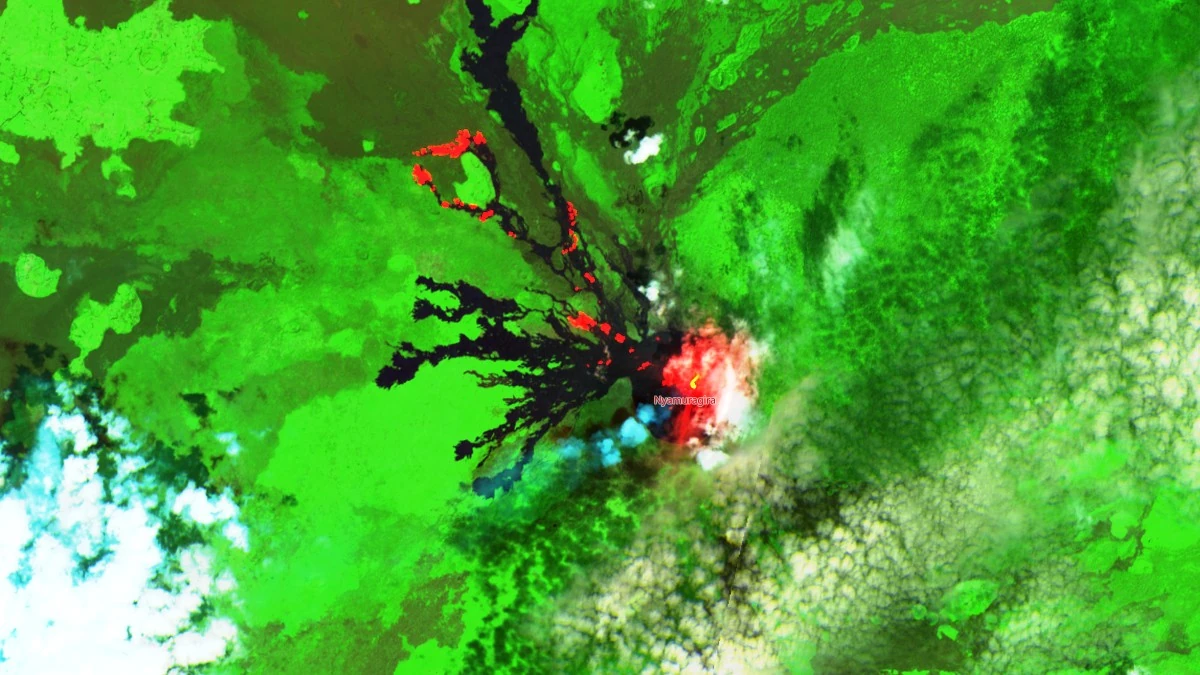
Nyamulagira volcano SWIR satellite image acquired on November 12, 2025. Credit: Copernicus EU/Sentinel-2, The Watchers
The ongoing eruption at Nyamulagira volcano (also known as Nyamuragira) in the Democratic Republic of the Congo remains effusive, characterized by continuous lava lake activity and strong degassing.
Sentinel-2 imagery from November 12 shows that lava from the active lake overflowed the northern rim of the summit caldera and advanced downslope along the northwestern flank, reaching a length of approximately 6.5 km (4 miles). The flow maintains a high thermal signature, indicating continued lava effusion.
Satellite thermal detection systems, including MIROVA (University of Turin), have reported persistent and strong radiative power values throughout early November, consistent with ongoing surface effusion and internal convection within the lava lake.
No explosive activity or significant ash emissions have been observed by the Toulouse Volcanic Ash Advisory Center (VAAC) or other satellite platforms, confirming the eruption remains dominantly effusive.
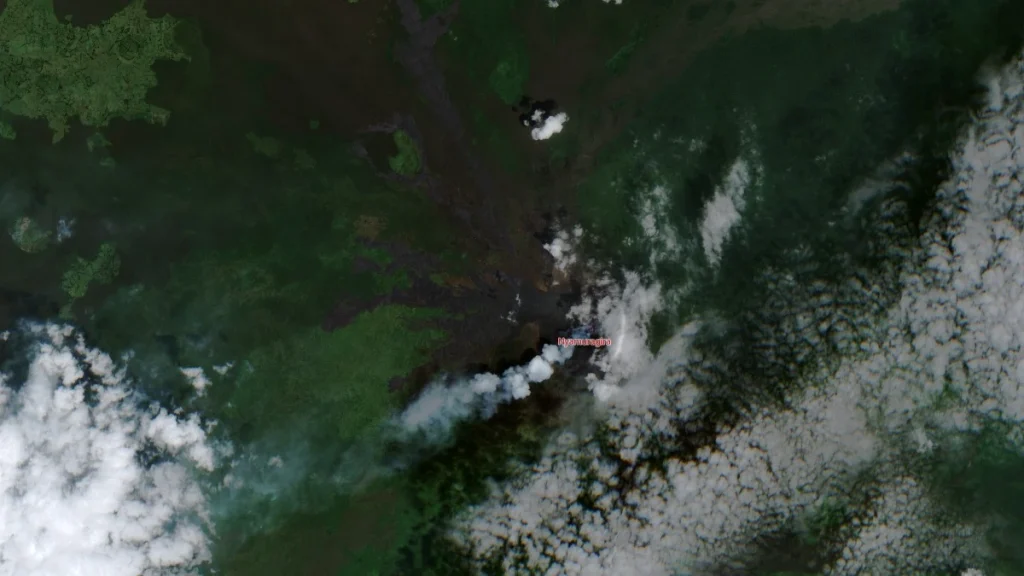
On November 14, the Support to Aviation Control Service (SACS) detected a high-level sulfur dioxide (SO2) plume over the Nyamulagira–Nyiragongo region using TROPOMI data.
The plume, centered near 2.7°S, 25.7°E, contained a maximum SO2 column of 12.8 Dobson Units (DU) at an estimated altitude of 15 km (49 200 feet). The calculated total mass loading was 2.789 kilotons, with a plume area of approximately 139 900 km².
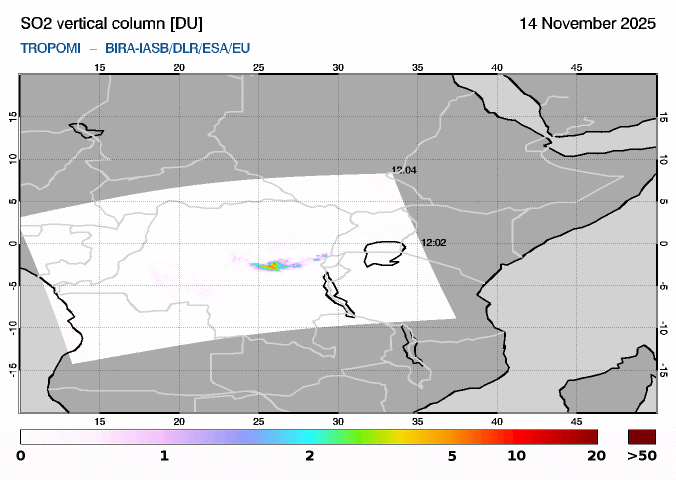
The detection corresponds spatially with the area of active lava overflow, suggesting intensified degassing likely linked to increased convection within the lava lake.
Despite the elevated SO2 output, there are no signs of explosive transition or atmospheric ash hazards at this time.
Nyamulagira, located about 25 km (16 miles) north of Goma, is one of Africa’s most active volcanoes and part of the Virunga volcanic complex, alongside Nyiragongo.
The volcano’s previous major effusive phase occurred between 2023 and 2024, producing extensive lava flows confined mainly within the caldera. The current phase continues that trend, maintaining the volcano’s characteristic low-explosivity, high-output behavior.

I'm a dedicated researcher, journalist, and editor at The Watchers. With over 20 years of experience in the media industry, I specialize in hard science news, focusing on extreme weather, seismic and volcanic activity, space weather, and astronomy, including near-Earth objects and planetary defense strategies. You can reach me at teo /at/ watchers.news.

Commenting rules and guidelines
We value the thoughts and opinions of our readers and welcome healthy discussions on our website. In order to maintain a respectful and positive community, we ask that all commenters follow these rules.