
Comet C/2025 K1 ATLAS fragments as it approaches its November 25 close pass to Earth
High-resolution observations from the Virtual Telescope Project on November 13, 2025, revealed multiple fragments and debris structures in the inner coma of comet C/2025 K1 (ATLAS), confirming a post-perihelion breakup.
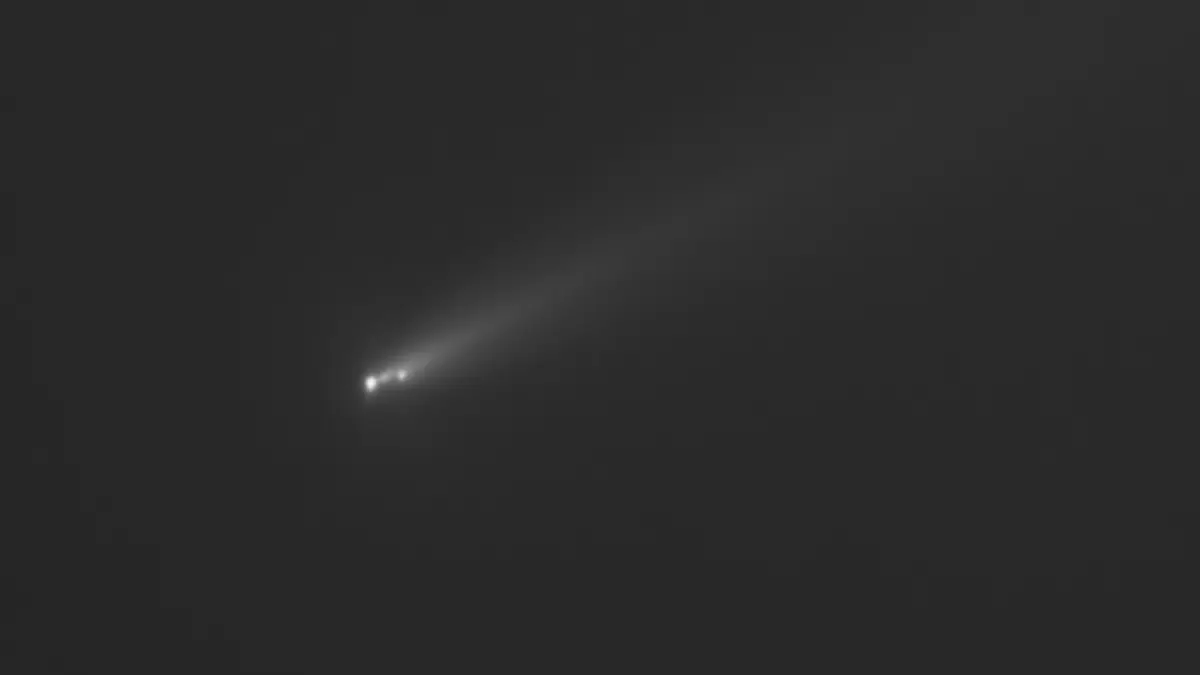
Comet C/2025 K1 (ATLAS) at 04:30 UTC on November 13, 2025, showing multiple bright fragments and a diffuse dust structure in the inner coma. The image is a sigma-clipping combination of fifteen 60-second unfiltered exposures, taken with a remotely operated C14 + Paramount ME + SBIG ST-10XME system of the Virtual Telescope Project in Manciano, Italy. The telescope tracked the comet during acquisition, resolving the primary components and associated dust plume. Credit: Gianluca Masi/Virtual Telescope Project
Fresh observations of comet C/2025 K1 (ATLAS) obtained on November 13 show that the object has fragmented into several components following its recent perihelion passage.
The data was acquired by the Virtual Telescope Project using a remote Celestron C14 telescope paired with a Paramount ME mount and an SBIG ST-10XME CCD, operated from Manciano, Italy. Fifteen unfiltered 60-second exposures were combined via sigma-clipping to preserve fine structural detail within the inner coma.
The resulting image displays multiple discrete condensations, interpreted as sub-nuclei or compact debris clouds, along with a faint plume positioned below the leading fragment.
A second product, processed with a 20-degree rotational-gradient filter centred on the brightest component, enhances these structures and highlights the spatial separation between the fragments.
Using imagery from both November 12 and 13, the Virtual Telescope Project produced an animation documenting the relative motion of the individual units over a 24-hour period.
The sequence confirms that the breakup was well underway by mid-November, with distinct elements diverging inside a broad, diffuse coma.
C/2025 K1 (ATLAS) was discovered on May 24 by the Asteroid Terrestrial-impact Last Alert System. Orbital solutions place its perihelion on October 8, at a distance of roughly 0.334–0.335 AU from the Sun.
The comet will make its closest approach to Earth on November 25, at approximately 0.403 AU. Its near-parabolic eccentricity, around 1.0015 depending on the specific solution, identifies it as a dynamically new object likely arriving from the Oort Cloud.
Spectroscopic studies conducted earlier in the apparition reported that the comet’s coma is strongly depleted in carbon-bearing species, including C2 and CN, placing it within the small group of carbon-chain-depleted comets known so far.
This compositional signature, coupled with its dynamical youth, provides an opportunity to examine volatile behaviour in previously unprocessed material.
 The inner coma after a 20-degrees rotational gradient filtering. Credit: Gianluca Masi/Virtual Telescope Project
- Comet C/2025 K1 (ATLAS) on November 13, 2025 at 04:30 UTC, showing multiple bright fragments and a diffuse dust structure in the inner coma. The image is a sigma-clipping combination of fifteen 60-second unfiltered exposures, taken with a remotely operated C14 + Paramount ME + SBIG ST-10XME system of the Virtual Telescope Project in Manciano, Italy. The telescope tracked the comet during acquisition, resolving the primary components and associated dust plume. Credit: Gianluca Masi/Virtual Telescope Project


At the time of the November 13 observations, the comet was located in the constellation Leo, positioned for pre-dawn observation depending on longitude and sky brightness conditions.
References:
1 Comet C/2025 K1 ATLAS fragmentation: 13 Nov. 2025 image and animation. – Virtual Telescope Project – November 13, 2025

I’m a science journalist and researcher at The Watchers, contributing to the Epicenter edition, where I cover peer-reviewed scientific research and emerging discoveries across Earth and space sciences. With a background in astronomy and a passion for environmental science, I’ve worked in shark and coral conservation in Fiji, conducting reef and shark-behavior research, contributing to mangrove restoration, and earning PADI Open Water and Coral Reef Certifications. I bring a blend of scientific rigor and storytelling to illuminate the discoveries shaping our planet and beyond.

I wonder if it was in the path of CME emissions from Active Region 4274 that struck Earth around this time, could be a bonus for spectroscopic and behavioural insights?
Kudos to Gianluca, Virtual Telescope Project, grazie di cuore!. Thank you, Reet.
Thank you for sharing Reet.