
Extreme rainfall floods Kolkata, leaving at least 12 people dead
At least 12 people died after record breaking rains flooded Kolkata, West Bengal on September 23, 2025, leaving roads inundated, transport paralyzed, and power disrupted.
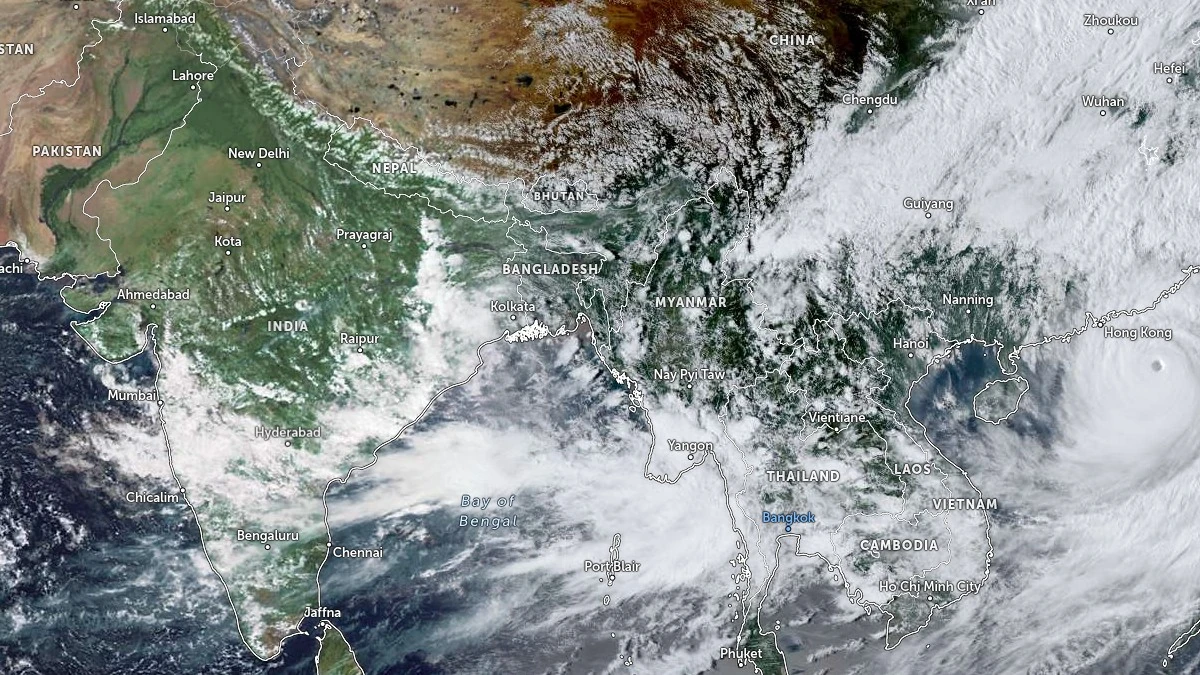
Satellite image centered over Kolkata, India at 08:20 UTC on September 23, 2025. Typhoon Ragasa is visible on the right. Credit: JMA/Himawari-9, Zoom Earth, The Watchers
Parts of Kolkata (population 6.2 million) received extremely heavy rains over the past 36 hours, causing widespread flooding and leaving at least 12 people dead.
An average of 251.6 mm (9.9 inches) of rainfall fell over the city in the 24-hour period ending 08:30 IST on September 23, according to the India Meteorological Department (IMD). This ranked as the third-highest daily September total on record and the sixth-highest single-day total overall for the city.
Kolkata’s southern and central neighborhoods recorded the largest accumulations, with Garia Kamdahari receiving around 332 mm (13.1 inches), Jodhpur Park 285 mm (11.2 inches), Kalighat 280 mm (11 inches), Topsia 275 mm (10.8 inches), and Ballygunge 264 mm (10.4 inches), while Thantania in the north registered 195 mm (7.7 inches).
Most of the rainfall appears to have fallen within four hours during the early hours of September 23, an equivalent to a month’s rainfall for this region, coinciding with a high tide on the Hooghly River that severely restricted drainage and caused widespread flooding which persisted into September 24.
At least 12 deaths were reported, including nine in Kolkata, mostly from electrocution, and two drownings. The private utility Calcutta Electric Supply Corporation (CESC) told local media that several electrocutions were linked to faulty internal wiring or infrastructure outside its direct responsibility, though officials have not independently confirmed this.
Roads in several districts were submerged up to waist level, metro and rail services faced interruptions, and multiple flights were delayed or canceled. Sixteen trees were uprooted across the city, causing further traffic disruption.
Schools and colleges were ordered to remain closed while authorities focused on pumping operations and clearance.
IMD linked the rainfall to a low-pressure system developing over the Bay of Bengal and warned of additional heavy showers in the following days. The U.S. Consulate in Kolkata issued a weather alert advising of continued flood risk.
The timing of the event coincided with preparations for the Durga Puja festival, damaging temporary pandals and clay idols in several neighborhoods. Relief operations, according to municipal officials, included distribution of food and essentials in waterlogged wards.
This event is now among Kolkata’s most extreme rainfall episodes, following 369.6 mm (14.6 inches) on September 28, 1978, and 259.5 mm (10.2 inches) on September 26, 1986.

I'm a dedicated researcher, journalist, and editor at The Watchers. With over 20 years of experience in the media industry, I specialize in hard science news, focusing on extreme weather, seismic and volcanic activity, space weather, and astronomy, including near-Earth objects and planetary defense strategies. You can reach me at teo /at/ watchers.news.

Commenting rules and guidelines
We value the thoughts and opinions of our readers and welcome healthy discussions on our website. In order to maintain a respectful and positive community, we ask that all commenters follow these rules.