
Los Alamos study reveals cosmic ray showers ignite lightning
Researchers at Los Alamos National Laboratory have found evidence linking lightning initiation in thunderstorms to cosmic ray showers, which could be the key to solving the mystery of what causes lightning to start in thunderstorms.

A lightning bolt over Brazil. Photo credit: Sergio Mazzi
- Lightning starts with a positive fast discharge, followed by an even faster and more extensive negative discharge observed in 3D.
- Signal polarizations slant from the discharge propagation direction and rotate between the two opposite fast discharges.
- These features can only be due to a cosmic-ray shower that preconditioned the discharge path and guided the discharge current direction.
How lightning starts in thunderstorms is something that remained a mystery for centuries, but researchers at the Los Alamos National Laboratory in New Mexico have found evidence linking lightning to cosmic ray showers (CRS).
To investigate the earliest moments of lightning formation, Shao and colleagues built a radio interferometer named “BIMAP-3D.” Consisting of an array of 8 antennas in Los Alamos, BIMAP-3D can make three dimensional images of lightning and pinpoint the bolts inside thunderclouds.
The study focused on the s initial stage of lightning, known as positive fast discharge (+FD). Previous observations had indicated that lightning commonly begins with this rapid, positively charged discharge, but the underlying mechanisms remained unclear.
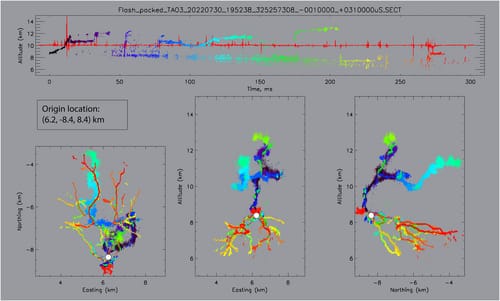
However, researchers observed that this +FD was frequently followed by an even faster, extensive negative discharge (−FD), which intriguingly propagated backward beyond the initial point of origin.
After analyzing the polarization data the researchers found polarization signals, indicative of discharge current orientations, were systematically slanted and rotated, contradicting existing theories that expected polarization to align straightforwardly with lightning paths and local electric fields.
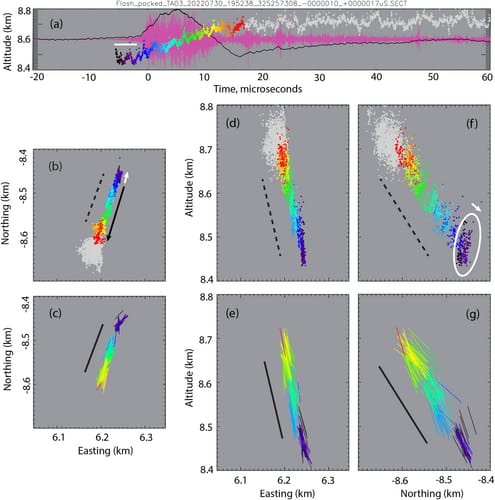
This prompted the team to explore the possibility of external factors that could be affecting the start of lightning. They found that cosmic-ray showers, high-energy particles continuously entering Earth’s atmosphere from space, create pre-ionized pathways within storm clouds.
“We believe that most lightning flashes in thunderstorms are ignited by cosmic ray showers,” said lead author Xuan-Min Shao, a senior scientist at the Los Alamos National Laboratory in New Mexico.
Cosmic ray showers contain both antimatter—positrons—and ordinary electrons. The 3D lightning maps produced at Los Alamos showed strong evidence for positrons.
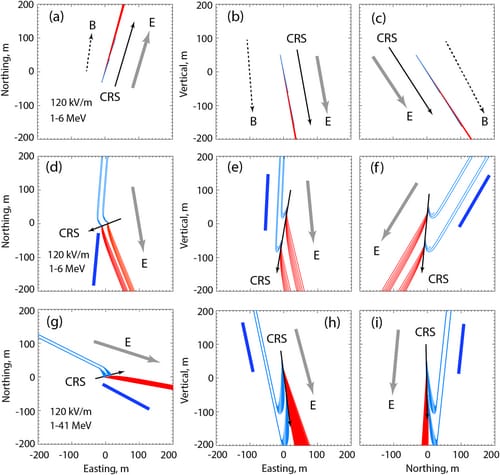
Because electrons and positrons are bent in opposite directions by Earth’s magnetic field, they leave opposite imprints on the lightning’s polarization, which was also measured by BIMAP-3D.
These pre-ionized pathways enable and guide subsequent lightning discharges, helping to explain the unusual polarization orientations and the extremely rapid propagation of lightning.
The shower’s high-energy positrons and electrons are deflected by electric and geomagnetic fields, resulting in slanted discharge currents and corresponding slanted polarization.
Because positrons and electrons are deflected differently in electromagnetic fields, they influence the two opposite discharges in different ways, explaining the polarization rotation observed between them.
This mechanism can also explain cases where only the fast positive discharge occurs, accounting for the initiation of most lightning flashes.
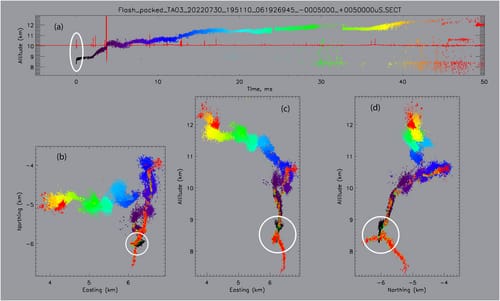
“It took me a while to figure this out,” said Shao. “I started with electrons only at the beginning but could not explain the observations. With both electrons and positrons involved, all the observations can be consistently explained.”
It remains unclear how much of Earth’s lightning is initiated by cosmic rays. More thunderstorms must be studied using this method to improve statistical confidence. “This will require a lot of long-term and good-quality lightning data,” said Shao.
References:
1 3D Radio Frequency Mapping and Polarization Observations Show Lightning Flashes Were Ignited by Cosmic-Ray Showers – Xuan-Min Shao et al. – Journal of Geophysical Research – Published on March 3, 2025 – https://doi.org/10.1029/2024JD042549 – OPEN ACCESS
2 New evidence that cosmic rays spark lightning – Spaceweather.com – March 20, 2025

I am an Assistant Editor and Severe Weather & Science Journalist at The Watchers, specializing in real-time severe weather coverage, geophysical event reporting, and research-driven scientific analysis. You can reach me at rishav(at)watchers(.)news.

Commenting rules and guidelines
We value the thoughts and opinions of our readers and welcome healthy discussions on our website. In order to maintain a respectful and positive community, we ask that all commenters follow these rules.