
Hawai’i’s two most active volcanoes share a common magma source
Volcanologists reporting in Oxford’s Academic Journal of Petrology have confirmed that the Kīlauea and Mauna Loa volcanoes share a deep magma source within the Hawaiian plume.
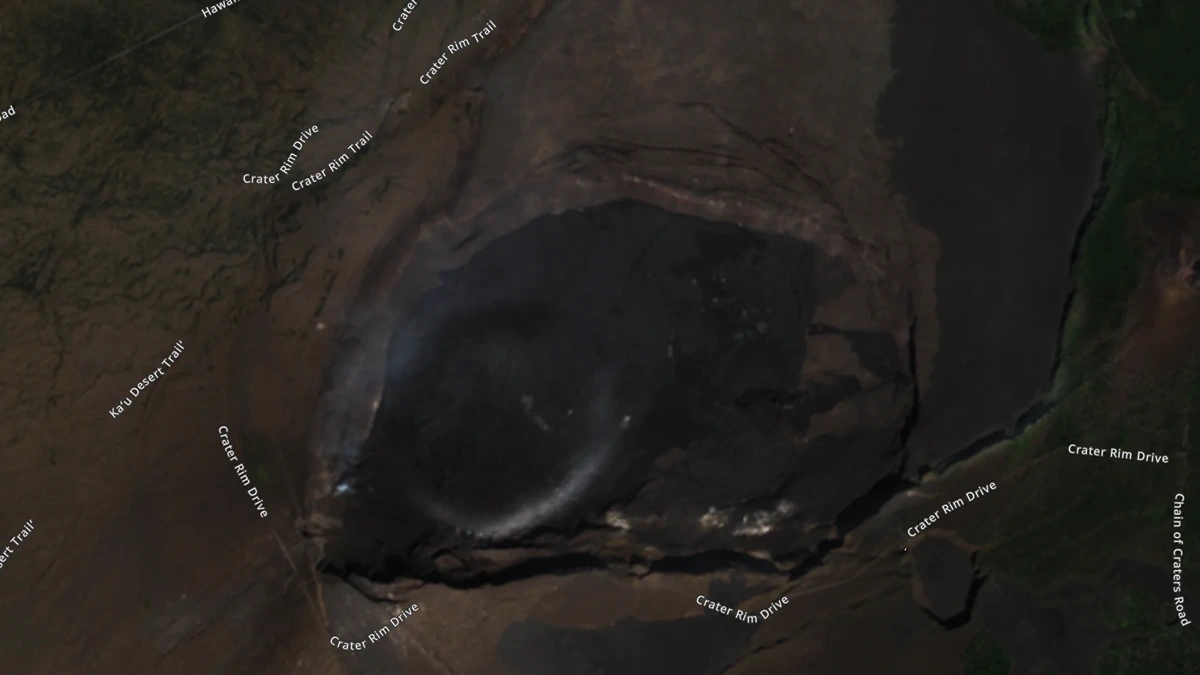
Satellite view of ongoing eruption at Kīlauea volcano and its surrounding features. Image credit: CopernicusEU/Sentinel-2, EO Browser, The Watchers
- New research confirms that Kīlauea and Mauna Loa share a deep magma source within the Hawaiian plume, influencing their alternating eruptive behavior over decades.
- Lava chemistry analysis from nearly 200 years of eruptions reveals that magma transport between these volcanoes shifts periodically which affects their activity cycles.
- Recent chemical shifts suggest magma is now being redirected from Kīlauea to Maunaloa which indicates a potential increase in Maunaloa’s eruptive activity in the coming decades.
A new study has confirmed that Kilauea and Mauna Loa, Hawai’i’s most active volcanoes, are linked by a shared magma source deep within the Hawaiian plume.
“In the past, the distinct chemical compositions of lavas from Kīlauea and Mauna Loa were thought to require completely separate magma pathways from the mantle source of each volcano to the surface,” Aaron Pietruszka, the study’s lead author and an Associate Professor in the Department of Earth Sciences at the UH Mānoa School of Ocean and Earth Science and Technology (SOEST) said.
“Our latest research shows that this is incorrect. Melt from a shared mantle source within the Hawaiian plume may be transported alternately to Kīlauea or Mauna Loa on a timescale of decades.”
Evidence from nearly 200 years of lava chemistry
Researchers identified a long-term pattern of alternating eruptive activity between Kīlauea and Mauna Loa by analyzing nearly 2 centuries of lava chemistry data.
The data indicates that when one volcano experiences an extended period of heightened activity, the other tends to remain dormant. The pattern has been linked to shifts in the transport of magma from the shared source beneath the Hawaiian Islands.
Mauna Loa, Earth’s largest active volcano, erupted in 2022 after its longest-known dormancy period of approximately 38 years. The period of inactivity largely coincided with the prolonged Pu’u’Ōkō eruption at Kīlauea which lasted from 1983 to 2018.
The Pu’u’Ōkō eruption ended with a summit caldera collapse and an unusually voluminous rift eruption.
Researchers have observed that variations in lava chemistry correspond to changes in the frequency and intensity of eruptions.
Kīlauea was highly active while Mauna Loa remained relatively quiet between the mid-20th century and 2010. During this period, the chemical composition of Kīlauea’s lava became increasingly similar to typical Mauna Loa lava. The shift suggests that magma transport had moved from Mauna Loa to Kīlauea.

Magma is shifting back to Mauna Loa
Since 2010, lava chemistry at Kīlauea has once again begun to change which indicates that magma is now being redirected back to Mauna Loa.
The shift was first observed in trace element ratios such as niobium to yttrium (Nb/Y) which reflect the degree of mantle melting. The study suggests that these chemical shifts could be a precursor to increased eruptive activity at Mauna Loa in the coming decades.
“We think this was caused by a change in the transport of mantle-derived melt from a shared source within the Hawaiian plume from Mauna Loa to Kīlauea,” Pietruszka stated.
“In other words, each volcano iteratively becomes more active when it receives melt from the shared source in the mantle, and this process causes measurable changes in lava chemistry.”

Forecasting future eruptions
The discovery provides a new approach to forecasting volcanic eruptions on the Big Island of Hawai’i. The study suggests that long-term monitoring of lava chemistry could serve as an indicator of which volcano is likely to become more active in the future.
“Our study suggests that monitoring of lava chemistry is a potential tool that may be used to forecast the eruption rate and frequency of these adjacent volcanoes on a timescale of decades,” Pietruszka explained.
“A future increase in eruptive activity at Mauna Loa is likely if the chemistry of lava continues to change at Kīlauea.”
The findings of the study have implications for hazard assessment and monitoring strategies.
Scientists may be able to provide more accurate predictions about when and where the next major eruption will occur if magma movement from the shared source can be tracked through lava chemistry. The knowledge could help mitigate risks for the communities living near these volcanoes.
Geological history of Mauna Loa volcano
Mauna Loa, the world’s largest basaltic shield volcano, is part of the Hawaiian-Emperor Hotspot Volcano Group and rises approximately 9 km (5.6 miles) from the ocean floor, with an elevation of 4 170 m (13 680 feet).
The volcano has experienced 110 confirmed Holocene eruptions, with the most recent occurring between November 27 and December 10, 2022. The eruption had a Volcanic Explosivity Index (VEI) of 0.
The Hawaiian Volcano Observatory (HVO) reported that following the 2022 eruption, seismic activity returned to background levels but inflation continued as magma replenished the summit reservoir. On March 16, 2023, the Volcano Alert Level was lowered to Normal and the Aviation Color Code to Green.
Mauna Loa’s eruptions originate from its Moku’aweoweo caldera or its extensive northeast and southwest rift zones, with lava flows covering about 90% of its surface in the past 4 000 years. Documented historical eruptions date back to at least 1843, with older events inferred from geological evidence.
The volcano has also produced debris avalanches such as the Alika landslides which traveled nearly 100 km (62 miles).
A major emission event occurred during the March 25, 1984, eruption, releasing 1 197 kilotons of sulfur dioxide (SO2) at an altitude of 11 km (36 000 feet), as detected by the Nimbus-7 TOMS satellite.
Mauna Loa is situated within the Hawaiian Islands, a UNESCO World Heritage property, and remains a key site for geological research because of its active history and unique intraplate oceanic setting.
Geological history of Kīlauea volcano
Kīlauea, an active shield volcano in the Hawaiian-Emperor Hotspot Volcano Group, is located on the southeastern flank of Mauna Loa, with an elevation of 1 222 m (4 009 feet). The volcano has had 75 confirmed Holocene eruptive periods, with the most recent eruption beginning on December 23, 2024, and continuing into 2025.
Lava fountains from the northern vent reached heights of up to 100 m (328 feet) on January 15, while those from the southern vent rose to 50 m (164 feet).
Both vents had built cones approximately 30 to 35 m (98 to 115 feet) tall and lava continued to ooze from cracks in the caldera floor by January 17. The eruption gradually subsided, with the northern vent ceasing activity at 09:45 UTC on January 18, followed by the southern vent at 10:10 UTC. Incandescence persisted overnight but by January 19, the caldera floor was almost entirely dark, with only residual heat remaining visible.
The Volcano Alert Level remained at Watch (the third level on a four-level scale) and the Aviation Color Code was maintained at Orange.
Kīlauea has a history of frequent eruptions including a long-term eruption from the East Rift Zone between 1983 and 2018 which covered more than 100 km2, destroyed hundreds of homes, and added a new coastline.
The volcano sits within the Hawaiian Islands and has a surface composed of lava flows less than 1 100 years old. A notable past emission event occurred on May 7, 1986, when the Nimbus-7 TOMS satellite detected 36 kilotons of sulfur dioxide (SO2) at an altitude of 5 km (16 404 feet).
References:
1 Awakening of Maunaloa Linked to Melt Shared from Kīlauea’s Mantle Source – Aaron J Pietruszka, Daniel E Heaton, Jared P Marske, Marc D Norman, et. al. – JOURNAL OF PETROLOGY – November 16, 2024 – https://doi.org/10.1093/petrology/egae121 – OPEN ACCESS
2 Mauna Loa – GVP – Accessed on January 28, 2025
3 Kīlauea – GVP – Accessed on January 28, 2025

Rishika holds a Master’s in International Studies from Stella Maris College, Chennai, India, where she earned a gold medal, and an MCA from the University of Mysore, Karnataka, India. Previously, she served as a Research Assistant at the National Institute of Advanced Studies, Indian Institute of Science, Bengaluru, India. During her tenure, she contributed as a Junior Writer for Europe Monitor on the Global Politics website and as an Assistant Editor for The World This Week. Her work has also been published in The Hindu newspaper, showing her expertise in global affairs. Rishika is also a recipient of the Women Empowerment Award at the district level in Haryana, India, in 2022.

Commenting rules and guidelines
We value the thoughts and opinions of our readers and welcome healthy discussions on our website. In order to maintain a respectful and positive community, we ask that all commenters follow these rules.