
Major X1.1 solar flare erupts from Region 3936, CME impact possible on December 31
A major X1.1 solar flare erupted from Active Region 3936 at 07:18 UTC on December 29, 2024. The event started at 07:08 and ended at 07:34 UTC. Two CMEs were noted in LASCO imagery following multiple solar flares today. Initial analysis indicates at least one has a likely Earth-directed component, with a possible arrival early on December 31.
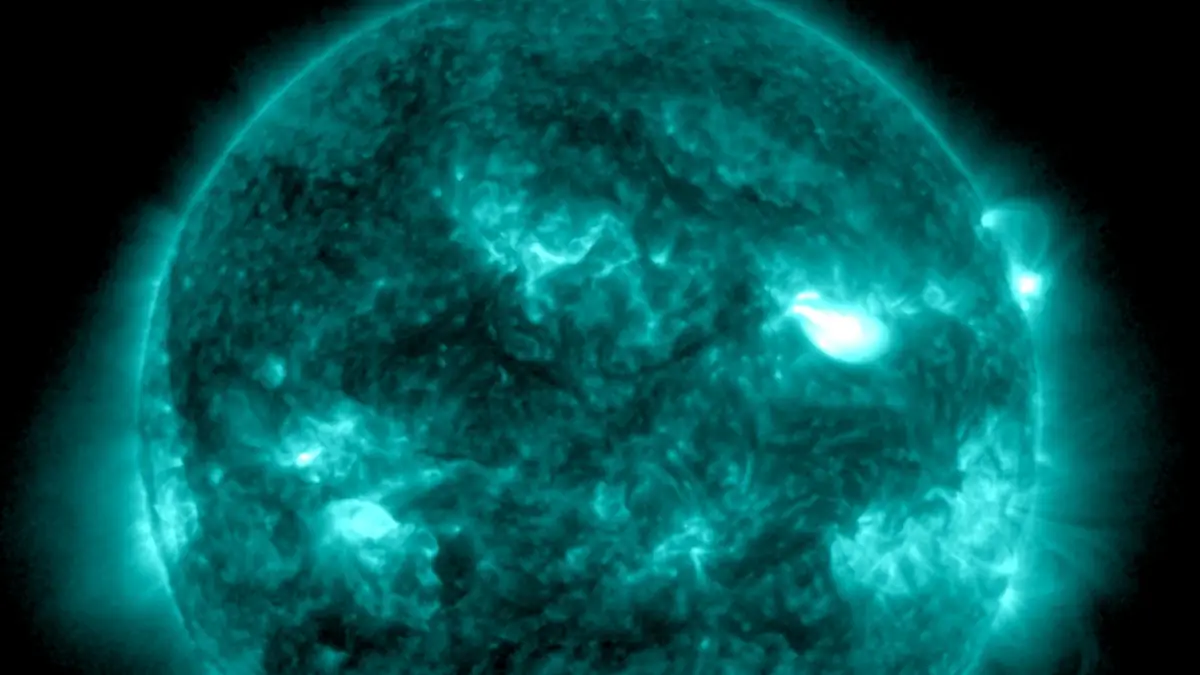
Image credit: NOAA/GOES-16, The Watchers
Solar activity increased again to high levels on December 29, with a major X1.1 solar flare at 07:18 UTC, preceded by a flurry of M-class flares — mostly from Region 3936.
There were no detected radio signatures associated with the X1.1 event that would suggest a coronal mass ejection (CME) was produced.
Region 3936 has a ‘beta-delta’ magnetic configuration and is capable of producing more strong eruptions on the Sun. Its current location still favors Earth-directed CMEs but the probabilities are diminishing as it continues rotating toward the west limb.
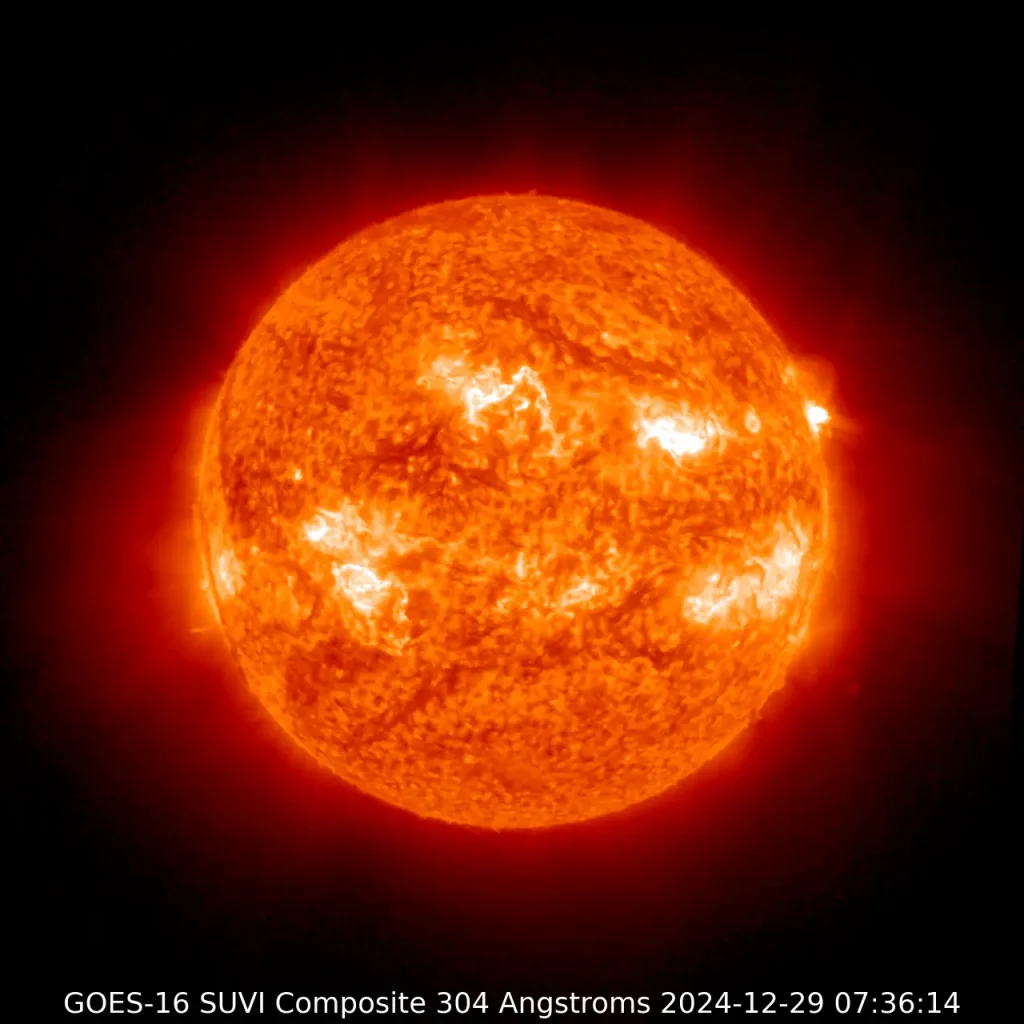

Radio frequencies were forecast to be most degraded over the Indian Ocean at the time of the flare.

Solar activity was at moderate levels in 24 hours to 00:30 UTC today, with three M-class flares — M4.5 at 11:21 UTC on December 28, M1.3 at 15:18 UTC, and M1.2 at 22:14 UTC.
This was followed by a notable rise in activity with 8 M-class flares preceding the X1.1 — M1.0 at 02:35 UTC, M1.3 at 02:46 UTC, another M1.3 at 03:30 UTC, M1.2 at 04:05, M2.0 at 04:30, M3.1 at 05:26, M3.5 at 05:47 and M3.0 at 06:59 UTC. This latest event was associated with a Type IV Radio Emission, suggesting a strong CME was produced.
Almost all of them were produced by regions 3936 and 3939.

Region 3939 also produced a long-duration C8.6 flare that began at approximately 19:13 UTC on December 28, with dimming observed near this region at 19:24 UTC. Analysis of this event determined the bulk of the CME was behind and south of the Sun-Earth line.
Two additional CMEs were noted in LASCO imagery following the multitude of M-class flares and the X-class flare. The first one was very faint and directed mostly southward, and can be first seen in LASCO C2 imagery at approximately 01:48 UTC.
The second, an asymmetrical partial halo is visible from 06:24 UTC moving off the East and Southeast. Both are suspected to have originated near Region 3939.
Initial analysis indicates a likely Earth-directed component, with a possible arrival early on December 31. Additional analysis is underway to corroborate these results.
Solar activity is expected to remain elevated over the next three days, with 70 to 75% of M-class flares and 20 to 25% of X-class.
The greater than 10 MeV proton flux remained slightly elevated above the background over the past 24 hours but remained below the S1 – Minor solar radiation storm threshold. A slight chance for S1 – Minor radiation storm event persists through December 31 given the current total disk potential.
Solar wind parameters remained at mostly nominal levels during the reporting period. The total magnetic field was primarily under 5 nT, with brief periods reaching up to 6 nT. The Bz component stayed mostly neutral, with no significant southward deflections. Solar wind speeds increased slightly, rising from below 300 km/s to approximately 350 km/s in the latter half of December 28. The phi angle was predominantly negative, with occasional excursions into a positive solar sector.
Weak enhancements are possible through December 30 due to the influence of a weak, positive polarity coronal hole high-speed stream (CH HSS). However, solar wind parameters are expected to remain at mostly nominal levels by December 31.
Quiet to unsettled geomagnetic conditions, with a chance for isolated active periods, are anticipated on December 29 and 30 due to the weak CH HSS influence. By December 31, primarily quiet conditions are expected to prevail.
References:
1 Forecast Discussion – NOAA/SWPC – Issued at 00:30 UTC on December 29, 2024

I'm a dedicated researcher, journalist, and editor at The Watchers. With over 20 years of experience in the media industry, I specialize in hard science news, focusing on extreme weather, seismic and volcanic activity, space weather, and astronomy, including near-Earth objects and planetary defense strategies. You can reach me at teo /at/ watchers.news.

Commenting rules and guidelines
We value the thoughts and opinions of our readers and welcome healthy discussions on our website. In order to maintain a respectful and positive community, we ask that all commenters follow these rules.