
Increased activity at White Island volcano, Aviation Color Code raised to Orange, New Zealand
The Aviation Color Code for White Island volcano in New Zealand was raised to Orange on December 16, 2024, following observations of occasional volcanic ash emissions alongside larger steam and gas plumes on December 14. The activity could lead to a new eruptive episode. The Volcanic Alert Level remains at 2.

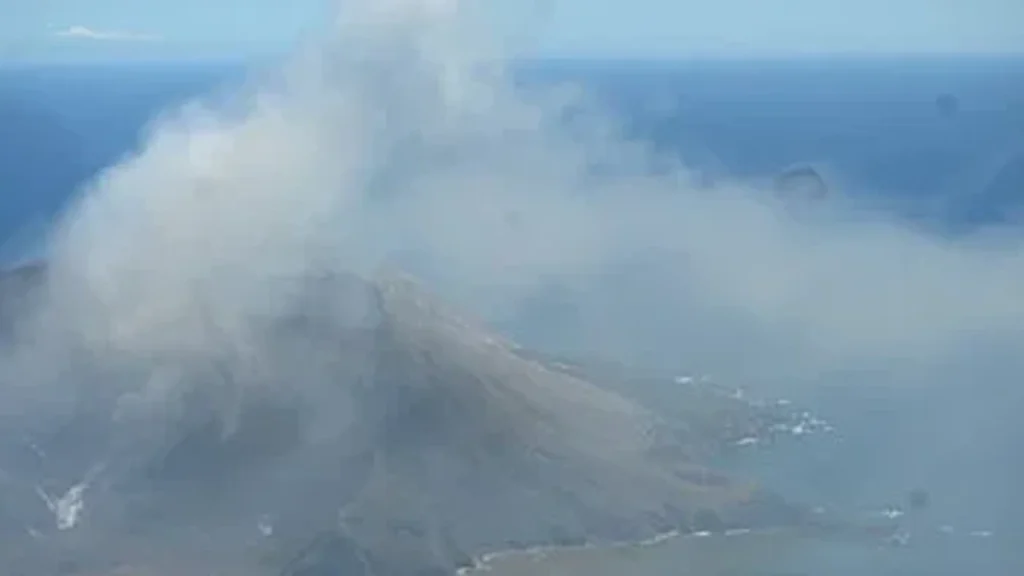
White Island volcano image captured during the gas measurement flight on December 14, 2024. Image credit: GNS
New Zealand’s White Island volcano is currently emitting larger steam and gas plumes, with occasional passive emission of volcanic ash. While the volcano is still not actively erupting, the current activity could lead to a new eruptive episode.
Observations during a routine gas measurement flight on December 14 revealed a noticeable increase in sulfur dioxide (SO2) and carbon dioxide (CO2) emissions along with intermittent volcanic ash emissions from the active vent.
“These are taken together to indicate a new eruptive episode maybe starting,” GNS Duty Volcanologist Agnes Mazot noted on December 16.
The gas plume recorded during this flight reached moderate temperatures and included ash emissions, which were not detected in earlier observations on December 5 and December 10. The plume was also captured on satellite images and remote cameras with emissions drifting downwind.
Ash was not identified in weather satellite analyses conducted by MetService nor detected visually from webcams located in Whakatāne and Te Kaha.
Images from the gas measurement flight and other observations indicate that fresh magma might be causing the recent activity.
Measurements recorded during a previous monitoring flight on December 5, indicated moderate activity, with steam and gas temperatures reaching 150 °C (302 °F). There was no evidence of fresh ash deposits on the volcano’s surface or its surroundings.
Larger steam and gas plumes were first noted on December 10. These plumes, visible during favorable weather conditions, were captured by webcams and satellite images from various locations.
Similar indications were observed between May and September 2024, but the absence of consistent real-time monitoring data has increased uncertainty about the volcano’s behavior.

The Alert Level remains at 2 but the Aviation Color Code was raised to Orange.
“These levels acknowledge the current level of activity but also reflect the degree of uncertainty about the level of unrest due to the current lack of consistent, usable real-time monitoring data,” Mazot said.
The level of volcanic activity could escalate back to levels seen earlier in the year and the volcano can erupt with little or no warning.
Read more:
Whakaari/White Island is a stratovolcano rising 294 m (965 feet) above sea level, with a much larger underwater base measuring 16 by 18 km (10 by 11 miles).
The southeastern crater faces the sea, and its last eruption occurred in 2019, resulting in multiple casualties during a tourist visit. The eruption was classified as Volcanic Explosivity Index (VEI) 2.
Other past eruptions include events in 2016 (VEI 1) and a prolonged period of activity from 1986 to 1994 (VEI 3). These events reshaped the volcano’s terrain and caused notable environmental impacts.
References:
1 Whakaari/White Island – Larger steam and gas plumes with intermittent ash emissions at Whakaari. Volcanic Alert Level remains at Level 2 and Aviation Colour Code is raised to Orange – GeoNet – December 16, 2024
2 Whakaari/White Island – GVP – Accessed on December 16, 2024

Rishika holds a Master’s in International Studies from Stella Maris College, Chennai, India, where she earned a gold medal, and an MCA from the University of Mysore, Karnataka, India. Previously, she served as a Research Assistant at the National Institute of Advanced Studies, Indian Institute of Science, Bengaluru, India. During her tenure, she contributed as a Junior Writer for Europe Monitor on the Global Politics website and as an Assistant Editor for The World This Week. Her work has also been published in The Hindu newspaper, showing her expertise in global affairs. Rishika is also a recipient of the Women Empowerment Award at the district level in Haryana, India, in 2022.

Commenting rules and guidelines
We value the thoughts and opinions of our readers and welcome healthy discussions on our website. In order to maintain a respectful and positive community, we ask that all commenters follow these rules.