
Spurr volcano alert raised after increased seismicity and ground deformation, Alaska
A gradual increase in volcanic unrest was observed at Spurr volcano in Alaska over the past couple of months, prompting the Alaska Volcano Observatory to increase the Volcano Alert Level to Advisory and the Aviation Color Code to Yellow on October 16, 2024. Spurr is located about 120 km (75 miles) west of Anchorage.

3D satellite image of Spurr volcano on September 21, 2024. Credit: Copernicus EU/Sentinel-2, EO Browser, The Watchers
- The last eruptive phase of Mount Spurr occurred at the Crater Peak from June 27 to September 17, 1992, with a Volcanic Explosivity Index estimated at 4.
- The last known eruption from the summit of Mount Spurr was more than 5 000 years ago.
- Primary hazards during future eruptions include far-traveled ash clouds, ash fall, pyroclastic flows, and lahars or mudflows that could inundate drainages all sides of the volcano, but primarily on the south and east flanks.
A gradual increase in volcanic unrest observed at Spurr volcano since April 2024 and sustained upward and outward ground deformation since March, prompted the Alaska Volcano Observatory (AVO) to increase the Volcano Alert Level to Advisory and the Aviation Color Code to Yellow on October 16.
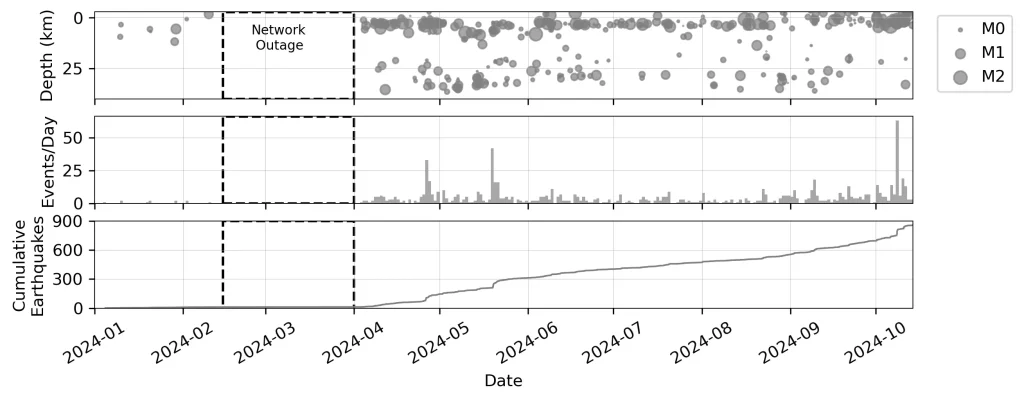
Over 900 earthquakes have been recorded by AVO since April, primarily clustered in two distinct zones. The first cluster is located at depths ranging from 0 to 10 km (0 to 6 miles) beneath the volcano, while the second is southeast of the Crater Peak vent at depths of 20 to 35 km (12 to 22 miles).
The largest recorded earthquake so far was a magnitude M2.3 on October 6. The current earthquake rate remains steady at approximately 20 per week, showing no significant increase in size or frequency since monitoring resumed in April.
A fresh analysis of seismic data indicates a subtle increase in the rate and size of earthquakes over the past few weeks.
In early summer 2024, a small lake formed in the summit crater, possibly linked to the ongoing unrest. The lake was first observed between May 15 and June 15 and was fully documented on June 23 during an aerial survey.
At the time, the lake covered an area of approximately 3 800 m2 (1 acre) and had expanded to around 5 600 m2 (1.4 acres) by late summer. This growth resulted from minor collapses and the melting of glacial ice inside the crater. The crater lake remains blue-green in color and is partially covered by ice.

Steaming activity from fumaroles along the northeastern shore of the lake and the crater rim has been observed, but no significant changes in the volume or intensity of steam emissions have occurred. This is consistent with observations made in previous years. Importantly, no signs of volcanic mudflows (lahars) or abnormal ice melt have been detected, reducing the likelihood of immediate volcanic hazards.
The last time a crater lake formed at Mount Spurr was during a period of seismic unrest in 2004, which also involved a likely magma intrusion but did not result in an eruption.
Gas emissions measured during the June 23 overflight revealed low levels of sulfur dioxide and carbon dioxide. These readings are consistent with background levels observed in previous years. Deep magma intrusions are often associated with elevated carbon dioxide emissions, but no such anomalies were detected, suggesting that the current activity may not lead to an imminent eruption.
At this time, there are no indications that an eruption is imminent. Often this type of seismicity and ground deformation will decline without producing an eruption, AVO said, adding that it continues to closely monitor activity at the volcano for signals that would indicate it is moving closer to an eruption.
Based on previous eruptions, changes from current activity in the earthquakes, ground deformation, summit lake, and fumaroles would be expected if magma began to move closer to the surface. Therefore, it is very likely that if an eruption were to occur it would be proceeded by additional signals that would allow advance warning.
References:
1 Volcanic Activity Notice for Spurr volcano, Alaska – AVO/USGS – Issued at 20:07 UTC on October 16, 2024
2 Seismic unrest continues at Spurr volcano in Alaska with over 900 earthquakes detected in 2024 – The Watchers – October 11, 2024

I'm a dedicated researcher, journalist, and editor at The Watchers. With over 20 years of experience in the media industry, I specialize in hard science news, focusing on extreme weather, seismic and volcanic activity, space weather, and astronomy, including near-Earth objects and planetary defense strategies. You can reach me at teo /at/ watchers.news.

Commenting rules and guidelines
We value the thoughts and opinions of our readers and welcome healthy discussions on our website. In order to maintain a respectful and positive community, we ask that all commenters follow these rules.