
Race to uncover fifth fundamental force
The race to uncover a fifth fundamental force is underway, as scientists at the Paris Observatory, along with researchers from UC and TDLI, analyze asteroid data that could reshape the way we understand the universe.
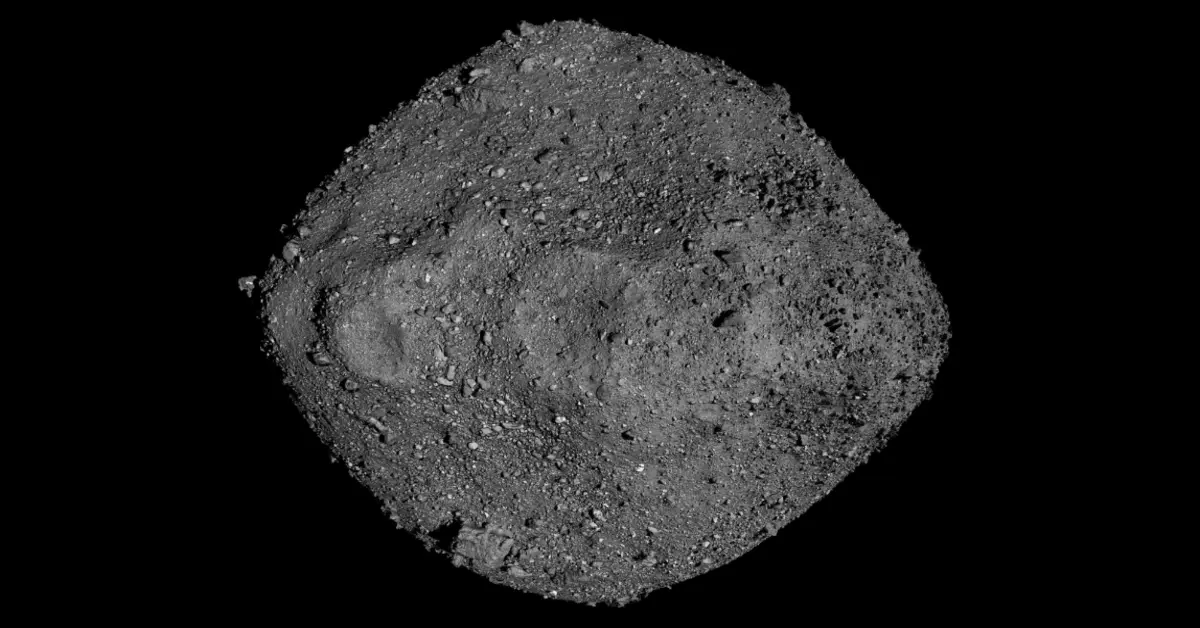
This mosaic of Bennu was created using observations made by NASA’s OSIRIS-REx spacecraft that was in close proximity to the asteroid for over two years. Image credit: NASA/Goddard/University of Arizona
- Researchers track NEOs using telescopes, radar, and simulations, comparing observed asteroid paths with predictions to detect potential gravitational anomalies.
- The study explores the possibility that these subtle asteroid trajectory deviations could be caused by a new particle, such as an ultralight boson, potentially providing direct evidence of dark matter or a fifth fundamental force.
Researchers based at the Paris Observatory led by Yu-Dai Tsai of the University of California and Luca Visinelli of the Tsung-Dao Lee Institute (TDLI), are using precise tracking data from near-Earth asteroids like Bennu to explore the possibility of a fifth fundamental force, which could reshape our understanding of gravity and the universe.
The study, which began in 2022 with full findings expected to be published by 2025, aims to explore the existence of a fifth fundamental force beyond the four currently known: gravity, electromagnetism, the weak nuclear force, and the strong nuclear force.
By examining the trajectories and movements of near-Earth objects (NEOs), the team looks for anomalies suggesting deviations from our current understanding of gravity. If such deviations are found, they could provide evidence of this hypothetical force, potentially leading to new discoveries in physics.
Because of their closeness to Earth and essentially unchanged routes through space, near-Earth asteroids such as Bennu are ideal natural laboratories for investigating gravitational forces.
The hunt for a fifth force is motivated by the limitations of current gravitational theory. While general relativity has effectively explained large-scale cosmic events, it struggles to agree with quantum mechanics, which governs particle behavior on a far smaller scale.
Additionally, the enigma of dark matter and dark energy, which are thought to account for 95% of the universe’s mass-energy content, has yet to be solved. A fifth force could assist in bridging theoretical gaps by providing insights into events that existing models cannot explain.
NASA’s OSIRIS-REx mission, which returned samples from Bennu in 2023, provided valuable data for the study, including comprehensive tracking of the asteroid’s journey.
While the primary research is based at the Paris Observatory, the study is global. NASA’s Jet Propulsion Laboratory (JPL) in California and ESA’s Near-Earth Object Coordination Centre in Italy are essential in collecting and analyzing asteroid tracking data.
Observations are also gathered from ground-based telescopes in Chile, Hawaii, and Spain, offering comprehensive coverage and precise measurements.
This research began in 2022 as part of a more significant, continuing endeavor to investigate extensions of gravitational theory.
The team’s study has quickened with breakthroughs in asteroid tracking and space observation technologies. Preliminary results are already stirring debate among the scientific community, with complete conclusions likely to be released by 2025.
Updates on the project were presented at major conferences in 2024, including the European Week of Astronomy and Space Science (EWASS), sparking interest in the potential consequences.
The study team tracks and models NEO orbits using telescopic observations, radar data, and advanced computer simulations.
The team can discover anomalies by comparing observed trajectories to simulated ones that account for all known forces, such as planet gravitational pull, solar radiation pressure, and relativistic corrections.
The research team examines this data to look for gravitational anomalies that could indicate a mediating particle, such as an ultralight boson, that influences this hypothetical fifth force.
“The tight constraints we’ve achieved translate readily to some of the tightest-ever limits on Yukawa-type fifth forces,” said Sunny Vagnozzi, assistant professor at the University of Trento in Italy and co-author on the paper. “These results highlight the potential for asteroid tracking as a valuable tool in the search for ultralight bosons, dark matter, and several well-motivated extensions of the Standard Model.”
NASA’s OSIRIS-REx mission, for example, gave Bennu valid X-band radiometric and optical navigation tracking data. These precise observations enabled scientists to place some of the strictest limitations on a fifth force’s potential range and strength.
The research was conducted by a team of researchers at the Paris Observatory, led by Yu-Dai Tsai of the Department of Physics and Astronomy, University of California, and Luca Visinelli of the Tsung-Dao Lee Institute (TDLI), Shanghai.
Researchers from the Jet Propulsion Laboratory (JPL), California Institute of Technology, Pasadena, European Space Agency (ESA) NEO Coordination Centre, Frascati (RM), and Department of Physics, University of Trento, Povo (TN) collaborated in this research.
References:
1 Constraints on fifth forces and ultralight dark matter from OSIRIS-REx target asteroid Bennu – Tsai, YD., Farnocchia, D., Micheli, M. et al. – Commun Phys 7, 311 (2024) – September 20, 2024 – https://doi.org/10.1038/s42005-024-01779-3
2 Near-Earth asteroid data helps probe possible fifth force of the universe – Brian Keenan – Los Alamos National Laboratory – October 7, 2024

Harsha Borah is an experienced content writer with a proven track record in the industry. Harsha has worked with LitSpark Solutions and Whateveryourdose, honing skills in creating engaging content across various platforms. A gold medalist in a state-level writing competition organized by Assam Tourism, Harsha’s travelogue on Tezpur was widely appreciated. Harsha’s article, "The Dark Tale of the Only Judge in India to Be Hanged," ranks second on Google and has garnered over 11 000 views and 8 900 reads on Medium. Outside of writing, Harsha enjoys reading books and solving jigsaw puzzles.

The Universe is ruled and unified by the magnetic force. All forces are manifestations of the magnetic force from the subatomic scales to the cosmological one.