
Powerful paroxysmal eruption at Etna, Aviation Color Code raised to Red, Italy
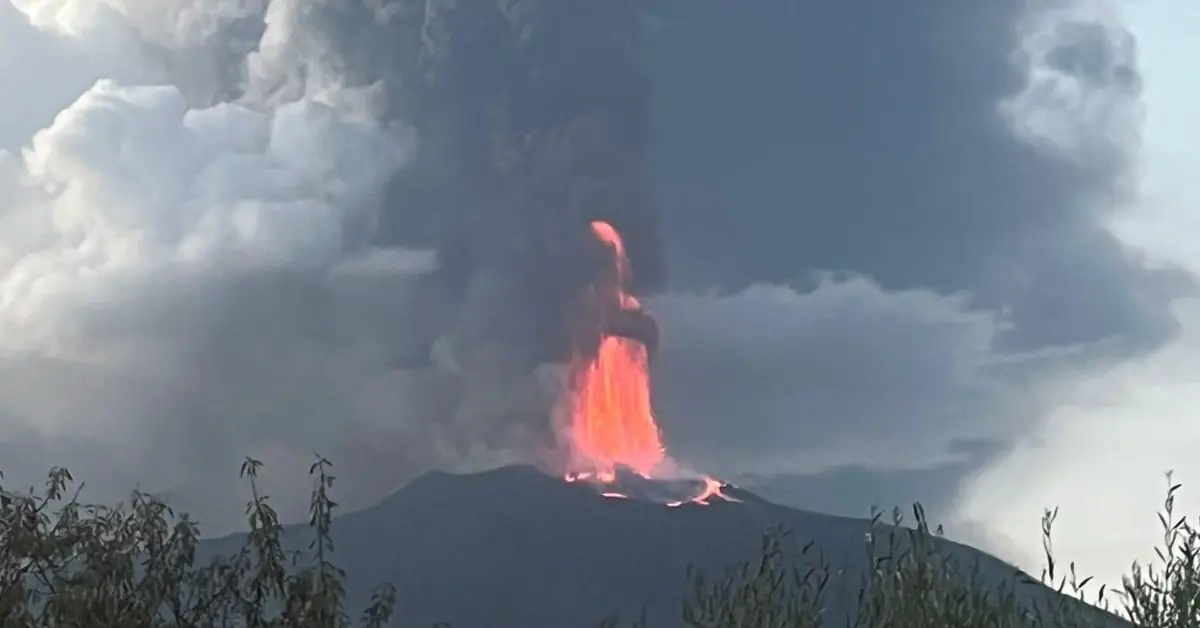
Image credit: Val Anton - It
Strombolian activity at Italy’s Etna volcano increased during the night of August 3 to 4, 2024, evolving into strong lava fountaining by 03:20 UTC on August 4. In response, the Aviation Color Code was raised from Orange to Red at 02:45 UTC, indicating a higher level of volcanic threat to air travel. The last significant eruption at Etna occurred on July 23.
The current eruption is centered at the Voragine crater, producing strong ash emissions toward SE and ESE.
Seismically, the average magnitude of the volcanic tremor, which had already reached very high levels around 02:30 UTC, has increased further.
Infrasonic activity has also surged, with very high values recorded. These infrasonic events are located at the Voragine crater and indicate significant expansions.
The Aviation Color Code was raised to Orange at 02:45 UTC. According to Etna Observatory, the volcanic ash cloud was reaching a height of about 10 km (32 800 feet) above sea level at 03:42 UTC.

Ground deformation monitoring systems have detected slight changes around the volcano. The tilt network recorded a measurable change of about 0.10 milliradians in both directions at the PDN station, indicating minor ground shifts. Similarly, the DRUV strain station noted a variation of approximately 10 nanostrains, showing small deformations in the Earth’s crust. However, the GNSS data, which tracks ground movement using satellites, showed no significant changes.
As a result of this morning’s volcanic activity, the crisis unit at Catania Airport has ordered the closure of sector B1 and the reduction of arrivals to six flights per hour. Passengers are requested to check the status of their flight with the airline if necessary.
COMUNICATO DI ATTIVITA' VULCANICA del 2024-08-04 03:20:44(UTC) – ETNA.
— INGVvulcani (@INGVvulcani) August 4, 2024
L'INGV-OE, comunica che la forte attività stromboliana al cratere Voragine è evoluta in fontana di lava. https://t.co/tJmhC0MNDm pic.twitter.com/DE7O3u1Gl3
#volcan #volcano #Etna C'est parti pour une nouvelle séquence paroxysmale depuis la Voragine!/Let's go for a new paroxysmal sequence from Voragine! pic.twitter.com/IPqkPZav4N
— CultureVolcan (@CultureVolcan) August 4, 2024
Der #Ätna ist wieder aktiv. Die #Aschewolke erreicht eine Höhe von über 10 km und wirft einen Schatten auf #Catania. pic.twitter.com/Q2KiCyEPl0
— MeteoSchweiz (@meteoschweiz) August 4, 2024
#Eruzione del #vulcano #Etna. Puro splendore e #magia come in ogni #spettacolo. 4 agosto, #Sicilia #Italia pic.twitter.com/0GixtFzn42
— Val Anton – it (@citiesval) August 4, 2024
#Etna #Volcano ,Sicily, 04.08.2024, 5th paroxysm, sunrise timelapse 64x speed, 2h30 min., ongoing
— Rita Bauer (@wischweg) August 4, 2024
source: Weather Italy – WS Cam pic.twitter.com/clXU0yIYwt
L'Etna vista da Zafferana Etnea alle 6 di mattina.
— Maurizio Puglisi (@maurizio_74) August 4, 2024
La nube di cenere si avvia a coprire la città,
Foto di Sandra Mancarella.#Etna pic.twitter.com/mopkPQ03Tl
References:
1 Etna volcano updates – INGV-OE – August 4, 2024

Teo Blašković founded The Watchers in 2011 and edited it until 2026, covering seismic and volcanic activity, extreme weather, space weather and near-Earth objects. Articles on this page are his archive.
Published in the last 24 hours
- In September 1859, a solar storm lit up the night sky so brightly that gold miners in the Rocky Mountains woke up after midnight and started cooking breakfast, convinced the aurora glowing over their camp was the sunrise Epicenter
- A patch of warm Pacific water that could become the strongest El Niño in more than 70 years sits thousands of miles from any American town, yet it is already the main reason NOAA expects a wetter winter across the South and a milder one across the North
- A 19-year-old Nebraska teacher reportedly tied her pupils together with twine and led them to safety through a blizzard in January 1888 Epicenter
