
Earthquake swarm at Campi Flegrei volcano, Italy
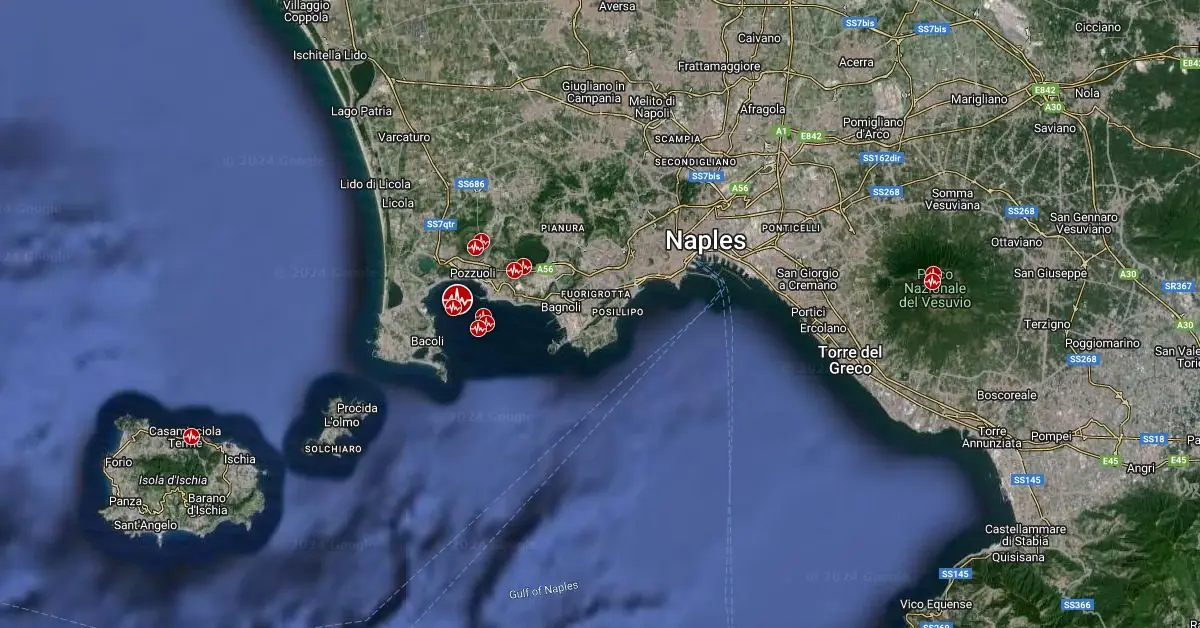
Image credit: TW/SAM, ESRI
A new earthquake swarm was registered at Campi Flegrei volcano, Italy on July 26, 2024. This is the latest episode in a series of such events this year.
The INGV Vesuvian Observatory reported an earthquake swarm started at Campi Flegrei volcano at 11:44 UTC on July 26.
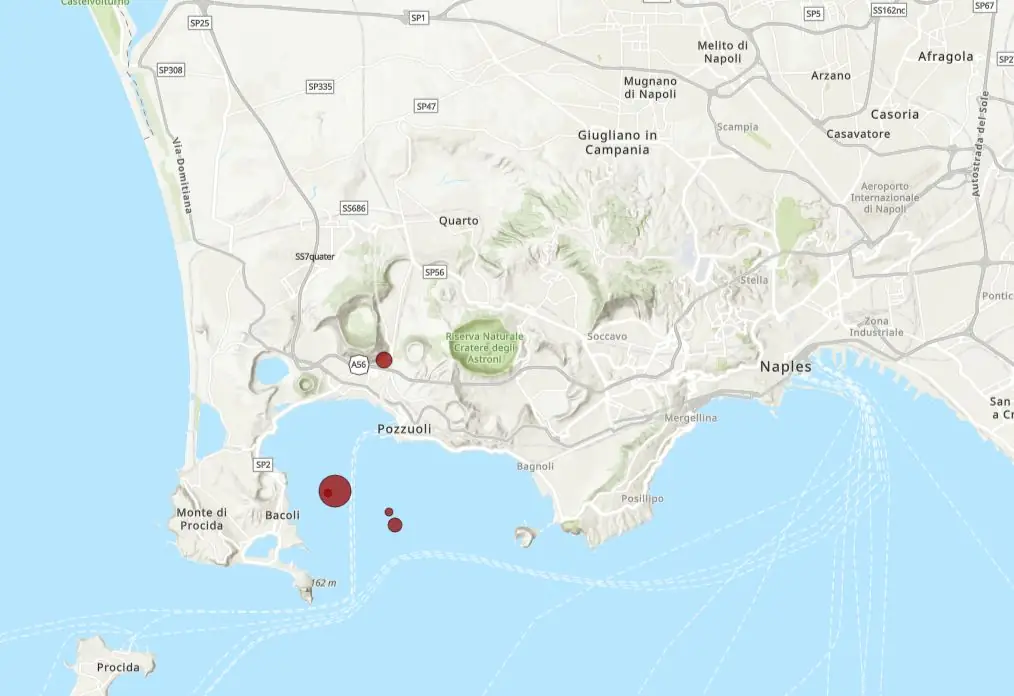
The swarm consisted of 6 earthquakes with the largest registered at 13:46 UTC at magnitude 4 and a depth of 4 km (2.5 miles). This quake was located about 3 km (1.8 miles) south of the town of Pozzuoli.
The swarm ended around 20:00 UTC.
Over 1.5 million people live above this vast underground volcano complex, with half a million residing within its 11.3 km (7-mile) long caldera, which was formed after an enormous eruption 39 000 years ago.
The Campi Flegrei area has a history of intense volcanic and seismic activity. Episodes of bradyseism—slow ground movement—accompanied by seismic swarms have been observed in the past, particularly during 1969-72 and 1982-84. More recently, ground uplift in the Rione Terra area reached approximately 113 cm (44 inches) by July 2023.
Seismic swarms and ground uplift may be due to the rising of gases and increased pressurization of the deep hydrothermal system. Another possibility is the injection of magma into the subsurface.
Though Campi Flegrei is often referred to as a supervolcano, this categorization is not yet definitive.
Supervolcanoes are capable of producing eruptions of the highest magnitude, an 8 on the Volcano Explosivity Index, expelling more than 1 000 cubic kilometers (240 cubic miles) of material. However, Campi Flegrei’s most significant eruption to date ejected up to 285 cubic kilometers (70 cubic miles) of material, classifying it as a category 7 eruption.
To learn more about Campi Flegrei, visit https://watchers.news/tag/campi-flegrei/

Teo Blašković founded The Watchers in 2011 and edited it until 2026, covering seismic and volcanic activity, extreme weather, space weather and near-Earth objects. Articles on this page are his archive.
Published in the last 24 hours
- A Virginia park ranger was struck by lightning seven times and lived, even though three of the strikes set his hair on fire Epicenter
- The hole in the ozone layer over Antarctica was about twice the size of the US this year, and scientists say it would have been bigger still if ozone-eating chemicals were at their 2000 levels Epicenter
