
CSU increases forecast, hurricanes like Beryl associated with hyperactive seasons

Image credit: The eye of Hurricane "Beryl" on July 1, 2024. Contains modified Copernicus Sentinel data [2024], processed by Pierre Markuse
Colorado State University (CSU) hurricane specialists have increased their 2024 forecast on July 9 and continue to call for an extremely active season. They anticipate 25 named storms, and 12 hurricanes, of which 6 are expected to be major. They also estimate the probability of at least one major hurricane making landfall along the continental U.S. coastline to be 57%.
- CSU anticipates a well above-average probability for major hurricane landfalls along the continental United States coastline and in the Caribbean.
- The main drivers are near record high sea surface temperatures and cool neutral ENSO or La Niña during the peak of the hurricane season.
- Hurricane Beryl, a deep tropical Category 5 hurricane, is also a likely harbinger of a hyperactive season.
- Coastal residents are reminded that it only takes one hurricane making landfall to make it an active season. Thorough preparations should be made every season, regardless of predicted activity
“We have slightly increased our forecast and continue to call for an extremely active Atlantic hurricane season in 2024,” CSU scientists said on July 9.
Sea surface temperatures in the Main Development Region (MDR) of the tropical Atlantic and Caribbean are near record highs, creating an environment conducive to hurricane formation and intensification.
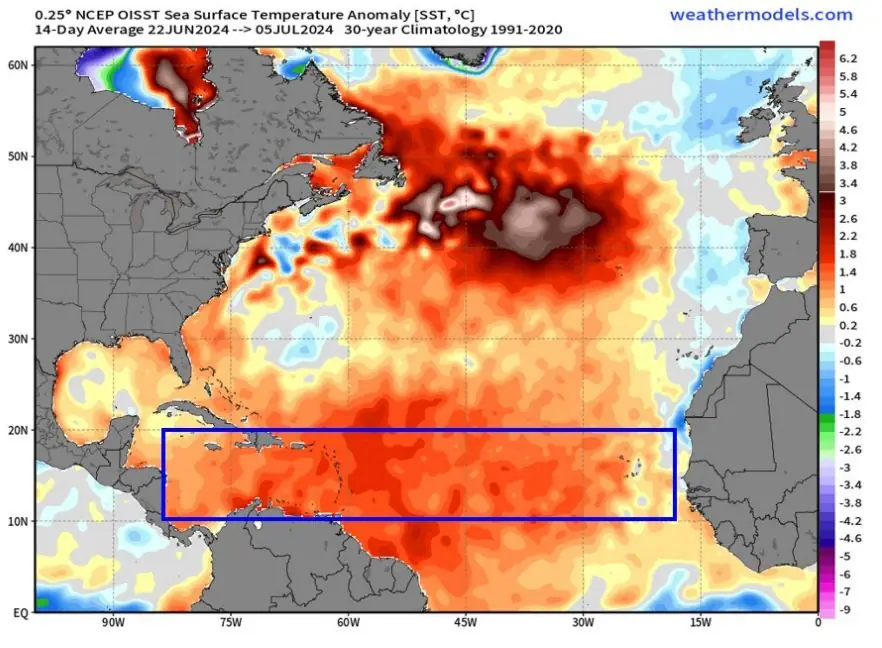
The forecast also anticipates cool neutral ENSO or La Niña conditions during the season’s peak, which typically reduces vertical wind shear and promotes hurricane activity.
In addition, while early-season storm activity in the western Atlantic typically has little relationship with overall basin-wide activity, deep tropical hurricane activity in the tropical Atlantic and eastern Caribbean (such as we saw with Beryl) is often associated with hyperactive seasons.
The Accumulated Cyclone Energy (ACE) is predicted to reach 210, far surpassing the average of 123.
The 2024 forecast anticipates 25 named storms, significantly above the 1991 – 2020 average of 14.4. This includes 120 named storm days, compared to the average of 69.4.
The forecast also predicts 12 hurricanes, well above the average of 7.2, and 50 hurricane days, nearly double the average of 27.0. Major hurricanes (Category 3 – 5) are expected to number six, with 16 major hurricane days, both figures exceeding the historical averages of 3.2 and 7.4, respectively.
The probability of at least one major hurricane making landfall along the continental U.S. coastline is estimated at 57%, compared to the historical average of 43%.
The U.S. East Coast, including the Florida Peninsula, has a 31% chance, higher than the average of 21%. The Gulf Coast, from the Florida Panhandle to Brownsville, has a 38% probability, up from the 27% historical average.
The likelihood of a major hurricane tracking through the Caribbean is 62%, also above the long-term average of 47%.
As of July 9, the forecast includes data up to July 8 and accounts for storms such as Alberto, Beryl, and Chris.
Sea surface temperatures in the tropical Atlantic and Caribbean are approximately 1 °C (1.8 °F) above the 1991-2020 average. This warmth supports an active season through favorable dynamic and thermodynamic conditions.
The forecast confidence is higher than usual due to persistent, hurricane-favorable large-scale environmental conditions.
The forecast also incorporates statistical/dynamical models from several meteorological agencies, all pointing towards a hyperactive season.
References:
1 FORECAST OF ATLANTIC SEASONAL HURRICANE ACTIVITY AND LANDFALL STRIKE PROBABILITY FOR 2024- CSU – July 9, 2024

I am an Assistant Editor and Severe Weather & Science Journalist at The Watchers, specializing in real-time severe weather coverage, geophysical event reporting, and research-driven scientific analysis. You can reach me at rishav(at)watchers(.)news.

Commenting rules and guidelines
We value the thoughts and opinions of our readers and welcome healthy discussions on our website. In order to maintain a respectful and positive community, we ask that all commenters follow these rules.