
Category 3 Hurricane “Rafael” makes landfall in Cuba, triggering nation-wide power outage
Hurricane “Rafael” made landfall in Cuba’s Artemisa Province, near Playa Majana, at 21:15 UTC on November 6, 2024, with maximum sustained winds of 185 km/h (115 mph) and a minimum central pressure of 956 hPa. The storm caused a national power outage, leaving 10 million people without electricity, marking Cuba’s second blackout in less than a month. Authorities suspended public transit, schools, and flights from Havana’s main airport and Varadero, while farmers in key agricultural regions moved to protect valuable tobacco crops and other produce from damage.
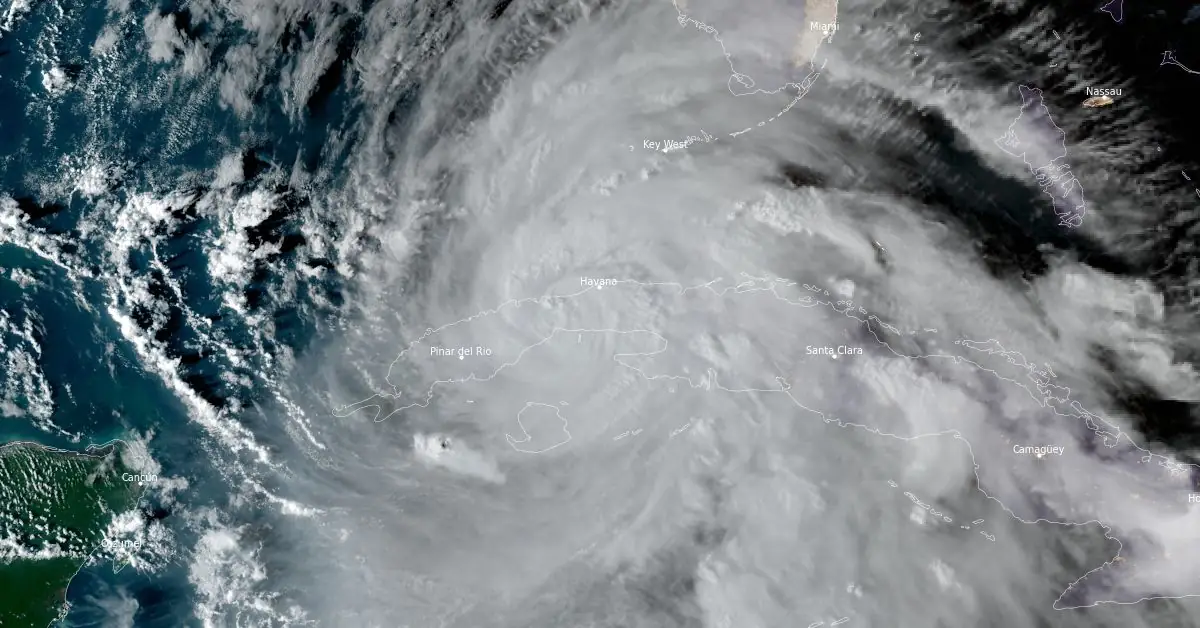
Hurricane "Rafael" making landfall in Cuba on November 6, 2024. Credit: NOAA/GOES-East, RAMMB/CIRA, The Watchers
Hurricane “Rafael” made landfall in western Cuba’s Artemisa Province just east of Plaja Majana (population 931) at 21:15 UTC on November 6, 2024, bringing life-threatening storm surges, damaging hurricane-force winds, and very heavy rain.
The landfall took place with maximum sustained winds of 185 km/h (115 mph) and a minimum central pressure of 956 hPa, according to the National Hurricane Center (NHC).
Cuba’s national energy operator UNE said strong winds produced by Rafael caused the country’s electrical system to collapse, leaving the country’s 10 million people without power. This is the second such incident in less than one month.
Authorities suspended public transportation, schools, and flights from Havana’s Jose Marti International Airport and Varadero’s resort area through Thursday.
Over 100 Canadian tourists were evacuated from Cayo Largo, a popular southwestern Cuban beach destination.
The storm’s impact on Artemisa and Pinar del Rio, Cuba’s major tobacco-growing regions, prompted farmers to safeguard 8 000 metric tonnes of tobacco, along with fruits and vegetables, according to Agriculture Minister Ydael Pérez Brito.
After making landfall, Rafael weakened slightly and moved into the southeastern Gulf of Mexico tonight (LT) as a Category 2 hurricane.
This is the 4th major hurricane landfall of the 2024 Atlantic hurricane season and the second hurricane to impact Cuba since Hurricane “Oscar” on October 20, 2024. Oscar made landfall in eastern Cuba with maximum sustained winds of 129 km/h (80 mph) and minimum central pressure of 986 hPa.
Rafael is also the first major hurricane to make November landfall in Cuba since Hurricane “Michelle” in 2011.


At 03:00 UTC on November 7, the center of Hurricane “Rafael” was located 125 km (80 miles) WNW of Havana, Cuba and 220 km (135 miles) WSE of Key West, Florida.
The system had maximum sustained winds of 165 km/h (105 mph) and minimum central pressure of 969 hPa, according to the NHC.
Rafael is moving toward the northwest near 20 km/h (13 mph). A general northwestward motion is anticipated tonight, followed by a turn toward the west at a slower forward speed on Thursday, with this general motion continuing through Saturday.
On the forecast track, Rafael is expected to move away from western Cuba over the southeastern Gulf of Mexico tonight. Rafael is then forecast to move over the southern Gulf of Mexico for the next few days.


Hurricane conditions are forecast for western Cuba and the Isle of Youth through the evening, with tropical storm conditions expected across west-central Cuba and the lower and middle Florida Keys through tonight.
Heavy rainfall is projected for the Western Caribbean until early Thursday, particularly affecting the Cayman Islands and western Cuba. Expected totals include:
- Western Cuba: 100 – 200 mm (4 – 8 inches), with isolated areas up to 300 mm (12 inches) in elevated terrain, raising the risk of flash flooding and mudslides.
- Cayman Islands: Additional 50 – 100 mm (2 – 4 inches) of rain.
- Lower and Middle Florida Keys: 25 – 75 mm (1 – 3 inches).
The storm surge could elevate water levels by 2.7 – 4.3 m (9 – 14 feet) along southern Cuba’s coast in the hurricane warning zone, including the Isle of Youth.
This surge could flood coastal areas as water moves inland:
- Dry Tortugas: Surge expected between 0.3 – 0.9 m (1 – 3 feet).
- Lower Florida Keys: Surge anticipated at 0.3 – 0.6 m (1 – 2 feet).
Isolated tornadoes may occur through tonight in the Florida Keys and southwestern Florida mainland.
Swells from Hurricane “Rafael” are forecast to impact much of the western Caribbean and spread across the Gulf of Mexico from east to west through the weekend. These swells are likely to produce life-threatening surf and rip currents.
Rafael is the 5th major hurricane of the 2024 Atlantic hurricane season and the 4th major Atlantic hurricane to form since September 26, after Helene, Kirk and Milton, tying 2024 with 2020 for most Atlantic major hurricane formations between September 26 and November 6 on record.
“No other Atlantic season on record has had more than 2 major formations between September 27 and November 6,” according to CSU meteorologist specializing in Atlantic basin seasonal hurricane forecasts, Dr. Philip Klotzbach.
“7 other seasons in the satellite era (1966-onwards) have had 5+ major hurricanes by November: 1995, 1996, 2004, 2005, 2010, 2017, 2020,” Klotzbach said.
References:
1 Hurricane Rafael advisories – NWS/NHC – November 6 and 7, 2024
2 Hurricane Rafael lashes Cuba, power grid collapse – Reuters – November 7, 2024

I'm a dedicated researcher, journalist, and editor at The Watchers. With over 20 years of experience in the media industry, I specialize in hard science news, focusing on extreme weather, seismic and volcanic activity, space weather, and astronomy, including near-Earth objects and planetary defense strategies. You can reach me at teo /at/ watchers.news.

Commenting rules and guidelines
We value the thoughts and opinions of our readers and welcome healthy discussions on our website. In order to maintain a respectful and positive community, we ask that all commenters follow these rules.