
Shallow M6.2 earthquake hits Kermadec Islands region

Image credit: TW/SAM, Google
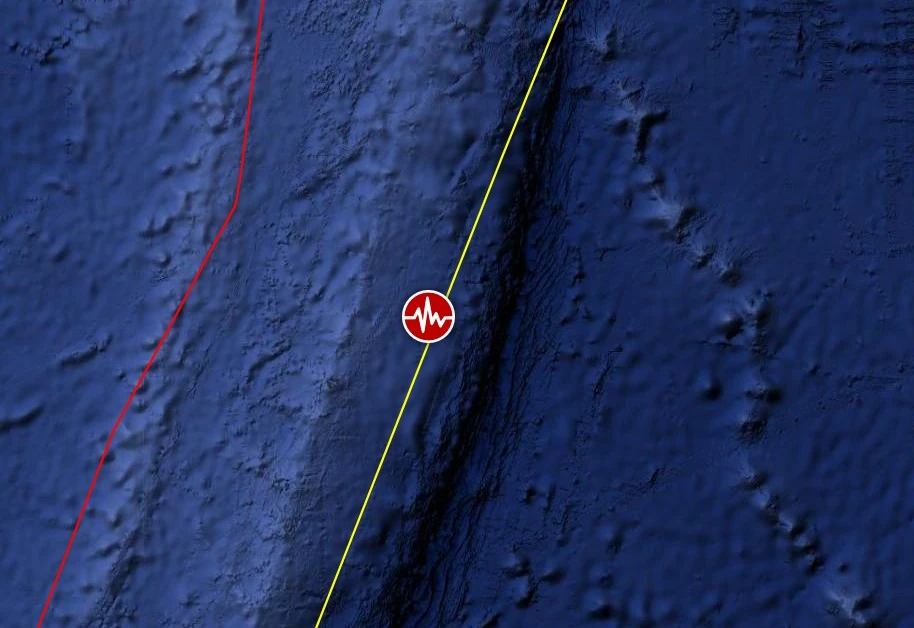
A strong and shallow earthquake registered by the USGS as M6.2 hit the Kermadec Islands region at 15:54 UTC on May 31, 2024. The agency is reporting a depth of 19.6 km (12.3 miles). EMSC is reporting the same magnitude and depth.
This is the second M6+ earthquake within just 10 minutes. It follows M6.2 at 15:46 UTC in the Prince Edward Islands region.
The epicenter was located 870 km (540 miles) SSW of ‘Ohonua, ʻEua, Tonga, and 1 115 km (693 miles) NE of Whangarei, Northland, New Zealand.
There is no tsunami threat from this earthquake.
The USGS issued a Green alert for shaking-related fatalities and economic losses. There is a low likelihood of casualties and damage.
Overall, the population in this region resides in structures that are highly resistant to earthquake shaking, though some vulnerable structures exist. The predominant vulnerable building types are reinforced masonry and unreinforced brick with timber floor construction.
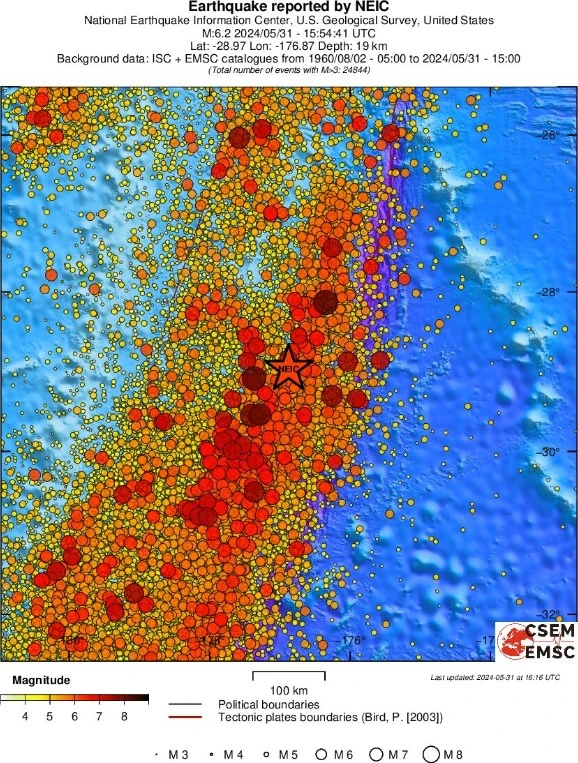
Regional seismicity

Teo Blašković founded The Watchers in 2011 and edited it until 2026, covering seismic and volcanic activity, extreme weather, space weather and near-Earth objects. Articles on this page are his archive.
Published in the last 24 hours
- A South Dakota man put the widest and heaviest hailstone on US record in his freezer, and a power cut melted part of it before NOAA measured it at 8 inches across and nearly 2 pounds in 2010 Epicenter
- Black kites and brown falcons in northern Australia have been seen snatching smoldering sticks from wildfires, flying them into unburned grass and dropping them, starting new fires that send lizards, rodents and insects running straight toward the waiting birds Epicenter
- A levee protecting a highway north of San Francisco is pocked with animal burrows and only 3 feet wide in places, and a report warns this winter's El Niño could push water over the top Epicenter
- In January 2000, chunks of ice weighing up to 6 pounds fell out of clear blue skies over Spain for 10 days. One smashed through a car windshield, and scientists still can’t fully explain where they came from Epicenter
