
Destructive cold lava flow on Indonesia’s Marapi volcano kills 50, leaves 27 missing
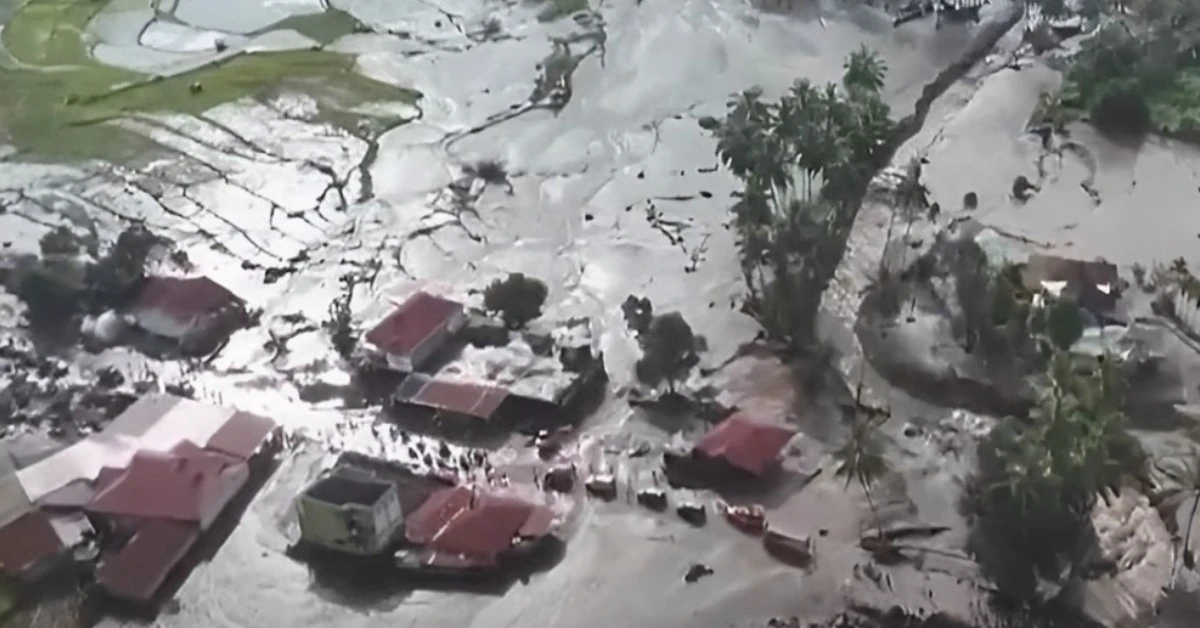
Image credit: Times Now (stillshot)
Heavy monsoon rains falling over Indonesia’s Sumatra island on Saturday, May 11, 2024, caused a destructive lahar to descend the slopes of Marapi volcano, killing at least 50 people and leaving 27 others missing.
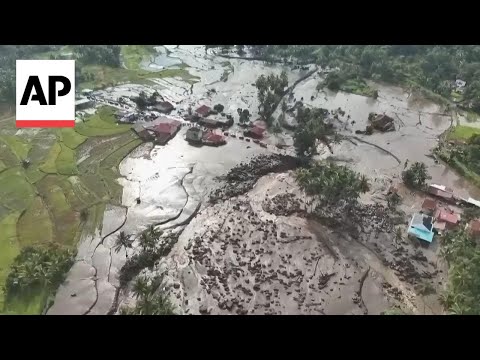
Several hours of heavy monsoon rains triggered a destructive flow of volcanic material and other debris — known as lahar or cold lava flow — down the slopes of Marapi volcano, causing a river to breach its banks and rip through several mountain villages.
Lahar is a fast-moving flow of volcanic debris, ash, and water, triggered by heavy rain or melting ice on a volcano. It can travel rapidly, carrying sediment and large boulders, making it extremely destructive. Lahars can obliterate structures, bury communities, and cause significant fatalities due to their speed and unpredictability, posing severe risks even far from the volcano.


The disaster affected the districts of Agam, Tanah Datar, Padang Panjang, and Padang Pariaman — at around 22:30 LT (15:30 UTC) on May 11.
Officials initially reported 12 fatalities and 9 missing people, but on Sunday, May 12 at 21:00 LT (14:00 UTC), the National Disaster Management Agency (BNPB) reported at least 37 fatalities and 18 people missing. On Monday, May 13, the death toll rose to 43, with 15 people still missing.
The agency reported extensive damage, with more than 100 houses and buildings submerged. By Sunday afternoon, rescue operations in Agam district’s Canduang village led to the recovery of 19 bodies, making it the worst-hit area. Additionally, bodies were recovered from neighboring districts, including 9 from Tanah Datar.

Padang Pariaman district, another affected area, witnessed 8 casualties due to the mudflows. In the city of Padang Panjang, 1 fatality was reported.
The disaster also resulted in significant infrastructural damage, with mudflows blocking main roads around the Anai Valley Waterfall in Tanah Datar district, cutting off access to other cities, as stated by Padang Panjang Police Chief Kartyana Putra.
Search and rescue efforts have been temporarily suspended on Sunday evening due to the lack of light and warnings of heavy rainfall and potential new lahars in the upstream area.
BNPB appeals to people who live around the riverbanks that originate at Mount Marapi to always be aware of the potential risk of further danger.
“Residents are expected to evacuate independently to a safer place,” said Abdul Muhari, Head of BNPB Disaster Data, Information and Communication Center.
This event follows closely on another recent disaster in the region—just two months prior, flash floods and a landslide triggered by heavy rains in West Sumatra’s Pesisir Selatan and Padang Pariaman districts claimed 21 lives.
Marapi is Indonesia’s most active volcano known for its sudden eruptions. It’s a massive 2.8 km (9 460 feet) high complex stratovolcano in the Padang Highlands.
A sudden, powerful eruption at Marapi on December 3, 2023, claimed the lives of 23 climbers and stranded multiple others who were on the mountain at the time of the eruption.
The eruption, which started at 08:00 UTC, was characterized by a high-level volcanic activity that sent ash as high as 15 km (50 000 feet) into the air and produced a pyroclastic flow on the volcano’s northern slope, covering a distance of 3 km (1.8 miles).
Updates
12:00 UTC, May 14
The death toll rose to 50 and the number of missing to 27 on May 14. 37 people had been injured. In addition, more than 3 300 people have been forced to evacuate.
Authorities warned the death toll could continue rising.
References:
1 [UPDATE] Banjir Lahar Dingin Sumatra Barat, Total Korban Meninggal 37 Orang – BNPB – May 13, 2024
2 Death toll rises to 34 in West Sumatra floods – The Jakarta Post – May 12, 2024
3 Flash floods and cold lava flow hit Indonesia’s Sumatra island. At least 37 people were killed – AP – May 12, 2024

Teo Blašković founded The Watchers in 2011 and edited it until 2026, covering seismic and volcanic activity, extreme weather, space weather and near-Earth objects. Articles on this page are his archive.
Published in the last 24 hours
- In September 1859, a solar storm lit up the night sky so brightly that gold miners in the Rocky Mountains woke up after midnight and started cooking breakfast, convinced the aurora glowing over their camp was the sunrise Epicenter
- A patch of warm Pacific water that could become the strongest El Niño in more than 70 years sits thousands of miles from any American town, yet it is already the main reason NOAA expects a wetter winter across the South and a milder one across the North
- A 19-year-old Nebraska teacher reportedly tied her pupils together with twine and led them to safety through a blizzard in January 1888 Epicenter
- NASA built the Opportunity rover to last 90 days on Mars, and Martian winds helped keep it alive for nearly 15 years by blowing dust off its solar panels, until a planet-wide dust storm in 2018 blocked sunlight and silenced the rover Epicenter

The evidence that climate change not only exist but is changing and expanding geographical patterns, yearly.
It now is a safety issue for us all.