
Satellite images reveal devastating flooding in Porto Alegre, Rio Grande do Sul, Brazil
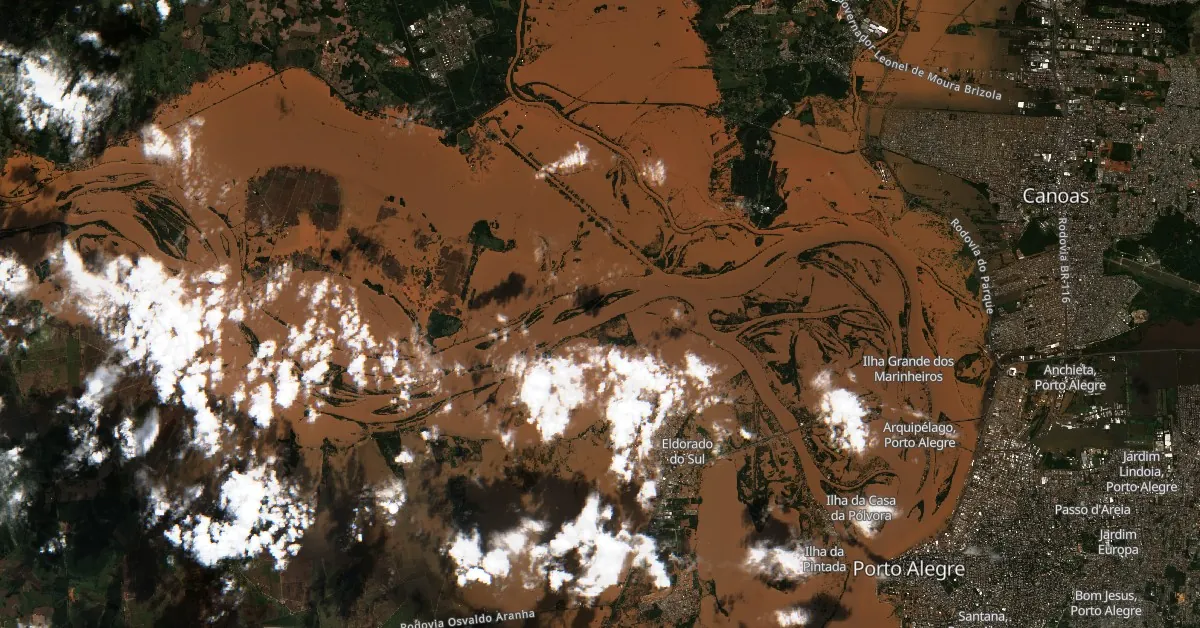
Featured image: Flood in Porto Alegre, Rio Grande do Sul, Brazil. Credit: Copernicus EU/Sentinel-2, The Watchers. Acquired on May 8, 2024
Heavy rainfall across southern Brazil has caused severe flooding and landslides over the past 9 days, significantly affecting the states of Rio Grande do Sul, Parana, and Santa Catarina.
The most severe impact has been in Rio Grande do Sul, where rising casualties and widespread destruction continue to mount. As of May 9, at least 95 people have died, 372 have been injured, and 131 remain missing. Additionally, more than 208 000 people have been displaced, and at least 1.5 million people have been affected.
The extensive flooding has left over 1.4 million people without electricity and isolated 48 cities from telecommunications.
Widespread severe flooding was reported in Porto Alegre, the state capital. Roads have been rendered impassable across the city, cutting off the capital, and flights at the main airport have been suspended.
Widespread agricultural damage was also reported while analysts anticipate that damage to silos, storage facilities, transportation networks, and ports will hinder grain exports. Rio Grande do Sul is a key hub for the production and export of soy, rice, wheat, and meat.
Satellite imagery acquired on May 8 showed devastating flooding across Porto Alegre, including Salgado Filho International Airport completely flooded.
Authorities are closely monitoring four dams: Blang, Dal Bo, Santa Lucia, and the 14 de Julho dam in Cotipora municipality, which has partially collapsed.
Read more:

Teo Blašković founded The Watchers in 2011 and edited it until 2026, covering seismic and volcanic activity, extreme weather, space weather and near-Earth objects. Articles on this page are his archive.
Published in the last 24 hours
- Scientists directly observe how submarine landslides unfold in western Canada Epicenter
- Odisha evacuated 983,642 people before Phailin crossed near Gopalpur on 12 October 2013 with winds of 200-210 km/h gusting to 220, and 44 died, against 9,885 in the 1999 super cyclone. Cyclone Akvan crossed the same coast on 20 November 2026. Epicenter
- Lava fountains reached 1,900 feet (580 m) at Kīlauea Iki in 1959, the highest ever recorded at Kīlauea, as USGS forecasts episode 57 fountaining at Halemaʻumaʻu for November 22-26. Epicenter
- Novarupta in Alaska erupted about 3 cubic miles of magma in roughly 60 hours from 6 June 1912, 30 times Mount St. Helens in 1980, and strong northwesterly winds lifted that same loose ash on 16 November 2026, prompting an NWS SIGMET. Epicenter
