
At least 30 dead and 39 missing after extreme rainfall causes severe flooding and landslides in Minas Gerais, Brazil
Severe flooding and landslides struck the southeastern Brazilian state of Minas Gerais between February 23 and 24, 2026, following extreme rainfall that exceeded three times the monthly average. At least 30 people died, 39 remain missing, and more than 3 000 were displaced as torrential downpours caused the Paraibuna River to overflow in Juiz de Fora and inundate parts of Ubá.
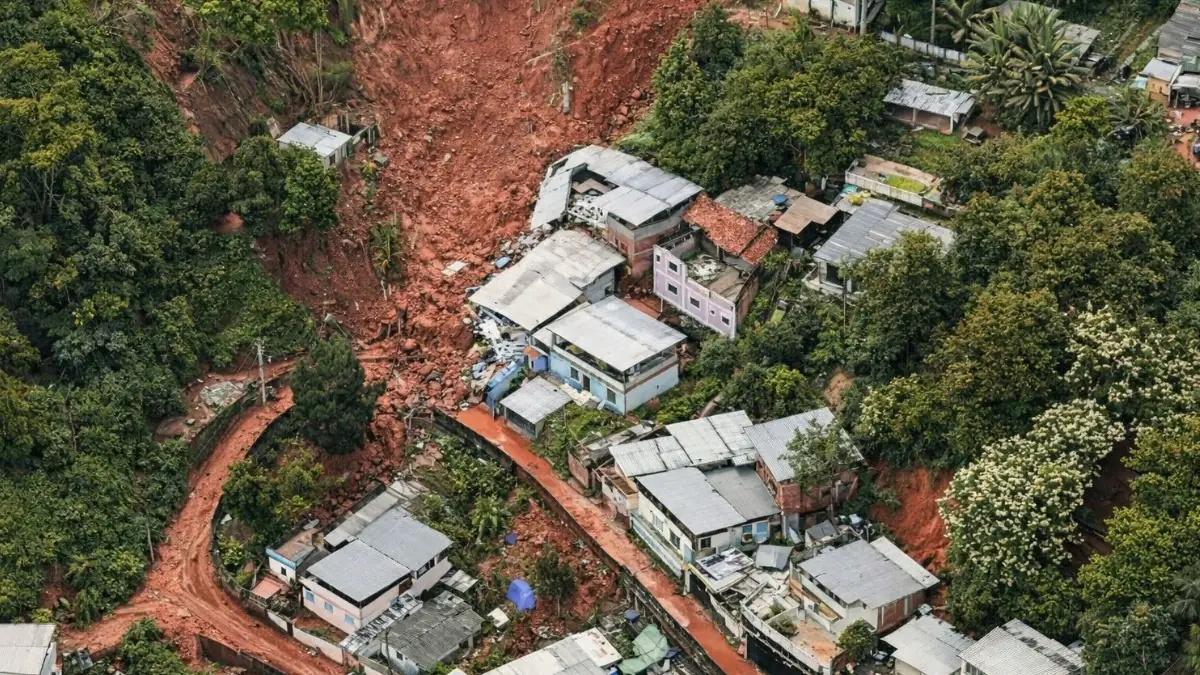
Aerial view of a major landslide triggered by extreme rainfall in Juiz de Fora, southeastern Brazil, February 2026. Credit: Governo de Minas Gerais / Defesa Civil de Minas Gerais. Enhanced for clarity – deblurred and denoised.
At least 30 people were confirmed dead, and 39 remain missing after severe flooding and landslides affected the southeastern Brazilian state of Minas Gerais between February 23 and 24.
The disaster followed extreme rainfall that reached 589 mm (23.18 inches) in Juiz de Fora by February 24, more than three times the February average, according to the National Institute of Meteorology (INMET).
Most of the fatalities occurred in Juiz de Fora, where 24 people were killed, and Ubá, where 6 deaths were reported. Authorities said the victims died primarily in landslides that buried homes and flash floods that trapped residents in low-lying areas. Many were found in neighborhoods built on steep slopes that collapsed under heavy saturation.
According to Prefeitura de Juiz de Fora, landslides occurred mainly during the night of February 23–24, when residents were asleep and unable to evacuate. Many hillside homes were built without retaining structures, increasing their vulnerability to slope failure during prolonged rainfall.
Meteorological data from INMET showed that the rainfall event was associated with a stationary frontal boundary and moist tropical inflow over southeastern Brazil, intensified by orographic lift along the Serra da Mantiqueira range. This configuration maintained convective systems over Minas Gerais for several days, producing continuous heavy precipitation.
According to INMET, February 2026 now ranks among the rainiest months in recent years across Minas Gerais, particularly in the central-south and western regions.
Juiz de Fora alone recorded 229.9 mm (9.05 inches) between February 22 and 24, contributing to a monthly accumulation of 579.3 mm (22.81 inches) by the morning of February 24, which is about 240% above the climatological February mean of 170.3 mm (6.7 inches).
In southern Minas Gerais, Lavras registered 330.0 mm (12.99 inches), representing 85% above average — while Araxá in the Triângulo Mineiro reached 263.2 mm (10.36 inches), 16 %above normal.
Northern and northeastern municipalities also exceeded their historical means, including Januária with 264.6 mm (10.41 inches, +118%), Salinas 183.5 mm (7.22 inches, +98%), Itamarandiba 269.1 mm (10.60 inches, +128%), and Araçuaí 175.8 mm (6.92 inches, +122%).
Even the capital, Belo Horizonte, totaled 267.4 mm (10.53 inches), which is roughly 50% above its February norm.
Floodwaters and debris flows across Juiz de Fora destroyed at least nine bridges and rendered more than 40 roads impassable, according to the Civil Defense of the State of Minas Gerais.
Power outages affected approximately 22 000 consumers, while water distribution was suspended in multiple neighborhoods after pumping stations were submerged.
Nearly 3 000 residents were displaced and 440 evacuated to temporary shelters as the municipality declared a state of calamity on February 24. Rescue and clearance operations continued through February 25, supported by municipal, state, and federal emergency teams.
Emergency teams comprising 134 firefighters, search dogs, and rescue vehicles worked through unstable terrain and debris to locate survivors. More than 200 people were rescued alive, though access to several isolated neighborhoods remained cut off due to road and bridge collapses.
President Luiz Inácio Lula da Silva authorized federal emergency assistance through the Ministry of Integration and Regional Development, prioritizing search and rescue operations and reconstruction of damaged infrastructure. Federal and state authorities urged residents to avoid returning to high-risk areas due to continuing rainfall forecasts for February 25.
Soil saturation and unstable slopes remain a concern, with the Minas Gerais Civil Defence agency maintaining a high alert in Juiz de Fora and surrounding municipalities.
The INMET forecast additional rainfall of 50–100 mm (2–4 inches) in the following 24 hours, warning that further slope movement or flash flooding could occur in already saturated areas. The weather forecast indicates continued rain, at least until Saturday, February 28, in areas of north-central Minas Gerais and north of Goiás, with values that may exceed 200 mm (4 inches).
The combination of intense rainfall, steep terrain, and densely built hillside settlements made this one of the most destructive regional flood and landslide events in recent years.
In addition, in areas of northern Goiás and Minas Gerais, excessive rainfall has significantly impacted the pace of agricultural activities.
The planting of the second corn crop, carried out after the soybean harvest, is progressing slowly, since the high accumulated volumes and frequency of rainfall keep the soil excessively wet, restricting the entry of machinery into the fields and delaying essential operations such as topdressing, fertilization, pest control, and weed management.
February marks the peak of Brazil’s rainy season, when the South Atlantic Convergence Zone frequently causes prolonged heavy rainfall across Minas Gerais, São Paulo, and Rio de Janeiro states.
ReferenceS:
1 February 2026 with above-average rainfall in Minas Gerais – INMET – February 24, 2026
2 Excess moisture in the soil slows the pace of agricultural activities in areas of Goiás and Minas Gerais. – INMET – February 24, 2026
3 At least 30 dead after heavy rains hit southeastern Brazil, 39 missing – Reuters – February 24, 2026

I'm a dedicated researcher, journalist, and editor at The Watchers. With over 20 years of experience in the media industry, I specialize in hard science news, focusing on extreme weather, seismic and volcanic activity, space weather, and astronomy, including near-Earth objects and planetary defense strategies. You can reach me at teo /at/ watchers.news.

Commenting rules and guidelines
We value the thoughts and opinions of our readers and welcome healthy discussions on our website. In order to maintain a respectful and positive community, we ask that all commenters follow these rules.