
Nearly 100 000 without power as severe thunderstorms hit Chicago, Illinois
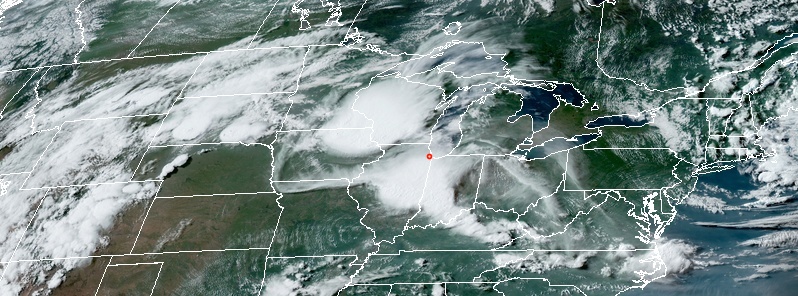
Image credit: NOAA/GOES-East. Acquired: 22:50 UTC on June 30, 2019.
A part of a line of severe thunderstorms swept over Chicago, Illinois metropolitan area on Sunday, June 30, 2019, causing damage throughout the city and leaving nearly 100 000 customers without power.
Winds as high as 119 km/h (74 mph) hit northern Illinois Sunday afternoon (CDT), leaving nearly 100 000 customers across the state without power. Chicago area recorded wind gusts over 96 km/h (60 mph), with 101 km/h (63 mph) at Rockford airport.
Power company ComEd said they sent over 200 crews to restore electricity. As of 05:56 UTC on July 1 (00:56 CDT), 44 626 customers are still without power.
The storms caused damage throughout the city and halted racing at Chicagoland Speedway. Three preliminary tornado reports came in around 16:30 CDT – one near Platte Creek and others in Gregory County.
More than 300 000 customers were without power across the eastern U.S. by Sunday afternoon.
— Hallie Hallock (@HallieHallock) June 30, 2019
Observed a large #gustnado southeast of Chicagoland Speedway. Time: 2:29 PM. @NWSChicago #ILwx #StormHour pic.twitter.com/D3aSyscCdU
— Joey M. Marino (@WxJmar93) June 30, 2019
Storm cluster continues to move SE through area. Increasing coverage ahead of the main cluster is expected. Isolated t-storms with very strong winds, frequent lightning, and heavy downpours will continue to develop through early evening. Have a PLAN ready to seek shelter. pic.twitter.com/mkNXCSUvUk
— NWS Chicago (@NWSChicago) June 30, 2019
A second thunderstorm complex is approaching northwest IL. Arrival of these storms is expected during the 7-9 PM time frame in the outlined area. Frequent lightning and gusty winds are the primary threats. #ilwx #iawx pic.twitter.com/CX46Ta0QEf
— NWS Chicago (@NWSChicago) June 30, 2019
An additional round of thunderstorms is likely through 9 PM this evening. Storms could be severe along and W of I-39, posing a risk of damaging winds and a tornado or two. Additional showers and storms are possible towards the Chicago Metro, but severe weather chances are low. pic.twitter.com/bhXA7Johvu
— NWS Chicago (@NWSChicago) June 30, 2019
"The storms were part of what’s known as a Mesoscale Convective System, or an MCS for short. This is a group of thunderstorms that moves together, often producing damaging winds and occasional tornadoes. These are fairly typical during the late spring and summer," Meteorologist Chris Bianchi noted.
"More storms are possible in the Chicago area over the next few days, but they shouldn’t be quite as strong as Sunday’s."

Teo Blašković founded The Watchers in 2011 and edited it until 2026, covering seismic and volcanic activity, extreme weather, space weather and near-Earth objects. Articles on this page are his archive.
Published in the last 24 hours
- Weather radar tracked meteorites falling into Cape Cod Bay after a 1.1-kiloton fireball over Massachusetts on 30 May 2026; researchers have now traced its orbit almost out to Jupiter. Epicenter
- 10 named storms, one hurricane for the first time since 1925: Why has the Atlantic been so quiet in 2026 Epicenter
- Amazon fire hotspots rise 82.6% in October 2026 as El Niño intensifies Epicenter
- In 2005, a driver near Russia's Chulyshman River picked up a stone to wedge under his car wheel and kept it for 20 years; the Meteoritical Bulletin has now approved it as the Altai Republic's first meteorite. Epicenter
