
Meteorite fragments from June 1 fireball found, several homes damaged, China

Featured image: Bright fireball explodes over Chinese Jinghong City, Yunnan Province on June 1, 2018. Credit: SS Xiao Jiao Gong Gong
Numerous fragments of a meteorite that fell in southwest China's Yunnan Province on June 1, 2018 have been found by locals in Menghai County.
Executive deputy director of the Professional Committee for Meteorite Scientific Investigation of the China Scientific Expedition Association, Jiang Wei, told Yunnan.cn reporters that meteorites fell on Manlun Village in Mengzhe Town of Yunnan's Menghai County.
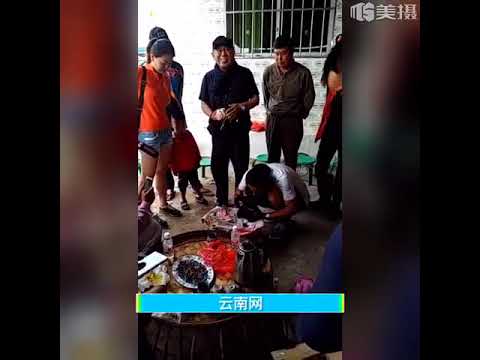
Wei, together with meteorite expert Zhang Baolin, has so far found four fragments. "Two of the four found pieces fell through house roofs, one fell on the dry ground and another in a rice field," he said.
Fragments range from the size of a ping-pong ball to a few hundred grams, he added.

While the search for other fragments continues, deputy director Wei urged villagers to 'surrender samples for further analysis' because they are considered mineral resources under China's law and the ownership belongs to the country.


All images courtesy of Yunnan.cn
Some argue that the definition of mineral resources refers to natural resources that are formed by geological actions and have utility value. Therefore, according to the definition of mineral resources, it is inappropriate to classify meteorites as a mineral resource.
According to Yunnan.cn, the current mainstream view is that collectors of meteorite should be given appropriate rewards and compensations in order to promote the public hand over.

Teo Blašković founded The Watchers in 2011 and edited it until 2026, covering seismic and volcanic activity, extreme weather, space weather and near-Earth objects. Articles on this page are his archive.

It looks like a charcoal briquette!