
New York City sees heaviest April snow since 1982
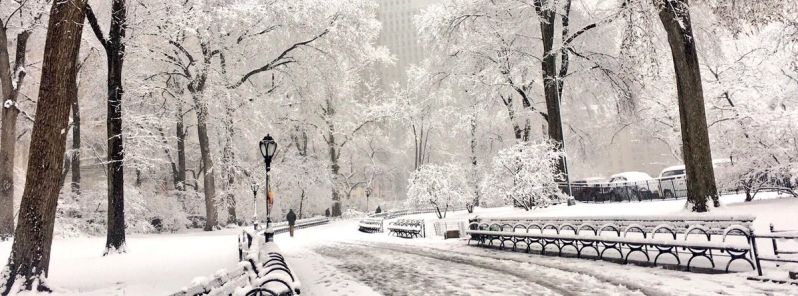
Image credit: New York Snow on April 2, 2018.
14 cm (5.5 inches) of snow had accumulated in Central Park, New York by 10:00 EDT on April 2, 2018 (14:00 UTC). It was the most amount of snow in April since 1982, when 24.38 cm (9.6 inches) fell on the 6th of the month. The amount was also 7th most on record in April.
The snow started falling between 07:00 – 08:00 UTC (03:00 – 04:00 EDT). Temperatures stayed above freezing the entire duration of the snowfall, around 0.5 °C (33 °F) to 4.4 °C (40 °F). It snowed faster than the snow could melt, and colder surfaces such as grass and car tops allowed the snow to stay.
Sa far, New York City has received 103.89 cm (40.9 inches) of snow during the 2017-2018 cold season, almost 38.1 cm (15 inches) more than normal.

Central Park reported heavy snow and visibility of 400 m (0.25 miles) or less between 10:00 – 12:00 UTC (06:00 – 08:00 EDT) and a temperature of 0.5 °C (33 °F).
At LaGuardia Airport, the snow was falling at the rate of 50.8 mm (2 inches) per hour just before 11:00 UTC (07:00 EDT).
Snow amounts through 14:00 UTC (10:00 EDT):
Newark: 12.7 cm (5.0 inches)
LaGuardia Airport: 14 cm (5.5 inches)
JFK Airport: 9.4 cm (3.7 inches)
Islip Airport: 11.2 cm (4.4 inches)
White Plains, N.Y.: 19.8 cm (7.8 inches)
Bridgeport Airport, Conn.: 14.5 cm (5.7 inches)

The snow was the result of an area of low pressure that scooted along an Arctic front positioned south of the region. It also brought heavy snowfall to western Maryland and parts of Pennsylvania.
Up to 17.8 cm (7 inches) fell near Frostburg, Md., and the 11.4 (4.5 inches) in State College, Pa., tied for the heaviest snowfall of the winter, Washington Post reported.

Published in the last 24 hours
- Hawaii's largest freshwater lake was 200 feet deep at 10 a.m. on June 2, 2018. By that afternoon, lava from Kilauea had boiled it away Epicenter
- Flying glass cut a teacher in Russia but none of her 44 pupils, because when a meteor flashed across the sky in 2013, she told them to get under their desks Epicenter
- A South Dakota man put the widest and heaviest hailstone on US record in his freezer, and a power cut melted part of it before NOAA measured it at 8 inches across and nearly 2 pounds in 2010 Epicenter
- Black kites and brown falcons in northern Australia have been seen snatching smoldering sticks from wildfires, flying them into unburned grass and dropping them, starting new fires that send lizards, rodents and insects running straight toward the waiting birds Epicenter
