
Eta Aquarid meteor shower peaks – May 5/6, 2015
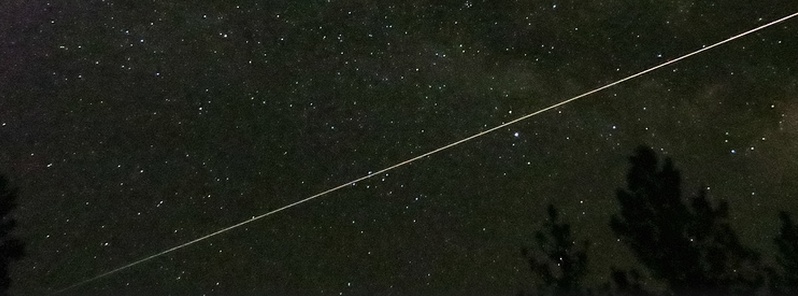
Image credit: Eta Aquarid by Rocky Raybell (CC - Flickr)
This year's Eta Aquarids, known for their speed, peak during the early morning hours of May 5 – 6. Traveling at about 66 km/s (148 000 mph) into Earth's atmosphere these meteors are leaving glowing trains (incandescent bits of debris in the wake of the meteor) which last for several seconds to minutes.
This is an above average shower, capable of producing up to 60 meteors per hour at its peak, which favors southern hemisphere observers. Sadly, the nearly full moon will be a big problem this year blocking out all but the brightest meteors.
In the northern hemisphere, the rate can reach about 10 to 30 meteors per hour, where they can be seen as "earthgrazers" – long meteors that appear to skip the surface of the Earth at the horizon.
The pieces of space debris that interact with our atmosphere to create the Eta Aquarids originate from comet 1P/Halley. Each time that Halley returns to the inner solar system its nucleus sheds a layer of ice and rock into space. The dust grains eventually become the Eta Aquarids in May and the Orionids in October if they collide with Earth's atmosphere.

Image credit: ESA/Max-Planck-Institute for Solar System Research.
Comet Halley takes about 76 years to orbit the Sun once and the last time it was seen from the Earth was in 1986. It will not enter the inner solar system again until 2061. Its dimensions are 16x8x8 km and it is one of the darkest, or least reflective, objects in the solar system, with an albedo of 0.03.
Meteors will radiate from the constellation Aquarius, but can appear anywhere in the sky.

Teo Blašković founded The Watchers in 2011 and edited it until 2026, covering seismic and volcanic activity, extreme weather, space weather and near-Earth objects. Articles on this page are his archive.
Earlier reporting
Nothing on Watchers was published in the last 24 hours. These are older articles.
- On October 22, 2017, a single flash of lightning stretched 515 miles from eastern Texas to near Kansas City, a distance that takes eight hours to drive, and nobody realized how far it had gone until scientists went back through the satellite data years later Epicenter
- CPC posts a slight risk of heavy rain from the Gulf Coast to the Northeast urban corridor November 25-29, and a moderate risk of West Coast wind and Sierra snow on November 25
- Florida's east coast faces a moderate flash flood risk Wednesday through Friday, with 4 to 8 inches of rain forecast and the St. Johns River near Cocoa already in major flood at 17.13 feet
- Cyclone Akvan to make landfall between Nellore and Visakhapatnam around noon on November 20, IMD forecasts 120-130 km/h winds gusting to 145
