
Earth entering a stream of debris from Halley’s Comet – Eta Aquarid meteor shower
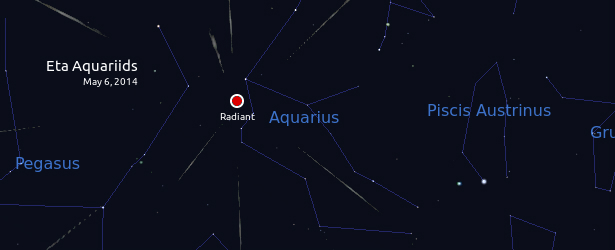
Image credit: Stellarium. Edit: The Watchers
Eta Aquarid meteor shower is visible from about April 19th to about May 28th each year but unlike most meteor showers Eta Aquarids don't have a sharp peak, meaning you can watch them for several days from May 4 – 7.
It is considered that the best time to observe them is during dark hours before sunrise on May 6, no matter where you live. They will radiate from the constellation Aquarius, two degrees southwest of the fourth magnitude star Gamma Aquarii.
This is an above average shower capable of producing up to 60 meteors per hour at its peak but most of the activity is seen in the southern hemisphere.
In northern hemisphere, the rate can reach about 30 meteors per hour and the radiant of the shower is only above the horizon for the few hours before dawn. However, early-rising observers are often rewarded with rates that climb as the radiant rises before sunrise.
The best place to look to see as many meteors as possible is not at the radiant itself, but at any dark patch of sky which is around 90° away from it, since it is at a distance of around 90° from the radiant that meteors will typically appear at their brightest.
The Eta Aquarids are one of the two meteor showers associated with Halley’s Comet. The Earth passes for a second time through Halley's path around the Sun in October. This creates the Orionid meteor shower, which peaks around October 20.

Teo Blašković founded The Watchers in 2011 and edited it until 2026, covering seismic and volcanic activity, extreme weather, space weather and near-Earth objects. Articles on this page are his archive.
Earlier reporting
Nothing on Watchers was published in the last 24 hours. These are older articles.
- On October 22, 2017, a single flash of lightning stretched 515 miles from eastern Texas to near Kansas City, a distance that takes eight hours to drive, and nobody realized how far it had gone until scientists went back through the satellite data years later Epicenter
- CPC posts a slight risk of heavy rain from the Gulf Coast to the Northeast urban corridor November 25-29, and a moderate risk of West Coast wind and Sierra snow on November 25
- Florida's east coast faces a moderate flash flood risk Wednesday through Friday, with 4 to 8 inches of rain forecast and the St. Johns River near Cocoa already in major flood at 17.13 feet
- Cyclone Akvan to make landfall between Nellore and Visakhapatnam around noon on November 20, IMD forecasts 120-130 km/h winds gusting to 145
