
Total lunar eclipse on March 3, 2026, fully visible from eastern Asia to western Americas
A total lunar eclipse will occur at 11:33 UTC on March 3, 2026, with totality lasting 58 minutes and 19 seconds and full visibility across East Asia, Australia, the Pacific region, and western North America. This is the only total lunar eclipse of 2026.

Total lunar eclipse on January 21, 2019. Credit: Giuseppe Donatiello
A total lunar eclipse will occur on March 3, 2026, when the Moon passes entirely through Earth’s umbral shadow, reaching greatest eclipse at 11:33 UTC.
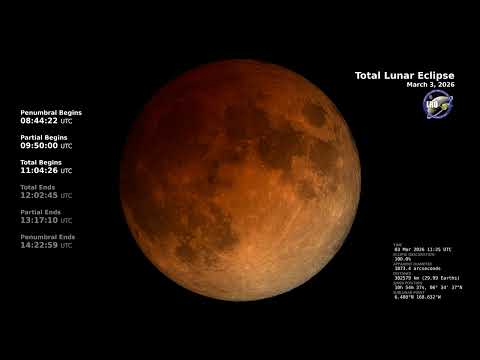
Totality will last 58 minutes 19 seconds, from 11:04:26 to 12:02:45 UTC, within a full eclipse sequence spanning 08:44:22–14:22:59 UTC. The event will be fully visible across East Asia, Australia, the Pacific region, and western North America, and it is the only total lunar eclipse of 2026.
The partial phase begins at 09:50 UTC as the Moon enters Earth’s umbra and a curved shadow gradually advances across the lunar surface. As the alignment deepens, the Moon becomes fully immersed in the umbra at 11:04 UTC, marking the start of totality.
The greatest eclipse occurs at 11:33 UTC, when the Moon is closest to the center of Earth’s shadow, before emerging from totality at 12:02 UTC. The partial phase concludes at 13:17 UTC, and the penumbral phase ends at 14:22 UTC.
All phases will be visible across eastern Asia, including China, Japan and the Korean Peninsula, as well as eastern Russia, Australia, New Zealand and much of the Pacific island region.
Western North America, including Alaska and the western United States and Canada, will observe the complete sequence where the Moon remains above the horizon.
In parts of Central America and northern South America, the Moon will set during the later stages of the eclipse, while Europe, Africa and much of western Asia will not see the event because the Moon will be below the horizon throughout the eclipse window.

The eclipse belongs to Saros series 133 and is the 27th of 71 eclipses in that cycle. Saros cycles repeat at intervals of approximately 18 years and 11 days, producing eclipses with closely similar geometry.
The gamma value of −0.3765 indicates that the Moon’s path through Earth’s shadow passes slightly south of center. An umbral magnitude of 1.1526 confirms full immersion within the umbra, allowing for a sustained total phase, while the penumbral magnitude is 2.1858.

The alignment occurs at the Moon’s descending node, where the lunar orbit crosses Earth’s orbital plane moving southward.
The March 3, 2026, event is the only total lunar eclipse of this year. The next total lunar eclipse is scheduled for December 31, 2028.
References:
1 Total Lunar Eclipse of 2026 March 03 – EclipseWise/Fred Espenak – Accessed February 25, 2026
2 Total Lunar Eclipse — NASA Science — January 29, 2026

Teo Blašković founded The Watchers in 2011 and edited it until 2026, covering seismic and volcanic activity, extreme weather, space weather and near-Earth objects. Articles on this page are his archive.
Published in the last 24 hours
- Scientists directly observe how submarine landslides unfold in western Canada Epicenter
- Odisha evacuated 983,642 people before Phailin crossed near Gopalpur on 12 October 2013 with winds of 200-210 km/h gusting to 220, and 44 died, against 9,885 in the 1999 super cyclone. Cyclone Akvan crossed the same coast on 20 November 2026. Epicenter
- Lava fountains reached 1,900 feet (580 m) at Kīlauea Iki in 1959, the highest ever recorded at Kīlauea, as USGS forecasts episode 57 fountaining at Halemaʻumaʻu for November 22-26. Epicenter
- Novarupta in Alaska erupted about 3 cubic miles of magma in roughly 60 hours from 6 June 1912, 30 times Mount St. Helens in 1980, and strong northwesterly winds lifted that same loose ash on 16 November 2026, prompting an NWS SIGMET. Epicenter
