
Watch live: Total solar eclipse on August 12, 2026
The August 12, 2026 total solar eclipse can be watched live online today through scheduled broadcasts from NASA, ESA, the Instituto de Astrofísica de Canarias (IAC), the Exploratorium and Royal Observatory Greenwich. IAC starts at 17:00 UTC, Royal Observatory Greenwich at 17:10 UTC, NASA at 17:15 UTC, and ESA and the Exploratorium at 17:30 UTC, before totality reaches Iceland and Spain.
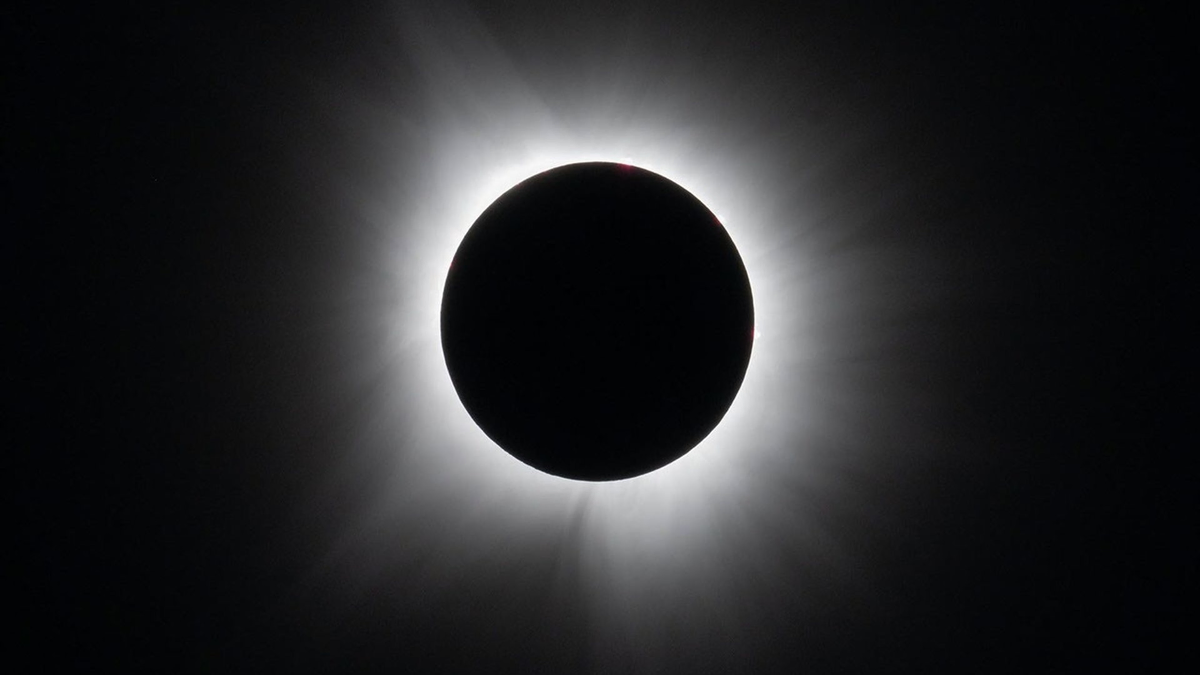
A total solar eclipse was seen in Dallas, Texas, on Monday, April 8, 2024. Credit: NASA
Five organizations listed below begin live coverage between 17:00 and 17:30 UTC. The streams carry telescope views from Spain and London, NASA coverage from across the eclipse path, and a dedicated ESA telescope feed from Javalambre.
IAC live stream from Palencia, Spain
The Instituto de Astrofísica de Canarias (IAC) starts its program from Cerro del Otero in Palencia at 17:00 UTC. IAC says the broadcast will connect live with telescopes recording the eclipse and the solar corona.

Royal Observatory Greenwich live stream
Royal Observatory Greenwich begins its presented stream from London at 17:10 UTC. The observatory will use a modern telescope to show the partial solar eclipse; NASA lists maximum eclipse coverage for London at 91%.

NASA total solar eclipse live stream
NASA begins its eclipse broadcast at 17:15 UTC. NASA says coverage will include telescope views from across the eclipse path, expert interviews and footage from a WB-57 high-altitude research aircraft used to study the solar corona.

ESA total solar eclipse live stream from Javalambre
The European Space Agency (ESA) starts its live program from the Observatorio Astrofísico de Javalambre in Teruel, Spain, at 17:30 UTC. ESA schedules totality at Javalambre for 18:31 UTC, lasting 1 minute 21 seconds.

ESA also has a dedicated telescope feed from Javalambre for continuous close-up views of the eclipse.
Exploratorium live telescope view from Spain
The Exploratorium starts its live telescope feed from Villalibado, Spain, at 17:30 UTC.

When does the August 12 total solar eclipse reach totality?
The totality will begin in Iceland at about 17:45 UTC and in Spain at about 18:28 UTC. The path of totality crosses Greenland, Iceland, northern Russia, the Atlantic Ocean, Spain and a small corner of Portugal.
The Instituto Geográfico Nacional (IGN) gives a maximum totality duration of 2 minutes 18 seconds near Iceland. IGN describes the August 12 event as the first total solar eclipse visible from the Iberian Peninsula in more than a century. In Spain, the path crosses much of the northern half of the country from west to east close to sunset.
Spain eclipse weather
AEMET’s special forecast, issued at 10:03 UTC (12:03 LT) on August 11, calls for mostly clear or clear skies across much of Spain during the eclipse. Low cloud is forecast in parts of the Cantabrian area and northern Galicia, while afternoon convective cloud is forecast over northern mountains and parts of eastern Spain.
AEMET notes that the Sun will be low above the western horizon during the eclipse. Cloud west of an observing site can block the Sun even when the cloud is some distance away.
How to watch the solar eclipse safely
NASA states that viewers must use proper solar eye protection during every partial phase. Eclipse glasses can come off only during totality for observers inside the path of totality and must go back on as soon as the bright Sun starts to reappear.
References:
1 NASA Sets Coverage for August Northern Hemisphere Total Solar Eclipse – NASA – July 29, 2026
2 Total solar eclipse: how to watch live from home – European Space Agency – August 5, 2026

I’m a science journalist and researcher at The Watchers, contributing to the Epicenter edition, where I cover peer-reviewed scientific research and emerging discoveries across Earth and space sciences. With a background in astronomy and a passion for environmental science, I’ve worked in shark and coral conservation in Fiji, conducting reef and shark-behavior research, contributing to mangrove restoration, and earning PADI Open Water and Coral Reef Certifications. I bring a blend of scientific rigor and storytelling to illuminate the discoveries shaping our planet and beyond.

Commenting rules and guidelines
We value the thoughts and opinions of our readers and welcome healthy discussions on our website. In order to maintain a respectful and positive community, we ask that all commenters follow these rules.