
Eta Aquariids peak May 5-6 under bright moonlight
The Eta Aquariid meteor shower peaks on the night of May 5-6, but strong moonlight will sharply reduce visible rates during this year’s maximum. Under ideal dark skies, the shower can produce up to about 50 meteors per hour, but bright moonlight in 2026 is expected to keep observed rates below 5 meteors per hour.
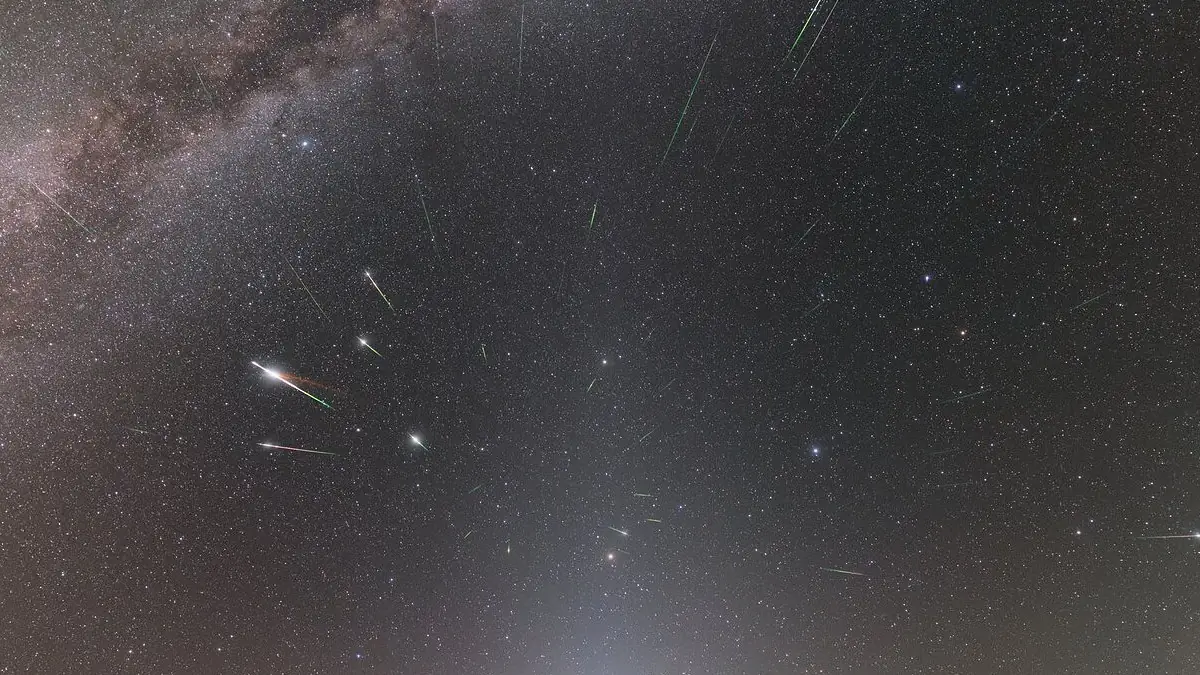
The Eta Aquariids meteor shower in 2022 captured by astrophotographer Petr Horálek near San Pedro de Atacama, Chile. Credit: ESO/Petr Horálek
The Eta Aquariids are active from April 19 to May 28, with the peak centered on the night of May 5-6. The shower is best observed before dawn, when the radiant is higher in the sky, especially from southern tropical latitudes. From the equator northward, normal rates are lower, usually 10-30 meteors per hour before dawn under better sky conditions.
The 2026 peak occurs under an 84% illuminated Moon, which will wash out fainter meteors through the main observing window. The American Meteor Society (AMS) said the bright Moon will severely compromise Eta Aquariid viewing this year, with hourly rates not expected to surpass 5 per hour from any location.
The shower is produced by debris left by Halley’s Comet, one of the few comets whose path through the inner Solar System gives Earth two annual meteor showers — the Eta Aquariids in May and the Orionids in October.
Despite sharing the same parent comet, a 2020 study comparing visual, video, and radar observations found the Eta Aquariids are usually two to three times stronger than the Orionids.
The comet itself won’t return until 2061, so every May, watching this shower is the closest most living people will ever get to it.
The particles responsible for this night sky event are usually no larger than a grain of sand or gravel, yet they slam into the atmosphere at 65.4 km/s, which is why they so often leave long, glowing, persistent trains that can linger for seconds to minutes after the meteor itself has gone.
The shower’s radiant appears near the star Eta Aquarii, but that’s just a line-of-sight coincidence. The star has no physical connection to the meteors whatsoever.
Eta Aquariids have a long and well-documented history of outburst years going back to 74 BCE, with notable events recorded in 401, 466, 839, and 934. Researchers have suggested that some of those ancient outbursts may be preserved in Classic Maya hieroglyphic inscriptions, making the Eta Aquariids possibly the only shower with pre-telescopic cultural records from Mesoamerica.
References:
1 Meteor Shower Calendar – IMO – Accessed May 5, 2026
2 Meteor Activity Outlook for May 2-8, 2026 – AMS – May 1, 2026

I'm a dedicated researcher, journalist, and editor at The Watchers. With over 20 years of experience in the media industry, I specialize in hard science news, focusing on extreme weather, seismic and volcanic activity, space weather, and astronomy, including near-Earth objects and planetary defense strategies. You can reach me at teo /at/ watchers.news.

Commenting rules and guidelines
We value the thoughts and opinions of our readers and welcome healthy discussions on our website. In order to maintain a respectful and positive community, we ask that all commenters follow these rules.