
Earthquake swarm recorded under Hakoneyama volcano, Japan

Image credit: Lake Ashi from Mt.Komagatake. (CC - Wikimedia)
A rise in the number of volcanic earthquakes is being recorded at Hakoneyama volcano, 90 km SW of capital Tokyo, prompting officials to raise volcanic eruption warning to Level 2 on May 6, 2015. This warning means people should stay clear of craters.
The increase in frequency of earthquakes started on April 26. On Monday, May 4, a total of 34 volcanic earthquakes was recorded. By 06:00 UTC (15:00 local time) on May 5, this number tripled and was at 98.
"Activity at Hakone… is in a state of uncertainty," JMA said in an advisory. "There is a possibility that a minor eruption may suddenly occur. Please do not enter dangerous zones."
“Shallow hot-water activity in parts of the Owakudani Valley has become unstable,” the agency said, as cited by the Kyodo news agency. (RT)
The town government of Hakone, Kanagawa Prefecture, announced that services of the Hakone Ropeway, which runs through popular tourist spot Owakudani, have been canceled for May 6, The Asahi Shimbun reported.
The Hakone government has also shut down a 1-kilometer section of Kanagawa prefectural road No. 734, which leads up to Owakudani. Hiking trails in Owakudani have been closed as well, along with tourist areas and souvenir shops.
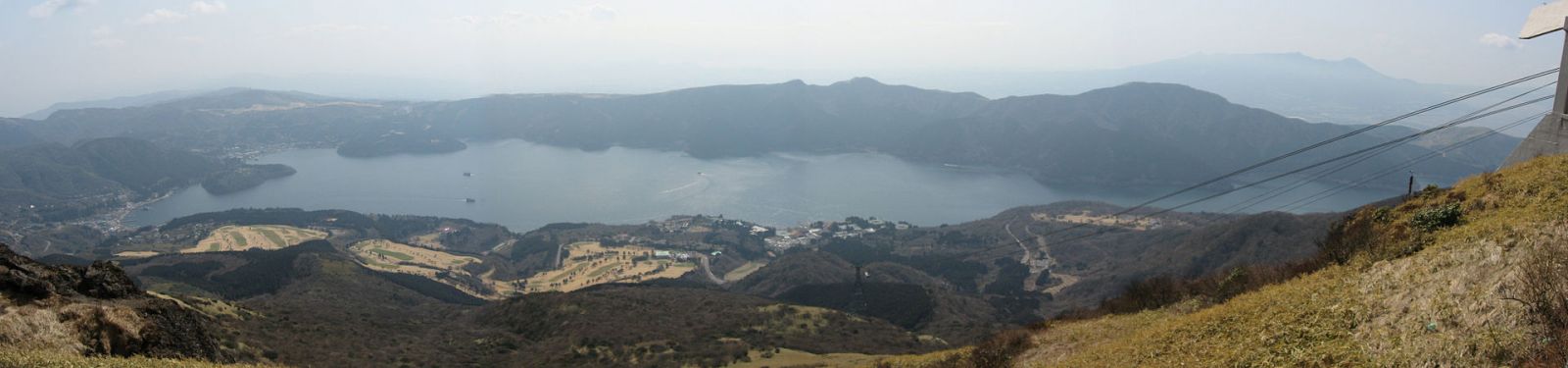
Lake Ashi from Mt.Komagatake. (CC – Wikimedia)
1 400 small earthquakes were recorded around Hakoneyama in February 2013, but there was no eruption.
The last time this volcano appeared in GVP's weekly volcanic report was during the week of August 8 – 14, 2001:
"Elevated seismicity had been recorded at Hakone during June 2001 to at least August 8. The seismicity was associated with a small amount of inflation that was centered at the volcano. Earthquake hypocenters occurred at depths less than 5 km beneath the volcano. A small swarm was also recorded under the northern end of the Ashino-ko (caldera lake). JMA noted that the change in activity might not be a precursor to an eruption since similar activity has occurred in the past that was not followed by an eruption."
Last known eruption of this volcano was in the year 1170 (VEI unknown).
Geologic summary
Hakoneyama volcano is truncated by two overlapping calderas, the largest of which is 10 x 11 km wide. The calderas were formed as a result of two major explosive eruptions about 180,000 and 49,000-60,000 years ago. Scenic Lake Ashi lies between the SW caldera wall and a half dozen post-caldera lava domes that were constructed along a SW-NE trend cutting through the center of the calderas.
Dome growth occurred progressively to the south, and the largest and youngest of these, Kamiyama, forms the high point of Hakoneyama. The calderas are breached to the east by the Hayakawa canyon.
A phreatic explosion about 3000 years ago was followed by collapse of the NW side of Kamiyama, damming the Hayakawa valley and creating Lake Ashi. The latest magmatic eruptive activity about 2900 years ago produced a pyroclastic flow and a lava dome in the explosion crater, although phreatic eruptions took place as recently as the 12-13th centuries CE. Seismic swarms have occurred during the 20th century. Lake Ashi, along with major thermal areas in the caldera, forms a popular resort area SW of Tokyo. (GVP)

Teo Blašković founded The Watchers in 2011 and edited it until 2026, covering seismic and volcanic activity, extreme weather, space weather and near-Earth objects. Articles on this page are his archive.
Earlier reporting
Nothing on Watchers was published in the last 24 hours. These are older articles.
- On October 22, 2017, a single flash of lightning stretched 515 miles from eastern Texas to near Kansas City, a distance that takes eight hours to drive, and nobody realized how far it had gone until scientists went back through the satellite data years later Epicenter
- CPC posts a slight risk of heavy rain from the Gulf Coast to the Northeast urban corridor November 25-29, and a moderate risk of West Coast wind and Sierra snow on November 25
- Florida's east coast faces a moderate flash flood risk Wednesday through Friday, with 4 to 8 inches of rain forecast and the St. Johns River near Cocoa already in major flood at 17.13 feet
- Cyclone Akvan to make landfall between Nellore and Visakhapatnam around noon on November 20, IMD forecasts 120-130 km/h winds gusting to 145


what is wrong with earth