
Shamal and dust storms over Southwest Asia
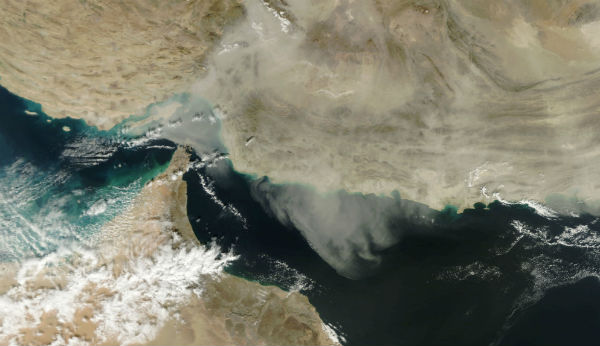
Image credit: TW
Dust blows off the coast of Iran and over the Strait of Hormuz and the Gulf of Oman. In winter time dust storms are associated chiefly with the passage of westerly depressions in this region.
This dust storm may be connected to a local phenomenon known as the “Shamal” (an Arabic word for “north”). A shamal is defined as sustained winds of 25 knots or greater. Wind direction is almost always northwesterly. The Shamal produces the most widespread hazardous weather known to the region. The winter Shamal is generally characterized by durations of either 24-36 hours or 3-5 days.
 Dust storms in southwest Asia on January 12, 2013 captured by MODIS/Terra satellite (Credit: LANCE/MODIS))
This “3-5 Day Shamal” occurs 1-3 times a winter and produces the strongest winds and highest seas found in the Persian Gulf. Over exposed Persian Gulf waters, sustained winds have reached 50kt which have produced 15+ ft seas. The 3-5 day shamal arises from the temporary stagnation of a 500mb short wave over or just east of the Strait of Hormuz , or from the establishment of a mean long wave trough stalling approximately 56E. Persistent dust and sandstorms occur.
 Dust across the Arabian Sea captured by MODIS/Aqua on January 13, 2013 (Credit: LANCE/MODIS)
Dust that restricts visibility is confined to the coasts and the immediate offshore areas of the Gulf of Oman during a strong “Shamal”. Visibility drops as low as 3-5NM. Worst conditions are found at the mouths of rivers or canyons. Dust settles rapidly once winds drop below 15kt.
Source: Earth Snapshots

Published in the last 24 hours
- High Risk of excessive rainfall covers Florida’s Space Coast as St. Johns River near Cocoa reaches 5.67 m
- Four small asteroids will pass close to Earth from November 21 to 23
- Cyclone Akvan weakens after landfall near Gopalpur; more than 300 000 evacuated in Odisha, India
- A broad low over southeastern Florida and the northwestern Bahamas has a 30 percent chance of subtropical or tropical development within 48 hours and a 50 percent chance within 7 days, the National Hurricane Center says
