
It rains on the Sun, and now we know why
A study published in the Astrophysical Journal on October 1, 2025, shows that sudden plasma rain in the Sun’s atmosphere is caused by shifting elemental abundances, solving a decades-old puzzle.

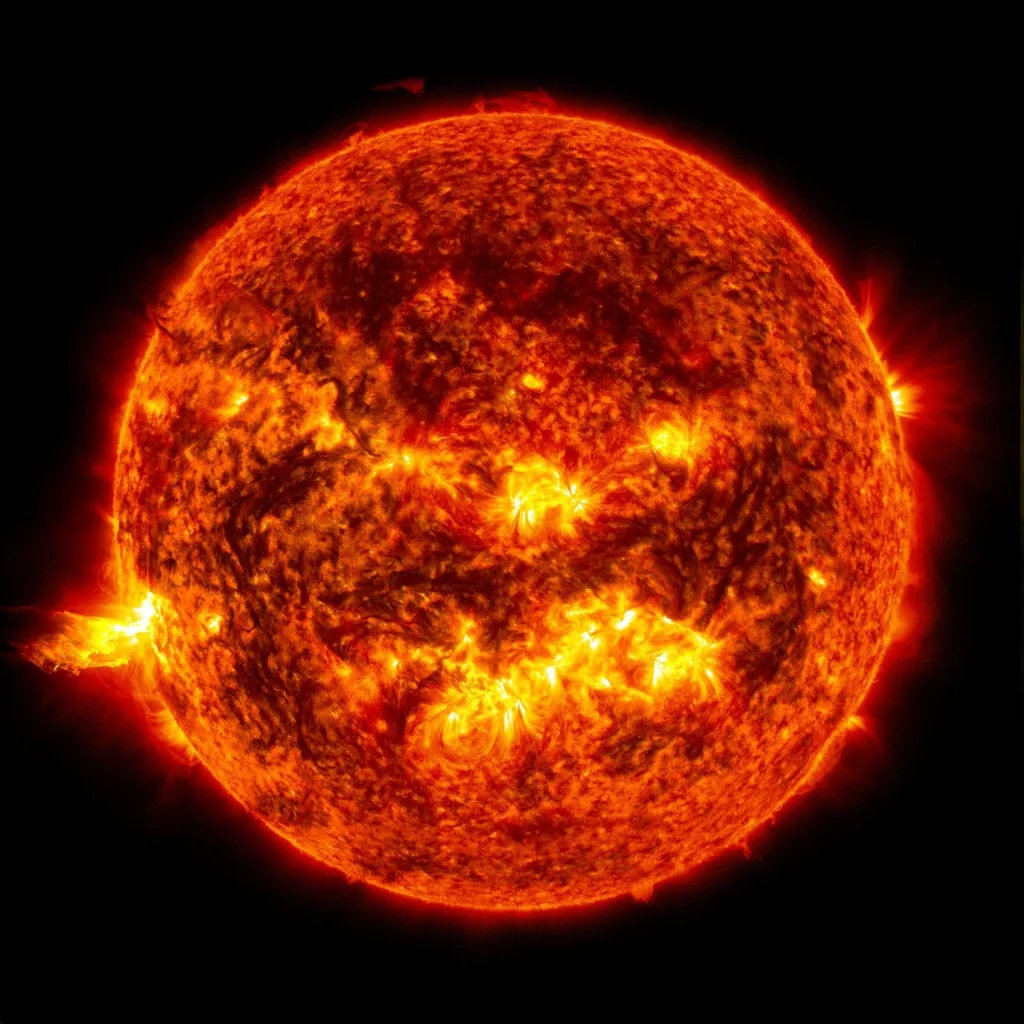
Researchers worked for years to unlock the mystery of solar rain in solar flares. Credit: NASA
For decades, scientists observed cool, dense plasma falling from the Sun’s upper atmosphere in events called coronal rain. These downpours appear minutes after solar flares, far faster than models had predicted. The mismatch puzzled astronomers, because older theories required hours or even days of heating for such rain to form.
Now researchers at the University of Hawaiʻi Institute for Astronomy, led by graduate student Luke Benavitz with astronomer Jeffrey Reep, have provided the missing explanation. By allowing the composition of the corona to vary over time, their models finally matched what telescopes have long observed on the Sun.
“Models assume that the distribution of elements in the corona is constant, which clearly isn’t the case,” said Benavitz. “When we allow elements like iron to change with time, the models finally match what we actually observe on the Sun.”
This breakthrough shows that dynamic plasma composition is a fundamental feature of the Sun’s outer layers. It is not a minor correction but a change that forces scientists to rethink how energy moves through the solar atmosphere.
Why the finding matters for space weather
Solar flares drive storms that affect Earth’s satellites, power grids, and communications. To predict these events, scientists rely on models of how the Sun heats and cools its atmosphere. Coronal rain is a visible signal of cooling, but until now simulations failed to reproduce it under real flare conditions.
“We can’t directly see the heating process, so we use cooling as a proxy,” explained Reep. “If our models haven’t treated abundances properly, the cooling time has likely been overestimated. We might need to go back to the drawing board on coronal heating.”
By correcting this error, scientists can now create more realistic models of solar flares. This means forecasts of space weather may become more accurate, with earlier warnings for disruptions to Earth’s technology.
The discovery also challenges long-standing assumptions about the stability of the corona’s composition. If abundances shift during every flare, then solar models must account for these variations in order to understand energy release and transport.
The physics behind solar rain
Solar rain is not made of water but of plasma, a state of matter where atoms are ionized and behave collectively under magnetic and electric forces. In the corona, plasma temperatures soar to over one million degrees Celsius, yet localized cooling can create dense clumps that fall downward along magnetic field lines.
The new research shows that the key driver is the abundance of elements with a low first ionization potential, such as iron, magnesium, and silicon. These elements are enhanced in the corona relative to the solar surface, while high-potential elements like helium and oxygen remain nearly unchanged. This pattern is called the First Ionization Potential effect.
When low-FIP abundances shift suddenly, they alter the local rate of radiative cooling. A spike in cooling at one location triggers a runaway process, creating cold blobs that condense into plasma rain. Without variable abundances, earlier models smoothed out these spikes and failed to generate condensations.
By modifying the HYDRAD code to include variable abundances, the research team demonstrated that even impulsively heated flare loops can naturally produce rain. This is the first time simulations have succeeded in replicating what astronomers routinely observe.
Earlier attempts to explain coronal rain
Since the 1970s, scientists have proposed several mechanisms for solar rain, but none could explain its sudden onset in flares. One idea was thermal nonequilibrium, where prolonged heating at the base of a magnetic loop creates gradients that trigger rain. Another was thermal instability, where imbalances in heating and cooling spiral into runaway condensation.
Other proposals included shock waves and nanoflares that disturb plasma conditions enough to create rain. While these mechanisms offered partial explanations, they still required extended heating timescales that did not fit with the rapid appearance of rain after solar flares.
Because of these gaps, models consistently failed to reproduce observations. Almost every flare shows coronal rain, yet simulations without variable abundances showed none. This mismatch signaled that a fundamental piece of solar physics was missing.
The new abundance-driven model resolves this discrepancy, proving that rain is not an anomaly but a natural outcome of flare dynamics once changing composition is included.
Looking ahead to future research
This discovery has implications that extend well beyond coronal rain. If abundances in the corona shift continuously, then every major solar model will need revision, from flare physics to the structure of coronal loops and the behavior of the solar wind.
Future studies will likely test how abundance variations interact with smaller-scale events such as nanoflares and micro-eruptions. These shifts may also influence the composition of the solar wind, which shapes the heliosphere and space weather conditions across the solar system.
Upcoming missions like ESA’s Solar Orbiter and future NASA observatories will provide high-resolution spectroscopic data to test these predictions. By directly measuring abundance changes, scientists can refine their models and deepen their understanding of coronal heating, one of the great unsolved questions in solar physics.
By linking observable rain to invisible abundance shifts, the study gives researchers a powerful diagnostic tool. It turns coronal rain from a curiosity into a window on the processes that power the Sun itself.
References:
1 Spatiotemporal Low First Ionization Potential Abundance: A Catalyst for Coronal Condensation – Luke Fushimi Benavitz et al. – The Astrophysical Journal – October 1, 2025 – https://doi.org/10.3847/1538-4357/ae019d – OPEN ACCESS
2 VIDEO: Solar rain mystery cracked by UH researchers – University of Hawaiʻi at Mānoa – October 1, 2025

I’m a science journalist and researcher at The Watchers, contributing to the Epicenter edition, where I cover peer-reviewed scientific research and emerging discoveries across Earth and space sciences. With a background in astronomy and a passion for environmental science, I’ve worked in shark and coral conservation in Fiji, conducting reef and shark-behavior research, contributing to mangrove restoration, and earning PADI Open Water and Coral Reef Certifications. I bring a blend of scientific rigor and storytelling to illuminate the discoveries shaping our planet and beyond.

Commenting rules and guidelines
We value the thoughts and opinions of our readers and welcome healthy discussions on our website. In order to maintain a respectful and positive community, we ask that all commenters follow these rules.