
Major X2.1 and long-duration X1.0 solar flares erupt from AR 3842
A major solar flare measuring X2.1 erupted from Active Region 3842 at 19:13 UTC on October 7, 2024. The event started at 19:02 and ended at 19:31 UTC.

X2.1 solar flare on October 7, 2024. Image credit: NASA/SDO AIA 304
The event comes just 4 days after X9.0 — thus far the strongest solar flare of Solar Cycle 25, also from Region 3842.
The event was associated with a 10cm Radio Burst (tenflare) lasting 4 minutes and with a peak flux of 640 sfu.
A 10cm radio burst indicates that the electromagnetic burst associated with a solar flare at the 10cm wavelength was double or greater than the initial 10cm radio background. This can be indicative of significant radio noise in association with a solar flare. This noise is generally short-lived but can cause interference for sensitive receivers including radar, GPS, and satellite communications.
At the time of press, there were no radio signatures that would suggest a coronal mass ejection (CME) was produced. Even if it was, the location of this region now close to the west limb does not favor Earth-directed CMEs.
Radio frequencies were forecast to be most degraded over the Pacific Ocean at the time of the flare.
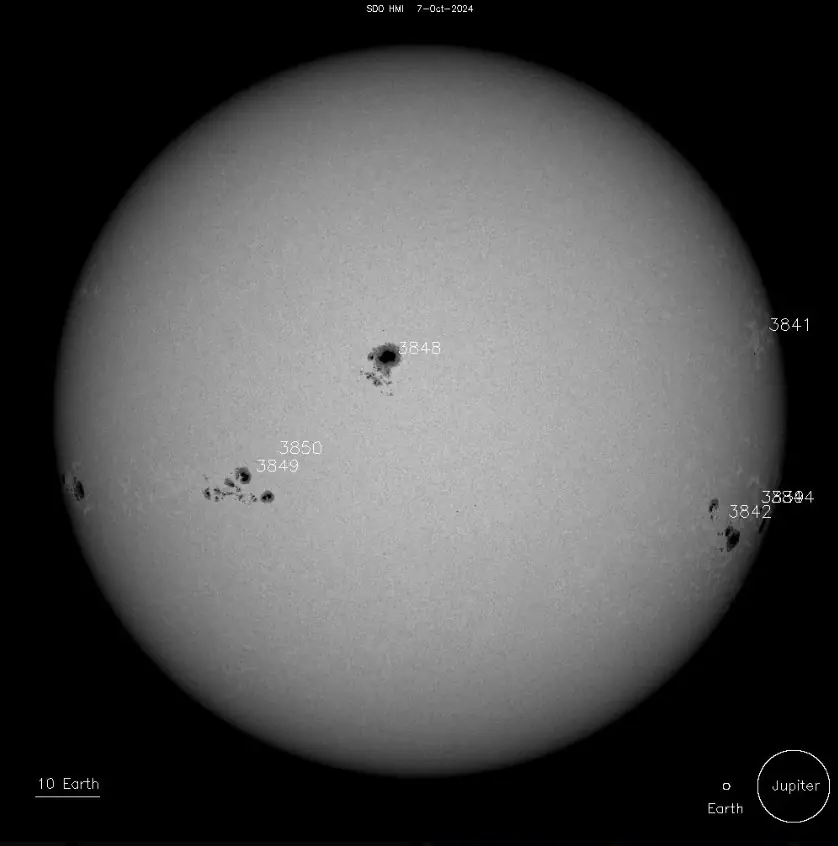


This event was followed by a long-duration flare peaking as X1.0 at 20:50 UTC and associated with a large CME off the west limb of the Sun.
While a direct impact on Earth from this CME is unlikely, a minor shock may pass the planet, though little to no geomagnetic activity is expected from this event.

Solar activity is expected to be moderate with 75% for M-class solar flares and 30% for isolated X-class flares through October 9.
The CME produced by the X9.0 solar flare on October 3 impacted Earth on October 6, producing G3 – Strong geomagnetic storming.
The auroras spread across more than 20 U.S. states, including Alaska, Maine, Vermont, Minnesota, North Dakota, Washington, Wisconsin, New York, South Dakota, Idaho, Montana, Wyoming, Pennsylvania, Ohio, Illinois, Virginia, Kentucky, Missouri, Kansas, North Carolina, Mississippi, and California.
Read more:

I'm a dedicated researcher, journalist, and editor at The Watchers. With over 20 years of experience in the media industry, I specialize in hard science news, focusing on extreme weather, seismic and volcanic activity, space weather, and astronomy, including near-Earth objects and planetary defense strategies. You can reach me at teo /at/ watchers.news.

Commenting rules and guidelines
We value the thoughts and opinions of our readers and welcome healthy discussions on our website. In order to maintain a respectful and positive community, we ask that all commenters follow these rules.