
Super-hot ions in solar flares may solve 50-year-old spectral mystery
Ions in solar flares reach temperatures exceeding 60 million °C (108 million °F), potentially solving a long-standing mystery over unexpectedly broad spectral lines first observed in the 1970s, according to new research published on September 3, 2025.

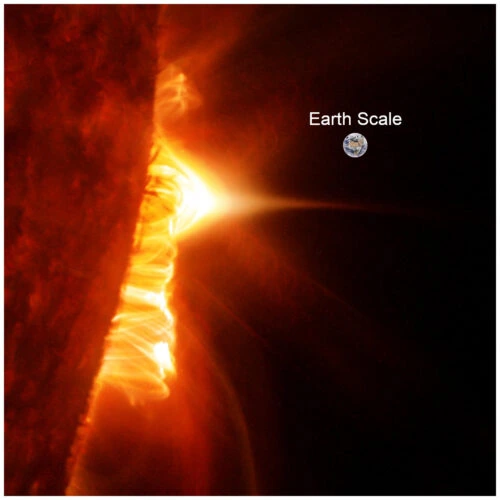
Solar flare on April 24, 2025. Image credit: NASA
New research from the University of St Andrews has proposed that ions in solar flares are heated 6.5 times more than previously thought, potentially solving a 50-year-old mystery about the Sun’s extreme-ultraviolet and X-ray spectra.
Since the 1970s, solar flare spectral lines have been observed to be broader than expected, a phenomenon traditionally attributed to turbulent motions in the solar atmosphere. However, the nature of this turbulence has remained unclear. The new findings suggest that previously unaccounted-for superheating of ions could explain the excess line broadening, offering a direct thermal explanation instead of unresolved turbulence.
Solar flares are sudden releases of energy in the Sun’s outer atmosphere that heat plasma to over 10 million °C (18 million °F). These events enhance solar X-rays and radiation reaching Earth, posing hazards to spacecraft and astronauts, and affecting the planet’s ionosphere and upper atmosphere.
The study, published in The Astrophysical Journal Letters on September 3, 2025, examined how magnetic reconnection during flares heats solar plasma — composed of ions and electrons. The results indicate that ion temperatures can exceed 60 million °C (108 million °F), far higher than previously assumed.
Dr. Alexander Russell, Senior Lecturer in Solar Theory at the University of St Andrews, said ions are heated much more strongly than electrons in flares.
“We were excited by recent discoveries that a process called magnetic reconnection heats ions 6.5 times as much as electrons,” he said. “This appears to be a universal law, and it has been confirmed in near-Earth space, the solar wind, and computer simulations. However, nobody had previously connected work in those fields to solar flares.”
“Solar physics has historically assumed that ions and electrons must have the same temperature,” Russell added. “Redoing calculations with modern data, we found that ion and electron temperature differences can last for tens of minutes in important parts of solar flares, opening the way to consider super-hot ions for the first time.”
The new ion temperature estimates also match the width of flare spectral lines. “This potentially solves an astrophysics mystery that has stood for nearly half a century,” Russell said.
Since the 1970s, flare spectra in extreme-ultraviolet and X-ray light have shown line widths broader than expected.
These were traditionally attributed to turbulent motions, but this explanation has been challenged as the nature of the turbulence has remained unclear. The new study argues that ion temperatures may make a major contribution to explaining the broadened spectral lines.
References:
1 Solar Flare Ion Temperatures – Alexander J. B. Russell, Vanessa Polito, Paola Testa, Bart De Pontieu, and Sergey A. Belov – The Astrophysical Journal Letters – September 3, 2025 – https://doi.org/10.3847/2041-8213/adf74a – OPEN ACCESS

I’m a science journalist and researcher at The Watchers, contributing to the Epicenter edition, where I cover peer-reviewed scientific research and emerging discoveries across Earth and space sciences. With a background in astronomy and a passion for environmental science, I’ve worked in shark and coral conservation in Fiji, conducting reef and shark-behavior research, contributing to mangrove restoration, and earning PADI Open Water and Coral Reef Certifications. I bring a blend of scientific rigor and storytelling to illuminate the discoveries shaping our planet and beyond.

Commenting rules and guidelines
We value the thoughts and opinions of our readers and welcome healthy discussions on our website. In order to maintain a respectful and positive community, we ask that all commenters follow these rules.