
Saskatchewan records first EF3 tornado since 2010 near Oxbow, Canada
Saskatchewan’s first EF3 tornado since 2010 struck near Oxbow on June 9, 2026. The tornado tracked 32 km (20 miles) on the Canadian side of the border, producing estimated peak winds of 245 km/h (152 mph). It claimed the life of a pet animal, destroyed buildings at a farm property, and caused damage that extended into North Dakota, United States.
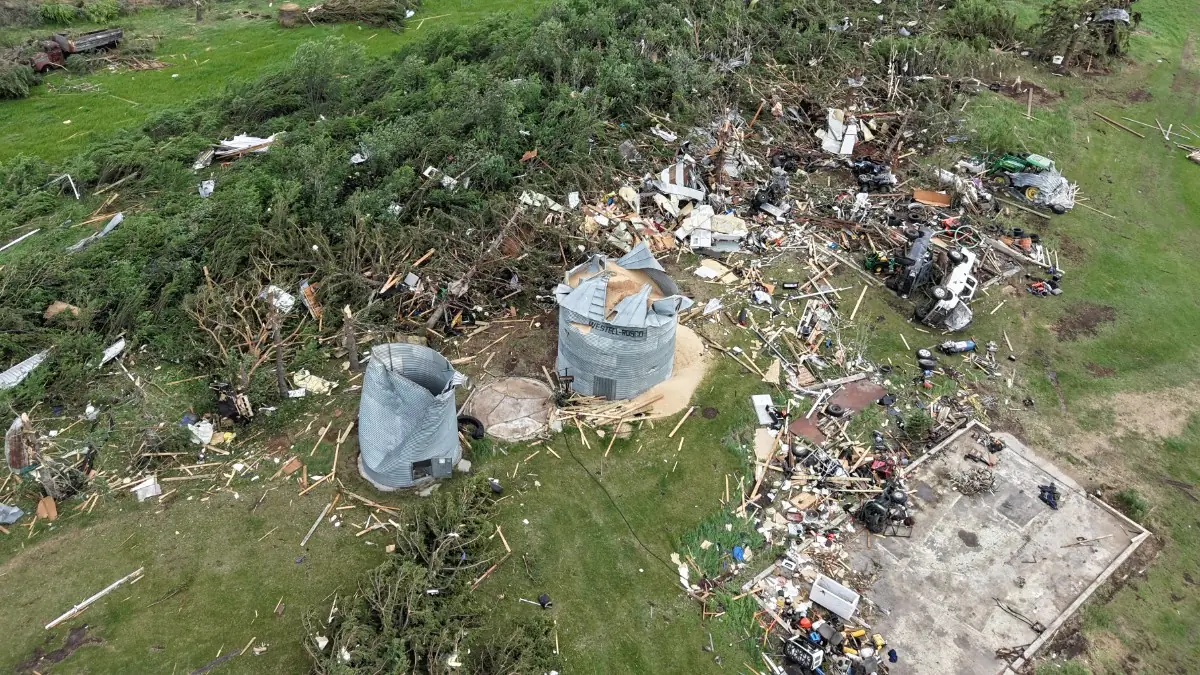
Damage caused by June 9, 2026 EF3 tornado in Oxbow, Canada. Credit: Northern Tornadoes Project
A tornado that struck near Oxbow, Saskatchewan, on June 9, has been rated EF3 by the Northern Tornadoes Project (NTP). The rating makes it Saskatchewan’s first EF3 tornado since 2010 and one of the strongest tornadoes documented in Canada in recent years.
The tornado formed near the Canada-U.S. border at approximately 18:55 CST (00:55 UTC). It tracked northeast for 32 km (20 miles) before dissipating near Oxbow, according to the NTP damage survey. It had estimated peak winds of 245 km/h (152 mph) and a maximum path width of 560 m (1 837 feet).
The June 9 North Portal–Oxbow tornado was Saskatchewan’s first F3/EF3-rated tornado since 2010 and Canada’s strongest tornado since the EF4 Didsbury, Alberta, tornado in July 2023, according to The Weather Network and the Northern Tornadoes Project.
Survey teams found that a home and an outbuilding were destroyed at a farm property, while grain bins, vehicles, and trees were heavily damaged. The family pet was also killed by the twister.
Additional damage was documented during ground and drone surveys conducted on June 10 and 11. Investigators also recorded snapped power poles, damage to a pump jack at a battery site, tree damage, and minor structural damage at other locations.
The tornado damage extended across the border into North Dakota, USA. While survey teams were unable to continue damage assessment in North Dakota, the damage in Saskatchewan was sufficient to support the EF3 classification. Its actual path length and time on the ground remain unknown.
“When you get those kinds of winds, you’re talking about not just the roof coming off a house, but walls going down and some large stands of forest being completely destroyed,” David Sills, the director of the NTP at Western University, told CBC News.
“We know from chaser accounts that this storm appears to have been generating a tornado for at least 40 km (25 miles), maybe more. And it might have actually crossed the U.S. border and then gone that far,” Sills added.
Sills said there had been only five F3 or EF3 tornadoes in Saskatchewan since 1980, but the province is a “big, wide-open place.”
Strong tornadoes rated EF3 or higher remain relatively uncommon in Canada. Such events represent a small fraction of the country’s annual tornado reports.
Environment Canada says over 90 percent of tornadoes in Canada are rated as “weak,” EF0 or EF1, with wind speeds between 90 and 175 km/h ( 56 and 109 mph).
The last F3 or EF3 tornado in Saskatchewan struck Kawacatoose First Nation on July 2, 2010, causing an estimated CAD 13.2 million in damage. Five homes were destroyed, 15 others sustained significant damage, and the tornado damaged a water treatment plant, cellphone tower, and power poles.
Only one minor injury was reported. A house, garage, and barn in the Semans, Saskatchewan, area were also significantly damaged.
The June 9 tornado was part of a larger severe weather outbreak that spawned multiple tornadoes in Saskatchewan and Manitoba as severe thunderstorms swept across the provinces. The same storms also prompted emergency declarations in parts of Manitoba due to severe flash floods.
Read more:
References:
1 Details on June 9 tornadoes in SK and MB – NTP – June 12, 2026
2 Saskatchewan rarely gets tornadoes as strong as the one that hit the Oxbow area this week – CBC – June 11, 2026

I am an Assistant Editor and Severe Weather & Science Journalist at The Watchers, specializing in real-time severe weather coverage, geophysical event reporting, and research-driven scientific analysis. You can reach me at rishav(at)watchers(.)news.

Commenting rules and guidelines
We value the thoughts and opinions of our readers and welcome healthy discussions on our website. In order to maintain a respectful and positive community, we ask that all commenters follow these rules.