
Ranger Road Fire doubles in size in one day, reaching over 114 650 ha (283 000 acres) in Kansas-Oklahoma
The Ranger Road Fire nearly doubled in size from 58 700 ha (145 000 acres) to over 114 650 ha (283 000 acres) within roughly 24 hours after ignition at 11:40 LT on February 17, 2026, when it crossed the Kansas–Oklahoma border. As of February 18, containment stood at 15% following rapid expansion driven by dry fuels and high winds. Authorities closed sections of Kansas highways 283, 160, and 183.
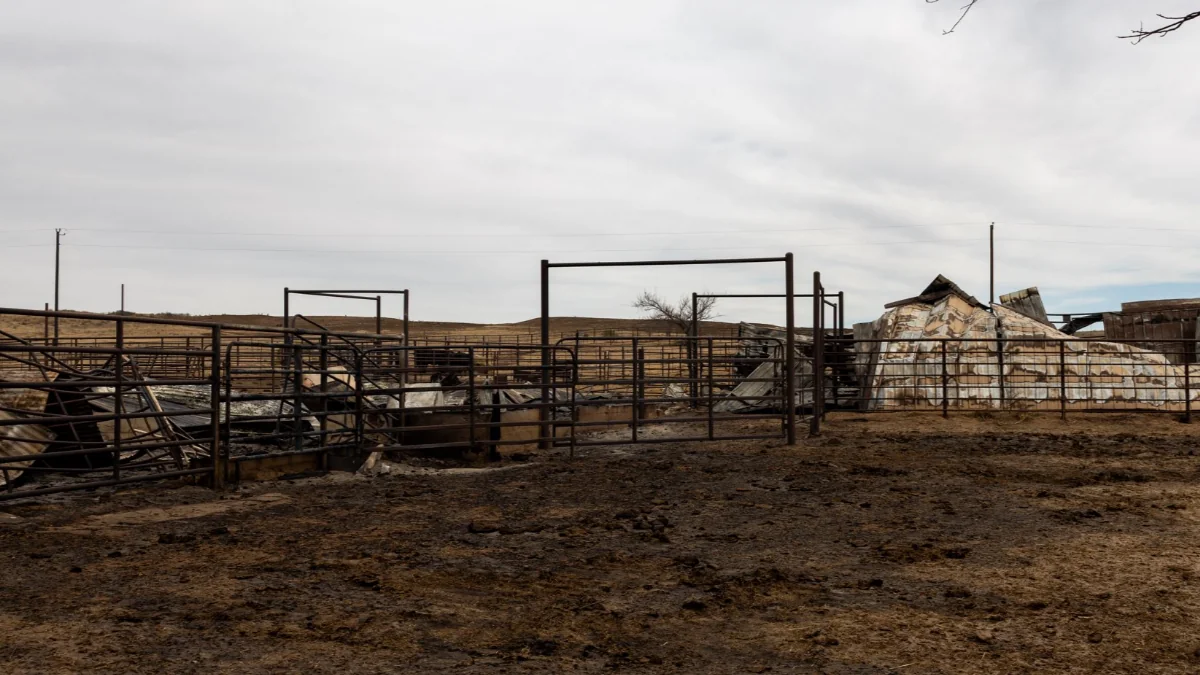
Wildfire damage in Oklahoma on February 18, 2026. Credit: Oklahoma Department of Agriculture
The Ranger Road fire continues to grow rapidly and has exploded in size to over 114 650 ha (283 000 acres) as of late February 18 (LT), standing at 15% containment.
The fire has been growing rapidly since ignition on February 17, as dry conditions and high winds fueled its expansion, reaching over 58 700 ha (145 000 acres) in just 9 hours since it was first reported at around 11:40 local time (LT).
The fire also prompted the closures of sections of Kansas Highway 283, Kansas Highway 160, and Kansas Highway 183.
Mandatory evacuations were issued for Ashland, Englewood, and southern Comanche counties but have since been lifted.
Multiple other wildfires are also affecting Oklahoma, having prompted a State of Emergency in three counties on February 18.
In Texas County, the Stevens Fire has burned 5 028 ha (12 428 acres) and is 50% contained, while the Side Road Fire has reached 1 490 ha (3 680 acres) with 60% containment. In Woodward County, the 43 Fire has burned 680 ha (1 680 acres) and is 30% contained, and the 206 Road Fire has affected 65 ha (160 acres).

Authorities identified 33 fires and hotspots across 23 counties, including Atoka, Beckham, Blaine, Bryan, Carter, Coal, Custer, Garvin, Hughes, Kay, Lincoln, Logan, Love, Marshall, Mustang, Oklahoma, Okmulgee, Pontotoc, Pottawatomie, Stephens, Tillman, Woods, and Woodward, on February 18.
At least 4 firefighters had been injured by the fires on February 17. While no human casualties have been reported since, hundreds of cattle have reportedly died after the blazes burned through farmlands.
Texas County officials reported five structures destroyed in the Stevens / Side Road fire complex, while Beaver County noted the loss of numerous outbuildings in the Ranger Road Fire.
Drone footage below shows multiple homes and buildings burning in Tyrone (Stevens Fire):


Six Oklahoma Forestry Services fire suppression teams were pre-positioned in Beaver County, Texas County, Woodward, Henryetta, and Shawnee. Meanwhile, four teams responded to active fires during the day.
The Federal Emergency Management Agency approved three Fire Management Assistance Grants for the Stevens Fire in Texas County, the Ranger Road Fire in Beaver County, and the 43 Fire in Woodward County.
The grants may reimburse eligible response costs for local governments, volunteer fire departments, and first responders.

Mass care operations included the provision of 200 meals for responders in Beaver County by Oklahoma Baptist Disaster Relief. All evacuation shelters have closed but may reopen if conditions deteriorate.
The Oklahoma Department of Emergency Management is asking residents impacted by the fires to report damage at damage.ok.gov.
Reporting damage helps local and state emergency managers better coordinate response and recovery efforts and can help connect residents with resources. Residents can report damage to homes, businesses, or agriculture through the online survey.
References:
1 Wildfire Situation Update 2 – ODEM – February 18, 2026

Teo Blašković founded The Watchers in 2011 and edited it until 2026, covering seismic and volcanic activity, extreme weather, space weather and near-Earth objects. Articles on this page are his archive.
Published in the last 24 hours
- In September 1859, a solar storm lit up the night sky so brightly that gold miners in the Rocky Mountains woke up after midnight and started cooking breakfast, convinced the aurora glowing over their camp was the sunrise Epicenter
- A patch of warm Pacific water that could become the strongest El Niño in more than 70 years sits thousands of miles from any American town, yet it is already the main reason NOAA expects a wetter winter across the South and a milder one across the North
- A 19-year-old Nebraska teacher reportedly tied her pupils together with twine and led them to safety through a blizzard in January 1888 Epicenter
- NASA built the Opportunity rover to last 90 days on Mars, and Martian winds helped keep it alive for nearly 15 years by blowing dust off its solar panels, until a planet-wide dust storm in 2018 blocked sunlight and silenced the rover Epicenter
