
Newfoundland hit by record-setting bomb cyclone with hurricane-force gusts and flooding
A record-breaking bomb cyclone ripped through Newfoundland from November 4 through 5, 2025 bringing along Category 2 hurricane force winds, coastal flooding, and causing widespread damage across the region.
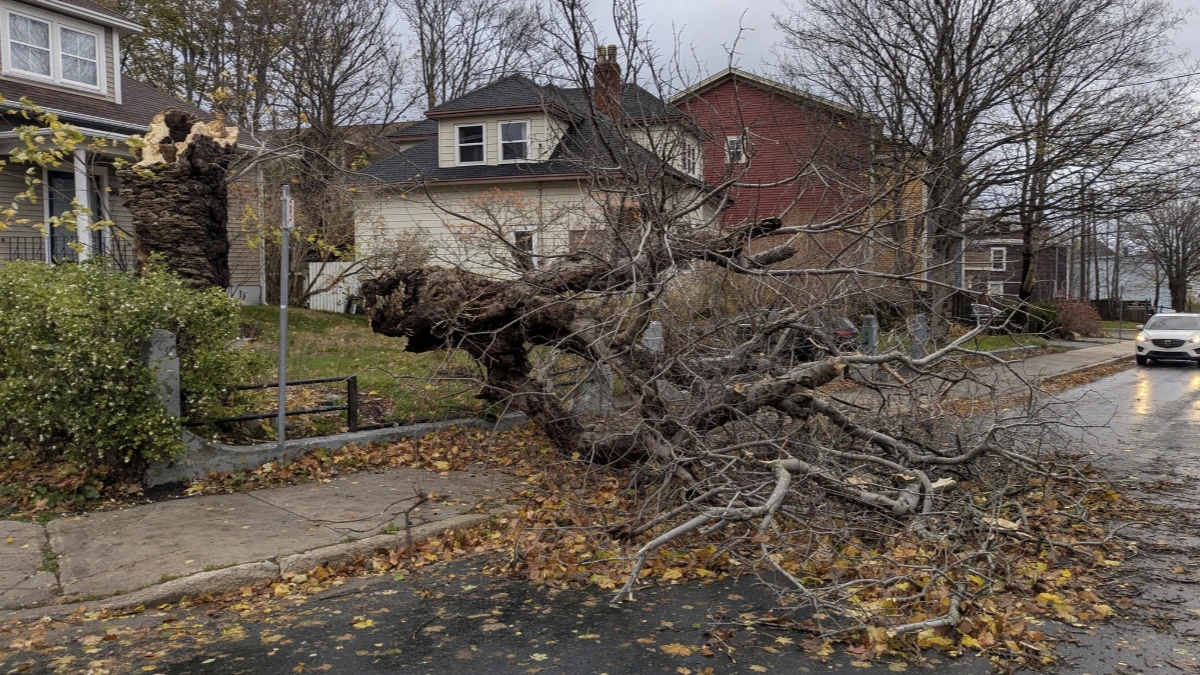
Tree snapped in St. Johns, Newfoundland after a bomb cyclone swept through the province through November 4-5, 2025. Credit: Colin Lane
A powerful fall storm underwent rapid intensification phase as it swept into Newfoundland, Canada, on November 4–5, deepening by more than 60 hPa within 24 hours.
According to Environment and Climate Change Canada (ECCC), the system reached a minimum mean sea-level pressure of 944.7 hPa at Marticot Island in Placentia Bay—the lowest ever recorded in the province during November—and 950.5 hPa at St. John’s International Airport, setting a new local record for the month.
ECCC observations confirmed hurricane-force gusts of 172 km/h (107 mph) at Cape St. Mary’s, 171 km/h (106 mph) at Trepassey (Powles Head), and 162 km/h (101 mph) at Cape Race.
Rainfall totals reached 54.5 mm (2.15 inches) in Lamaline and 44.3 mm (1.74 inches) in St. Lawrence, while western and central communities such as Corner Brook, Massey Drive, and Grand Falls–Windsor reported wet snow and mixed precipitation.
Coastal and offshore buoys measured waves over 9 m (30 feet), with some readings near 12 m (39 feet) along the southern Avalon and Burin Peninsulas.
Please be careful around the province today as crews are out cleaning up and dealing with many calls for service.
— Colin Lane (@ColinLa709) November 5, 2025
St.John's NL#ShareYourWeather @weathernetwork pic.twitter.com/XbPIEYzGQ1
The high tide, storm surge, and onshore winds led to significant coastal flooding, erosion. In Trepassey, two families were evacuated after waves broke through the town’s breakwater and flooded low-lying homes, CBC reported.
At the storm’s peak on November 4, more than 9 000 Newfoundland Power customers experienced outages, with the Avalon and Burin Peninsulas being the most affected. Ferry crossings were suspended, and multiple highways were closed due to downed trees, debris, and severely reduced visibility from wind-driven precipitation.
The low developed south of Nova Scotia on November 3 and underwent explosive cyclogenesis, dropping from roughly 1 006 hPa to 944.7 hPa in less than a day—well above the 24 hPa in 24 hours threshold for bombogenesis. The low pressure gradient produced the hurricane-force winds, heavy seas, and extensive coastal impacts observed across Newfoundland.
By November 5, the system had moved north of the island, but gusts above 100 km/h (62 mph) and large swells were expected to persist through early November 6. Marine warnings and coastal inundation advisories remained in effect as cleanup and restoration continued across the Avalon, Burin, and southern Newfoundland coasts.

I am an Assistant Editor and Severe Weather & Science Journalist at The Watchers, specializing in real-time severe weather coverage, geophysical event reporting, and research-driven scientific analysis. You can reach me at rishav(at)watchers(.)news.

Commenting rules and guidelines
We value the thoughts and opinions of our readers and welcome healthy discussions on our website. In order to maintain a respectful and positive community, we ask that all commenters follow these rules.