
Drillbit tornado hits Ulan Hada Volcanic Geological Park in Inner Mongolia, crushing vehicles
A tornado struck Ulan Hada Volcanic Geological Park in Chahar Right Back Banner, Ulanqab City, Inner Mongolia, China, on August 4, 2025, crushing multiple vehicles.
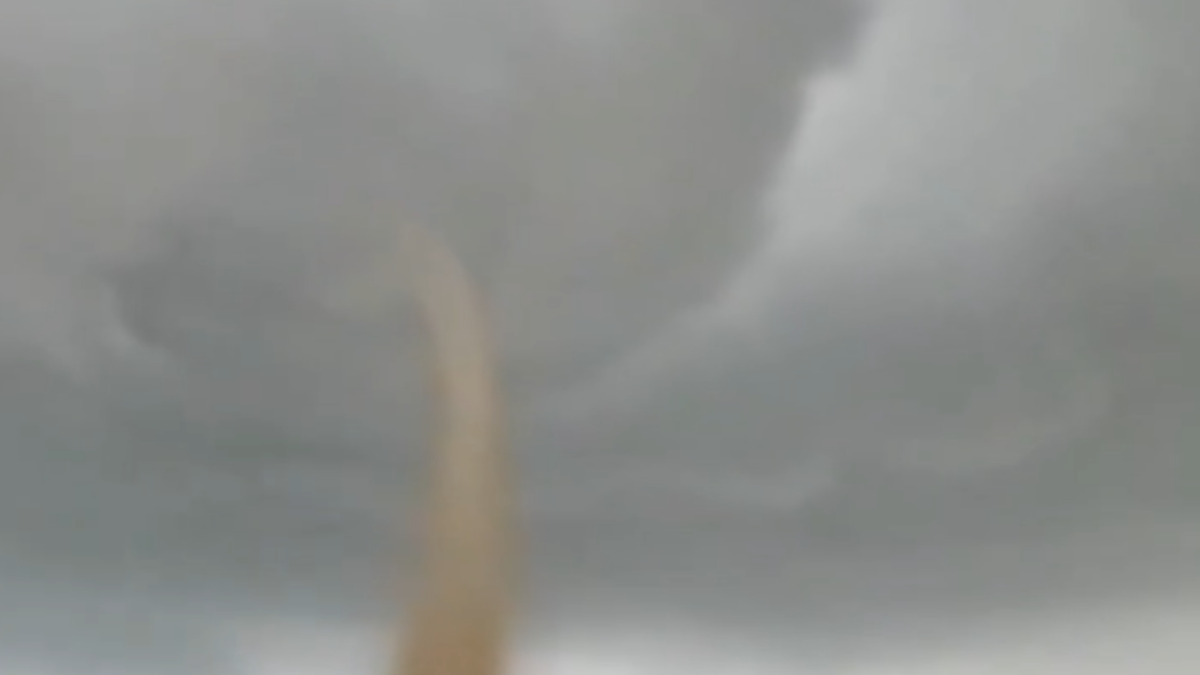
Tornado hits Ulan Hada Volcanic Geological Park, China on August 4, 2025. Image credit: Eric Wang
The event took place in the vicinity of the park’s volcanic landforms, which cover approximately 65 km2 (25 miles2) and are part of a well‑preserved basaltic volcanic field.
Video footage posted online shows a narrow tornado funnel over the park. Some meteorologists and weather observers on social media have described the feature as resembling a “drillbit tornado,” a narrow and tightly wound vortex, though no official classification has been made.
The Ulan Hada Volcanic Geological Park, sometimes referred to as the “volcano museum” or the “alchemy furnace of Supreme Lord Laozi,” is a protected geological reserve featuring more than 30 volcanic cones, lava flows, and dammed lakes.
Its open grassland setting provides an unobstructed view of weather phenomena developing in the area.
Tornadoes are uncommon but not unprecedented in Inner Mongolia. Summer convective storms occasionally produce rotating updrafts capable of generating tornadoes when local surface boundaries interact with upper‑level disturbances.

I’m a science journalist and researcher at The Watchers, contributing to the Epicenter edition, where I cover peer-reviewed scientific research and emerging discoveries across Earth and space sciences. With a background in astronomy and a passion for environmental science, I’ve worked in shark and coral conservation in Fiji, conducting reef and shark-behavior research, contributing to mangrove restoration, and earning PADI Open Water and Coral Reef Certifications. I bring a blend of scientific rigor and storytelling to illuminate the discoveries shaping our planet and beyond.
Published in the last 24 hours
- In September 1859, a solar storm lit up the night sky so brightly that gold miners in the Rocky Mountains woke up after midnight and started cooking breakfast, convinced the aurora glowing over their camp was the sunrise Epicenter
- A patch of warm Pacific water that could become the strongest El Niño in more than 70 years sits thousands of miles from any American town, yet it is already the main reason NOAA expects a wetter winter across the South and a milder one across the North
- A 19-year-old Nebraska teacher reportedly tied her pupils together with twine and led them to safety through a blizzard in January 1888 Epicenter
- NASA built the Opportunity rover to last 90 days on Mars, and Martian winds helped keep it alive for nearly 15 years by blowing dust off its solar panels, until a planet-wide dust storm in 2018 blocked sunlight and silenced the rover Epicenter
