
Very strong M7.4, series of powerful earthquakes hit Kamchatka Peninsula, triggering Tsunami Watch
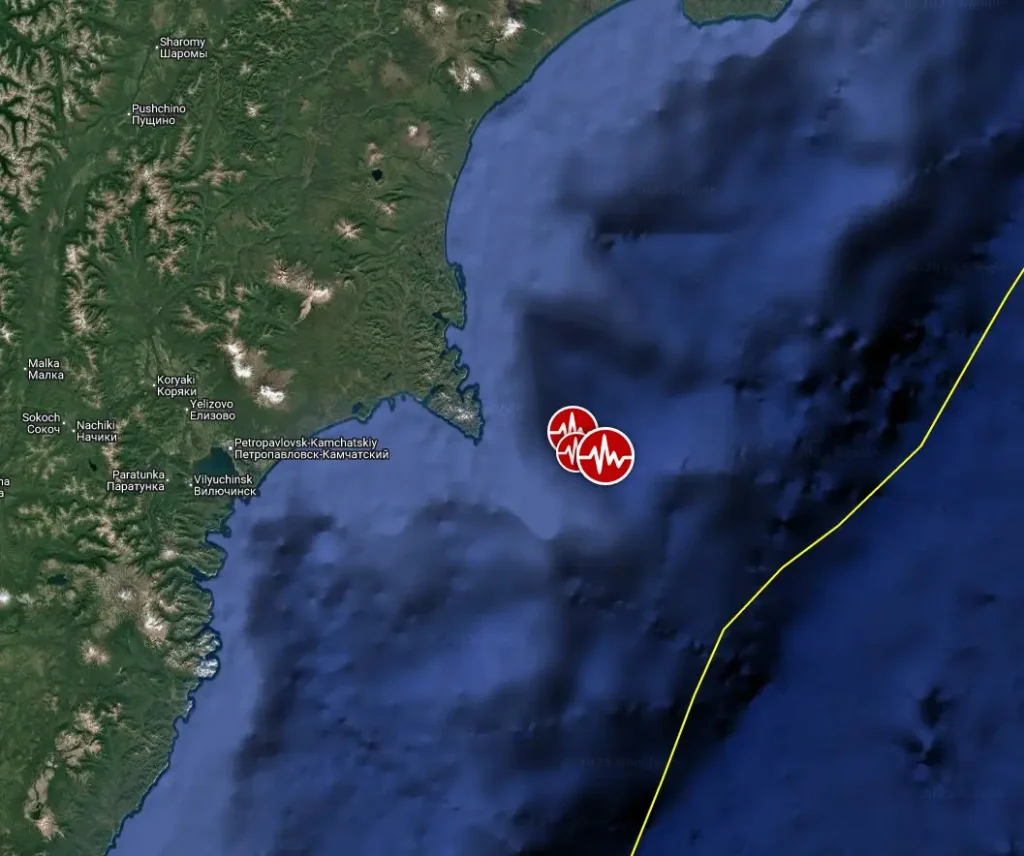
A very strong earthquake registered by the USGS as M7.4 hit near the coast of the Kamchatka Peninsula, Russia at 06:49 UTC (18:49 local time) on July 20, 2025. The agency is reporting a depth of 20 km (12.4 miles). The quake was preceded by M5.0 at 06:02 and M6.7 at 06:28 UTC and followed by another M6.7 at 09:07 UTC.

Image credit: TW/SAM, Google
The epicenter was located 144 km (89 miles) E of Petropavlovsk-Kamchatsky (population 181 216) and 158 km (98 miles) E of Vilyuchinsk (population 25 204), Kamchatka, Russia.
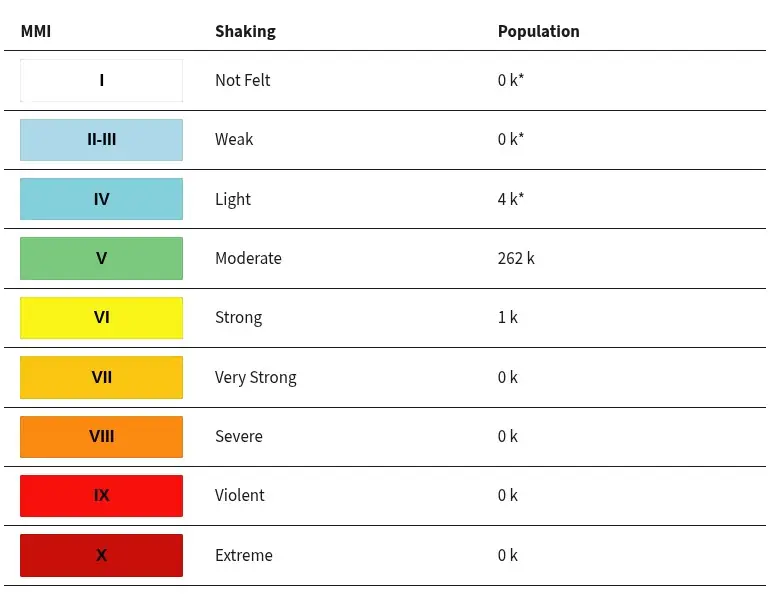
1 000 people are estimated to have felt strong shaking and 262 000 moderate.
“Based on the preliminary earthquake parameters, hazardous tsunami waves are possible for coasts located within 300 km (186 miles) of the earthquake epicenter,” NWS PTWC said.
Estimated time of arrival to Petropavlovsk is 07:28 UTC.
A tsunami is a series of waves, with the time between wave crests varying from 5 minutes to 1 hour. The threat may persist for several hours or longer after the first wave reaches the coast.
Tsunami impacts can differ significantly along the coastline due to variations in local bathymetry, as well as the shape and elevation of the shoreline.
The severity of the impact may also be influenced by the tidal stage at the time the largest tsunami waves arrive.
Individuals caught in the water during a tsunami are at risk of drowning, being struck by debris, or being swept out to sea.
The USGS issued a Green alert for shaking-related fatalities and economic losses. There is a low likelihood of casualties and damage.
Overall, the population in this region resides in structures that are resistant to earthquake shaking, though vulnerable structures exist. The predominant vulnerable building types are adobe block and unreinforced brick with mud construction.
Recent earthquakes in this area have caused secondary hazards such as tsunamis that might have contributed to losses.
The M7.4 mainshock at 06:49 UTC was preceded by M5.0 at 06:02 UTC and M6.7 at 06:28 UTC, and followed by at least 25 aftershocks, including M6.7 at 07:07 UTC, M6.6 at 07:22 UTC, and M6.0 at 07:26 UTC. The sequence also produced 10 earthquakes in the M5 range and 14 in the M4 range through 10:24 UTC.
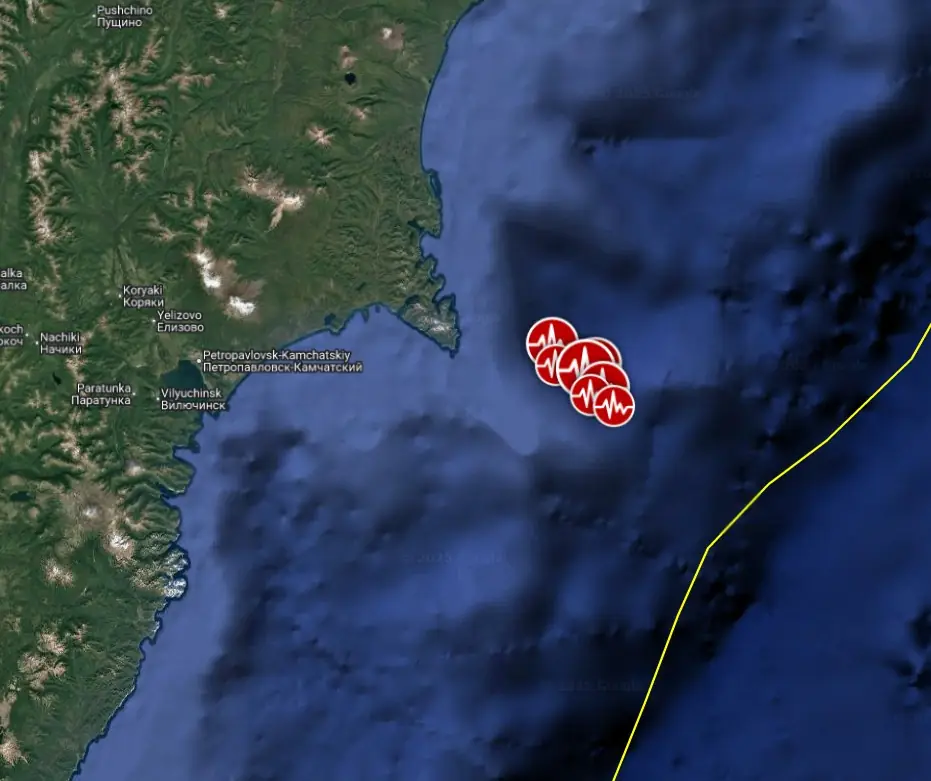
Tsunami alerts for the peninsula and coastal settlements was lifter without any evacuations taking place.
The shaking caused by M7.4 reportedly lasted for about one minute, prompting many people to evacuate buildings.
The press service of the regional Main Department of the Ministry of Emergency Situations said specialists will begin inspecting buildings as soon as possible.
Estimated population exposure to earthquake shaking

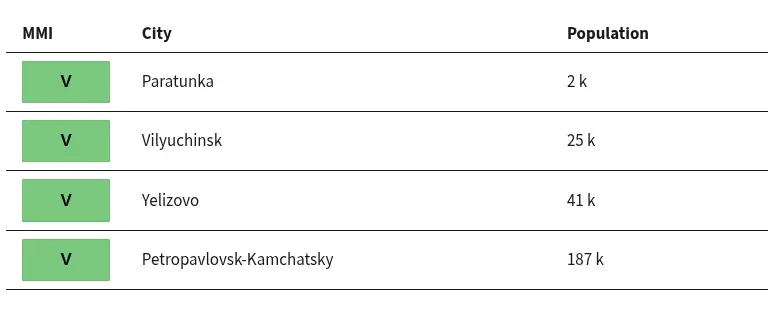
Selected cities exposed
Regional seismicity

References:
1 M7.4 earthquake Kamchatka, Russia – USGS – July 20, 2025
2 M6.7 earthquake Kamchatka, Russia – USGS – July 20, 2025

Teo Blašković founded The Watchers in 2011 and edited it until 2026, covering seismic and volcanic activity, extreme weather, space weather and near-Earth objects. Articles on this page are his archive.
Published in the last 24 hours
- Strong El Niño reinforces above-normal winter precipitation outlook across southern and eastern U.S.
- Scientists directly observe how submarine landslides unfold in western Canada Epicenter
- Odisha evacuated 983,642 people before Phailin crossed near Gopalpur on 12 October 2013 with winds of 200-210 km/h gusting to 220, and 44 died, against 9,885 in the 1999 super cyclone. Cyclone Akvan crossed the same coast on 20 November 2026. Epicenter
- Lava fountains reached 1,900 feet (580 m) at Kīlauea Iki in 1959, the highest ever recorded at Kīlauea, as USGS forecasts episode 57 fountaining at Halemaʻumaʻu for November 22-26. Epicenter
