
True polar wander of 1.13 m (3.72 feet) linked to global dam-building from 1835 to 2011
Storage of water in artificial reservoirs shifted Earth’s rotational poles by 113 cm (44 inches) and caused a 21 mm (0.83 inches) global sea level drop between 1835 and 2011, according to new research published in Geophysical Research Letters. The study modeled the geophysical effects of 6 862 global reservoirs and found distinct pole movements aligned with major dam-building phases.
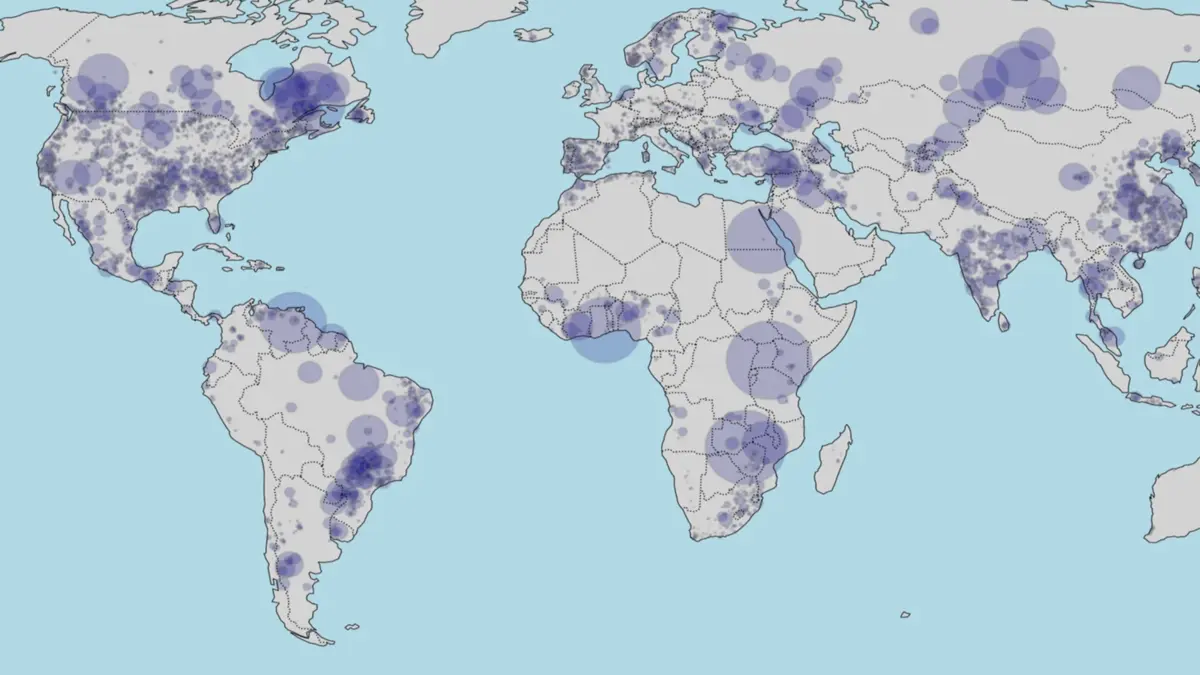
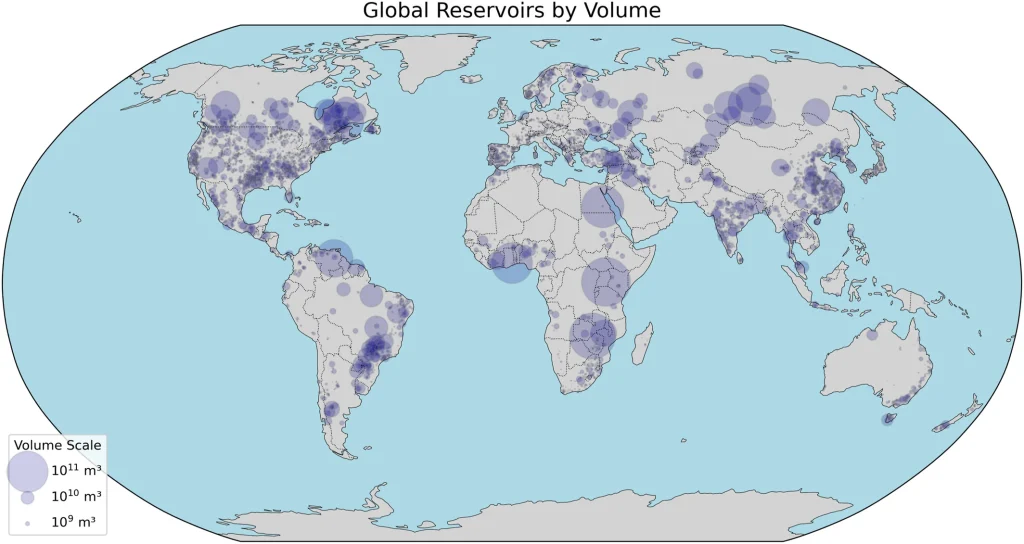
Reservoir locations in the Hawley et al. (2020) database. Location of 6 862 artificial reservoirs in the database adopted in this study. Symbol size is proportional to the logarithm of the reservoir capacity. Credit: Valencic et al.
New research published in Geophysical Research Letters finds that artificial water impoundment has contributed measurably to Earth’s true polar wander (TPW) over the past 175 years.
True polar wander refers to the shift of Earth’s entire solid outer shell, its crust and mantle, relative to the planet’s spin axis. As large masses like water are moved around the globe (e.g. by building reservoirs), the Earth gradually rebalances its outer shell to maintain rotational stability. This causes the geographic poles to migrate over time, even though the planet’s rotation axis in space remains fixed.
The study, led by Natasha Valencic, a graduate student in Earth and planetary sciences at Harvard University, integrated the global record of 6 862 reservoirs built between 1835 and 2011 to quantify the impact of redistributed water mass on Earth’s rotation axis.
Modeling of reservoir mass changes and secondary ocean redistribution reveals a total polar motion of 113.4 cm (3.7 feet) over the study period.
The outermost solid layer of Earth, which sits atop the planet’s molten interior, can move relative to the underlying magma when mass is shifted at the surface. Redistribution of mass, such as the trapping of water in dams, causes the surface to move relative to the axis of rotation, altering the geographic position of the poles. This effect is analogous to placing a lump of clay on a spinning basketball, which causes a shift in the ball’s axis to maintain angular momentum.
The study found that TPW due to artificial water storage occurred in two major phases. Between 1835 and 1954, dam construction was concentrated in North America and Europe, resulting in a 20.5 cm (8 inches) northward movement of the pole toward 103°E longitude, spanning Russia, Mongolia, and China. From 1954 to 2011, dam building intensified in East Africa and Asia, shifting the pole 57 cm (22 inches) toward 117°W, along the western United States and the South Pacific.
Overall, about 104 cm (41 inches / 1.04 m / 3.4 feet) of the total pole movement occurred in the 20th century, reflecting the acceleration of dam construction during this period. The combined reservoirs hold enough water to fill the Grand Canyon twice, demonstrating the scale of anthropogenic surface mass redistribution.
Beyond pole shift, this artificial impoundment caused a 21 mm (0.83 inches) decline in global mean sea level, as water that would otherwise contribute to ocean volume is stored inland. This effect represents roughly a quarter of the 20th century’s mean annual sea level rise of 1.2 mm (0.047 inches), according to the study’s lead author, Natasha Valencic of Harvard University.
Valencic noted, “As we trap water behind dams, not only does it remove water from the oceans, thus leading to a global sea level fall, it also distributes mass in a different way around the world. We’re not going to drop into a new ice age, because the pole moved by about a meter (3 feet) in total, but it does have implications for sea level.”
The findings show that water impoundment from dams is a significant component in the true polar wander budget and must be included in assessments of future sea level rise and the interpretation of polar motion data. The geometry of future sea level rise will also depend on where new reservoirs are constructed, since local sea level response is sensitive to the spatial pattern of surface mass changes.
The database used for this research covers almost 7 000 dams globally and represents 72% of all water impounded by artificial reservoirs; analysis shows that the missing 28%, mainly smaller reservoirs, would not significantly alter the results.
This research demonstrates the planetary-scale geophysical impact of human engineering, providing crucial insight into the role of artificial water storage in Earth’s rotational and sea level changes.
References:
1 True Polar Wander Driven by Artificial Water Impoundment: 1835–2011 – N. Valencic, E. Speiser et al. – Geophysical Research Letters – https://doi.org/10.1029/2025GL115468 – May 23, 2025

I’m a science journalist and researcher at The Watchers, contributing to the Epicenter edition, where I cover peer-reviewed scientific research and emerging discoveries across Earth and space sciences. With a background in astronomy and a passion for environmental science, I’ve worked in shark and coral conservation in Fiji, conducting reef and shark-behavior research, contributing to mangrove restoration, and earning PADI Open Water and Coral Reef Certifications. I bring a blend of scientific rigor and storytelling to illuminate the discoveries shaping our planet and beyond.

I call……..BS!!!!
Who believes this NONSENSE?!
No mention of the weight of Mega large Cement Cities causing an imbalance too.
Next I’m waiting for a study on Global temperature rise due to the Millions apon Millions of vehicles, generating heat on Sun baking parking lots and engines generating heat on hot asphalt roads and so on. then we have the amount of everyday release of fecal matter from man and animals, the study list of impacts on the blue spinning ball named Earth will get more attention as AL will reveal in time.