
Origins of gold traced to extreme explosions of collapsed stars
A new study suggests magnetar giant flares, like the 2004 event from SGR 1806-20, could produce gold and up to 10% of the galaxy’s heavy elements. Published in The Astrophysical Journal Letters on April 29, 2025, by Anirudh Patel et al., it uses NASA and ESA data to link these flares to heavy element synthesis.

A rupture in the crust of a highly magnetized neutron star, shown here in an artist’s rendering, can trigger high-energy eruptions. Credit: NASA’s Goddard Space Flight Center/S. Wiessinger
Gold may not come from where you think. According to new research, some of the gold found in objects like phones and laptops could have been forged in violent magnetar explosions billions of years ago.
In December 2004, the magnetar SGR 1806-20, 28 400 light-years away, emitted a giant flare observed by NASA’s RHESSI and ESA’s INTEGRAL satellites. A delayed gamma-ray signal, peaking 10 minutes later, indicated rapid neutron capture (r-process) producing gold and other heavy elements.
“It’s answering one of the questions of the century,” said Anirudh Patel, lead author and doctoral student at Columbia University.
The study, published in The Astrophysical Journal Letters, used 20-year-old archival data from NASA and ESA telescopes to estimate that the flare ejected one-millionth of a solar mass of r-process material. This included gold, silver, and uranium, contributing 1% to 10% of the galaxy’s heavy element inventory. The flare’s energy reached 1046 erg in less than a second.
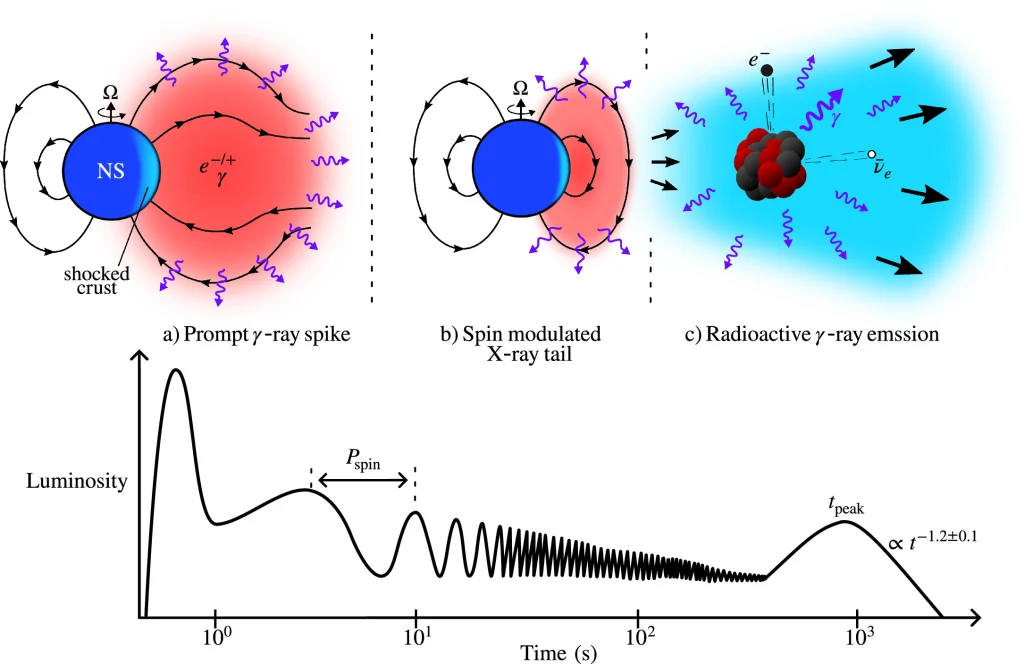
Magnetars, neutron stars with magnetic fields trillions of times stronger than Earth’s, trigger giant flares when their crust fractures. This ejects material at 10% the speed of light, enabling r-process synthesis of nuclei like gold, with atomic masses above 130. The process involves an alpha-rich freeze-out in the ejected material.
The delayed gamma-ray emission, detected from 400 to 12 000 seconds, showed a power-law decay index of 1.2, matching r-process decay predictions. Its fluence, 9 × 10⁻⁴ erg cm-2, supports models of gold and heavy element production.
“It was noted at the time, but nobody had any conception of what it could be,” said co-author Eric Burns on the signal’s initial mystery.

Konus-WIND data measured a fluence of 2 × 10⁻⁴ erg cm-2 in the 80–750 keV range, while RHESSI recorded thermal bremsstrahlung at 1.9 MeV. SkyNet simulations confirmed the gamma-ray signature as r-process decay.
Magnetar flares, unlike delayed neutron star mergers, occur soon after star formation, potentially seeding early stars with gold and other elements. This could explain their presence in metal-poor stars. Only three such flares have been observed in our galaxy and the Large Magellanic Cloud.

The flare’s ejecta may accelerate heavy nuclei, including gold, into cosmic rays, potentially surpassing other sources. Hydrodynamical simulations supported the ejection mechanism.
“It’s very cool to think about how some of the stuff in my phone or my laptop was forged in this extreme explosion,” Patel said.
NASA’s COSI mission, launching in 2027, will aim to detect specific isotopes in future flares, enhancing gold production studies. A UV/optical signal from these events may also be observable.
References:
1 Direct Evidence for r-process Nucleosynthesis in Delayed MeV Emission from the SGR 1806-20 Magnetar Giant Flare – Anirudh Patel et al. – The Astrophysical Journal Letters – April 29, 2025 – https://doi.org/10.3847/2041-8213/adc9b0 – OPEN ACCESS
2 Where Does Gold Come From? NASA Data Has Clues – NASA – April 29, 2025

I’m a science journalist and researcher at The Watchers, contributing to the Epicenter edition, where I cover peer-reviewed scientific research and emerging discoveries across Earth and space sciences. With a background in astronomy and a passion for environmental science, I’ve worked in shark and coral conservation in Fiji, conducting reef and shark-behavior research, contributing to mangrove restoration, and earning PADI Open Water and Coral Reef Certifications. I bring a blend of scientific rigor and storytelling to illuminate the discoveries shaping our planet and beyond.

This is total nonsense as far as the Earth is concerned and its geomorphic make up.