
Toxic metals pollute 17% of global cropland, threatening food safety
A new study reveals that 14–17 % of global cropland, roughly 242 million ha (598 million acres), is contaminated with toxic metals, affecting food safety for up to 1.4 billion people. The contamination, driven by metals like cadmium and nickel, poses risks to agriculture and human health worldwide.

Global soil pollution by toxic metals exceeding agricultural thresholds. Credit: Deyi Hou, Xiyue Jia, Liuwei Wang et al. / Science 2025
A study published in Science on April 18, 2025, found that 14–17 % of global cropland is contaminated with toxic metals surpassing safe amounts. The contaminated area spans about 242 million ha (598 million acres), affecting food production in areas vital to global supply chains. Researchers analyzed seven metals—arsenic, cadmium, cobalt, chromium, copper, nickel, and lead—with cadmium showing the highest exceedance rate at 9%.
The study estimates that 0.9 –1.4 billion people live in areas where soil contamination threatens public health and ecosystems. Approximately 6.8% of surficial soil exceeds safe thresholds, which are less stringent than agricultural limits. High-risk zones include northern India, southern China, Pakistan, Bangladesh, and parts of Africa and the Middle East.

Researchers identified a “metal-enriched corridor” across low-latitude Eurasia, extending from southern Europe to southern China. This region, historically associated with civilizations such as the Roman, Persian, and Chinese, has higher metal concentrations due to legacy mining and smelting. Natural processes, including weathering of metal-rich rocks, also contribute to contamination.
Cadmium contamination is widespread, affecting croplands in countries like India, China, Ethiopia, and Nigeria. Cadmium accumulates in staple crops such as rice, posing significant risks to food safety. Nickel and chromium are also high, with exceedance rates of 5.8% and 3.2%, respectively, concentrated in the Middle East and eastern Africa.
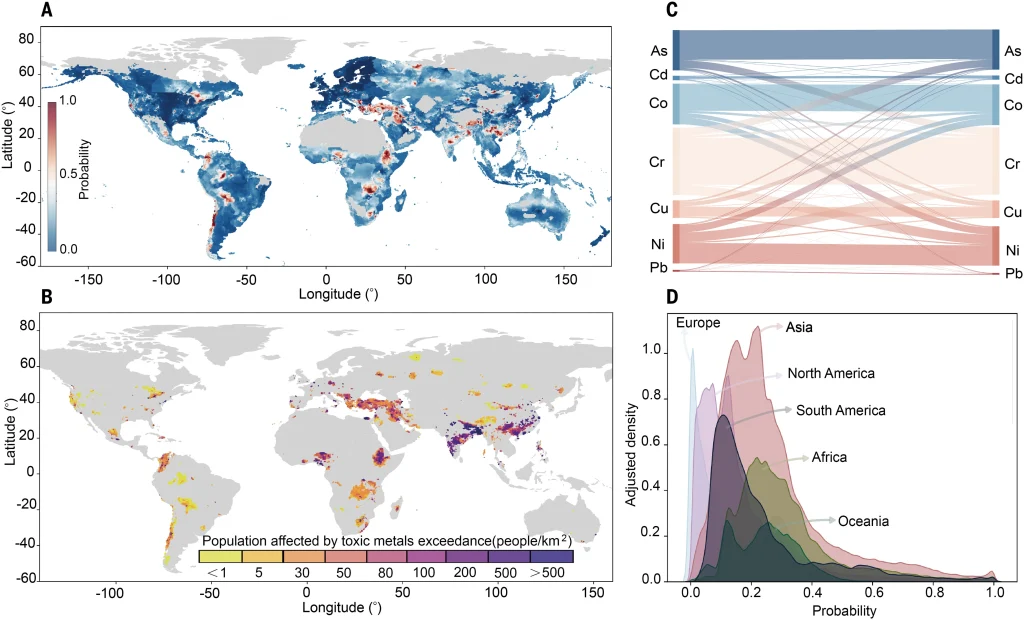
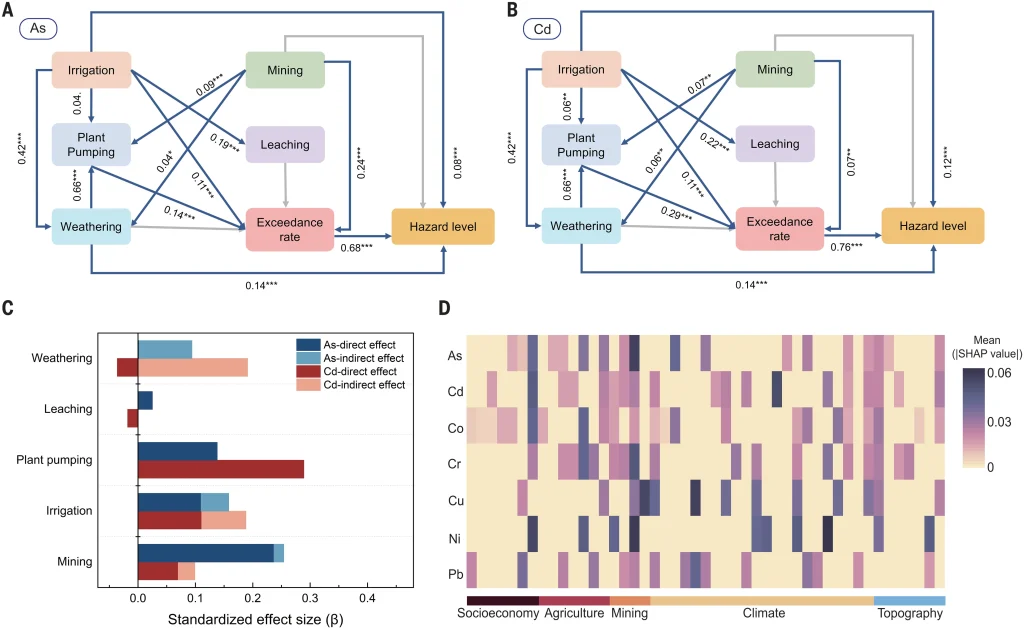
Natural factors, such as elevated temperatures and heavy rainfall, also contribute to metal contamination by rock weathering. Subtropical monsoon zones exhibit a 34% exceedance rate, compared to the global average of 15.7%. High-elevation regions with steep slopes, such as hilly terrain, experience up to 29% exceedance due to erosion.
Mining and irrigation significantly contribute to soil pollution. Regions with intensive mining and irrigation exhibit exceedance rates of 36%, more than double the global average. Irrigation using contaminated water sources, particularly in mining-intensive areas, further worsens contamination.
The study used machine learning to analyze 796 084 soil samples from 1 493 regional studies, mapping contamination across a 10 km (6 mile) grid. Models were validated with independent data, ensuring high accuracy.
Countries dependent on exports from contaminated cropland are particularly vulnerable. The study also shows that increasing demand for metals in green technologies, such as batteries, may increase soil pollution.
References:
1 Global soil pollution by toxic metals threatens agriculture and human health – Deyi Hou, Xiyue Jia, Liuwei Wang et al. – Science – April 17, 2025 – https://doi.org/10.1126/science.adr5214 – OPEN ACCESS

I’m a science journalist and researcher at The Watchers, contributing to the Epicenter edition, where I cover peer-reviewed scientific research and emerging discoveries across Earth and space sciences. With a background in astronomy and a passion for environmental science, I’ve worked in shark and coral conservation in Fiji, conducting reef and shark-behavior research, contributing to mangrove restoration, and earning PADI Open Water and Coral Reef Certifications. I bring a blend of scientific rigor and storytelling to illuminate the discoveries shaping our planet and beyond.

“This region, historically associated with civilizations such as the Roman, Persian, and Chinese, has higher metal concentrations due to legacy mining and smelting. Natural processes, including weathering of metal-rich rocks, also contribute to contamination.”
I wish the article went into more detail about what legacy mining and smelting is. To put it another way, it would be interesting to understand how human activity so contributed to this phenomenon.