
Oxford study suggests Earth’s water formed naturally during accretion, challenging the dominant theory of water delivery
A new study from the University of Oxford shows that Earth’s building blocks contained sufficient hydrogen to form water internally, challenging the prevalent theory that water was delivered mainly by asteroids or comets.
Image credit: NASA/ISS
A study published this month in Icarus, by researchers at the University of Oxford, identifies pyrrhotite, an iron sulfide mineral, as the primary host of hydrogen in enstatite chondrites (ECs).
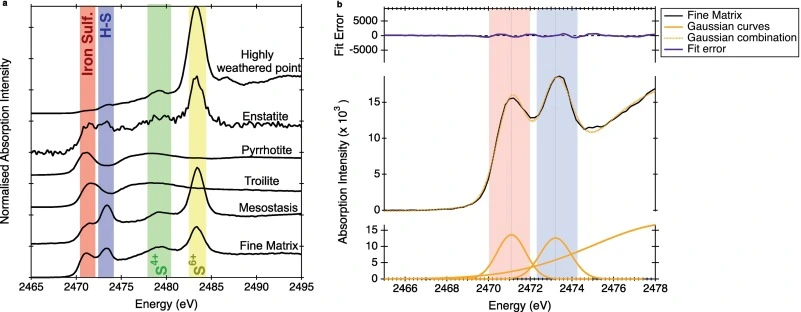
Using micrometre-scale X-ray Absorption Near Edge Structure spectroscopy (S-XANES), the team mapped the EH3 chondrite LAR 12252 and detected hydrogen–sulfur bonds in pyrrhotite. This mineralogical identification suggests that ECs may have been a primary source of Earth’s hydrogen and, by extension, its water.
The hydrogen in ECs is likely native, not a result of terrestrial weathering. The study focused on LAR 12252, a meteorite with minimal alteration, and found no correlation between hydrogen-sulfur bonds and oxidized sulfur from weathering. This indicates that the hydrogen was present when the meteorite formed, strengthening the case for ECs as Earth’s building blocks.
The findings show that Earth’s water may not rely on delivery from outer solar system bodies like comets or carbonaceous chondrites. Enstatite chondrites, with isotopic similarities to terrestrial rocks, could have provided sufficient hydrogen during Earth’s accretion.
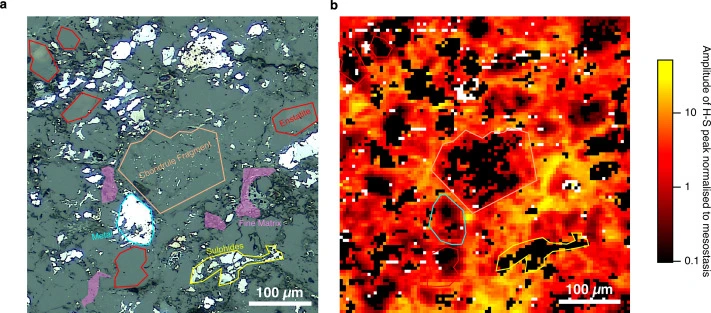
The meteorite LAR 12252, collected from Antarctica, was examined using X-Ray Absorption Near Edge Structure (XANES) spectroscopy at the Diamond Light Source in Harwell, Oxfordshire. The analysis showed hydrogen levels in the meteorite’s matrix were five times higher than in its chondrules. The hydrogen was identified as intrinsic, likely from hydrogen sulfide, not terrestrial contamination, due to its absence in oxidized sulfur samples.
Pyrrhotite, an iron sulfide mineral, was identified as the primary host for hydrogen in enstatite chondrites. Using micrometer-scale S-XANES, researchers detected hydrogen-sulfur bonds in the meteorite’s fine matrix, associated with pyrrhotite’s structural vacancies. This finding provides a mineralogical basis for hydrogen storage in these meteorites.
The XANES technique allowed precise mapping of hydrogen distribution, revealing its concentration in the meteorite’s fine matrix. The method, conducted at a synchrotron facility, builds on prior research published in Science in 2020.
Led by Tom Barrett, a DPhil student, and Associate Professor James Bryson from Oxford’s Department of Earth Sciences, the study provides new insights into planetary formation. The researchers noted that the hydrogen-rich nature of Earth’s building blocks could influence models of water on other planets. The findings contribute to ongoing debates in cosmochemistry.
The study says that hydrogen was mixed into pyrrhotite in the solar nebula under low-temperature, reducing conditions. Submicron iron sulfide grains likely transformed into pyrrhotite, capturing hydrogen in the process. This mechanism explains the presence of hydrogen in enstatite chondrites.

Challenging the dominant theory of water delivery
The findings of the study challenge the dominant theory that Earth’s water was delivered primarily by outer solar system bodies, such as carbonaceous chondrites or comets.
The prevailing view in planetary science holds that water arrived after Earth’s formation, brought by volatile-rich bodies originating beyond the snow line—regions of the early solar system cold enough for water ice to condense. Carbonaceous chondrites, and to a lesser extent comets, have been considered the main carriers.
This theory is supported by isotopic similarities, particularly in the deuterium-to-hydrogen (D/H) ratio, between Earth’s oceans and the water in some carbonaceous chondrites. These similarities have reinforced the hypothesis of late-stage delivery—often referred to as the late veneer model—where water and other volatiles were supplied during the final stages of planetary accretion.
Comets, while rich in water, are mostly excluded as major contributors due to their typically higher D/H ratios compared to Earth’s oceans.
However, recent measurements have shown that enstatite chondrites—meteorites formed in the inner solar system and isotopically similar to Earth’s mantle—contain more hydrogen than previously thought. This has prompted renewed investigation into whether Earth’s water could have originated, at least in part, from endogenous sources.
By demonstrating that hydrogen can be stored in iron sulfide minerals under reducing conditions present in the early solar system, the research reopens the question of how and where planetary water originates—both on Earth and potentially on other rocky planets formed under similar conditions.
References:
1 The source of hydrogen in earth’s building blocks – Thomas J. Barrett, James F.J. Bryson et al. – ScienceDirect – April 3, 2025 – https://doi.org/10.1016/j.icarus.2025.116588 – OPEN ACCESS

I’m a science journalist and researcher at The Watchers, contributing to the Epicenter edition, where I cover peer-reviewed scientific research and emerging discoveries across Earth and space sciences. With a background in astronomy and a passion for environmental science, I’ve worked in shark and coral conservation in Fiji, conducting reef and shark-behavior research, contributing to mangrove restoration, and earning PADI Open Water and Coral Reef Certifications. I bring a blend of scientific rigor and storytelling to illuminate the discoveries shaping our planet and beyond.

Commenting rules and guidelines
We value the thoughts and opinions of our readers and welcome healthy discussions on our website. In order to maintain a respectful and positive community, we ask that all commenters follow these rules.