
Study reveals how solar heat affects earthquake activity
A new study by researchers at the University of Tsukuba examined the role of solar heat in earthquake activity. By analyzing seasonal variations in seismicity, correlations between solar activity and earthquakes, and the influence of atmospheric temperature on earthquake predictability, the study provides new insights into how solar-driven thermal effects may contribute to stress changes in the Earth’s lithosphere.
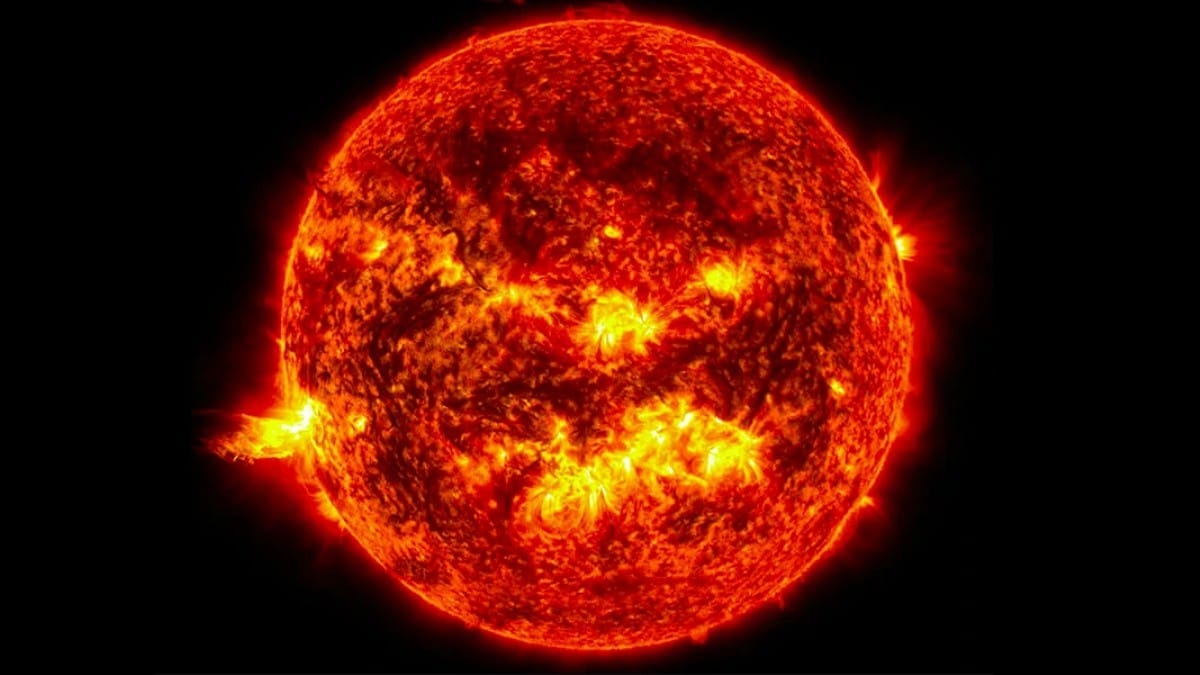
Image captured by NASA's Solar Dynamics Observatory on June 20, 2013 shows the bright light of a solar flare on the east side of the Sun. Credit: NASA/SDO
The study, led by Matheus Henrique Junqueira Saldanha, a Ph.D. candidate at the University of Tsukuba, and other university researchers, explores mechanisms by which the Sun affects seismic activity on Earth. It expands on a 2022 study by Saldanha and Yoshiro Hirata that established the causal influence of solar activity on earthquake activity on Earth. Hirata is also a contributor to the current study.
“Among the methods we use, one of them is edit distances, which allows us to compare patterns of earthquake occurrence spread around a geographical area. Radial basis functions were used to process these distances and obtain estimated values of next-day maximum earthquake magnitude,” Saldanha told The Watchers.
He also added that they used delay-coordinate embeddings on sunspot and surface temperature data to use them with radial basis functions.
The study analyzed earthquakes worldwide from January 1, 2000, to August 31, 2021, using earthquake catalogs from multiple global sources and solar data, including sunspot numbers and atmospheric temperatures. It found that seismic activity shows seasonal variations that correspond with changes in solar irradiation, indicating a significant impact of solar activity on earthquakes.

boundaries are shown in black. Image credit: The role of solar heat in earthquake activity, Matheus Henrique Junqueira Saldanha et al.
The paper explored different mechanisms through which solar activity could influence seismic activity. These include thermal stresses induced by solar heat affecting the Earth’s crust and indirect effects through changes in atmospheric and oceanic conditions.
One of the key findings was a delayed cause-effect relationship between solar activity and earthquakes. Solar heat takes time to get absorbed into deeper layers of the crust, delaying its effect on seismic activity. The delay depends on the location, the depth of geological features, and the thermal properties of the material in different regions.
The analysis found different delay periods for different regions to provide better earthquake forecasts. For Japan, a delay of around 30 days provided the best earthquake forecasting accuracy, while for other areas like the Balkans, longer delays ranging from 180 days to even a year provided the best results.

boundaries are shown in black. Image credit: The role of solar heat in earthquake activity, Matheus Henrique Junqueira Saldanha et al.
“Our findings provide new evidence that solar activity and atmospheric heat influence seismic activity. This adds an important piece to the puzzle of earthquake forecasting, suggesting that climate-related factors may play a more significant role than previously thought,” said Saldanha.
“Understanding these influences could help refine earthquake prediction models and improve our ability to anticipate seismic events,” he added.
References:
1 The role of solar heat in earthquake activity – Matheus Henrique Junqueira Saldanha, Masanori Shiro, Yuji Yagi, Yoshito Hirata – Chaos – March 1, 2025 – https://doi.org/10.1063/5.0243721

I am an Assistant Editor and Severe Weather & Science Journalist at The Watchers, specializing in real-time severe weather coverage, geophysical event reporting, and research-driven scientific analysis. You can reach me at rishav(at)watchers(.)news.

Commenting rules and guidelines
We value the thoughts and opinions of our readers and welcome healthy discussions on our website. In order to maintain a respectful and positive community, we ask that all commenters follow these rules.