
Moon’s farside shows signs of ongoing tectonic activity
Small-scale tectonic structures have been identified on the Moon’s farside maria and within the South Pole–Aitken (SPA) Basin, revealing recent and potentially ongoing contractional tectonism. The discovery challenges previous assumptions that tectonic activity on the Moon ceased billions of years ago.

A new map from the Lunar Reconnaissance Orbiter Camera (LROC) team displays all detectable craters on the Moon ranging from 5 to 20 km (3.1 to 12.4 miles) in diameter, represented by red circles. When combined with an existing dataset of craters larger than 20 km (12.4 miles) in diameter, variations in crater density across different regions provide insights into the Moon’s geologic history. Image credit: NASA/GSFC/Arizona State University
A new study has identified 266 small mare ridges (SMRs) on the Moon’s farside, including within the South Pole–Aitken (SPA) Basin, providing evidence of recent and potentially ongoing tectonic activity. The discovery challenges the long-standing assumption that the Moon has been geologically inactive for billions of years.
The research, conducted by scientists from the Smithsonian Institution, NASA’s Goddard Space Flight Center, and the University of Maryland, suggests that the Moon is still contracting due to interior cooling, generating compressional stresses that continue to shape its surface.
“Our findings show that lunar fault structures may be recently and potentially currently active within regions of interest for upcoming lunar missions,” C. A. Nypaver, the lead researcher stated.
Distribution of small mare ridges
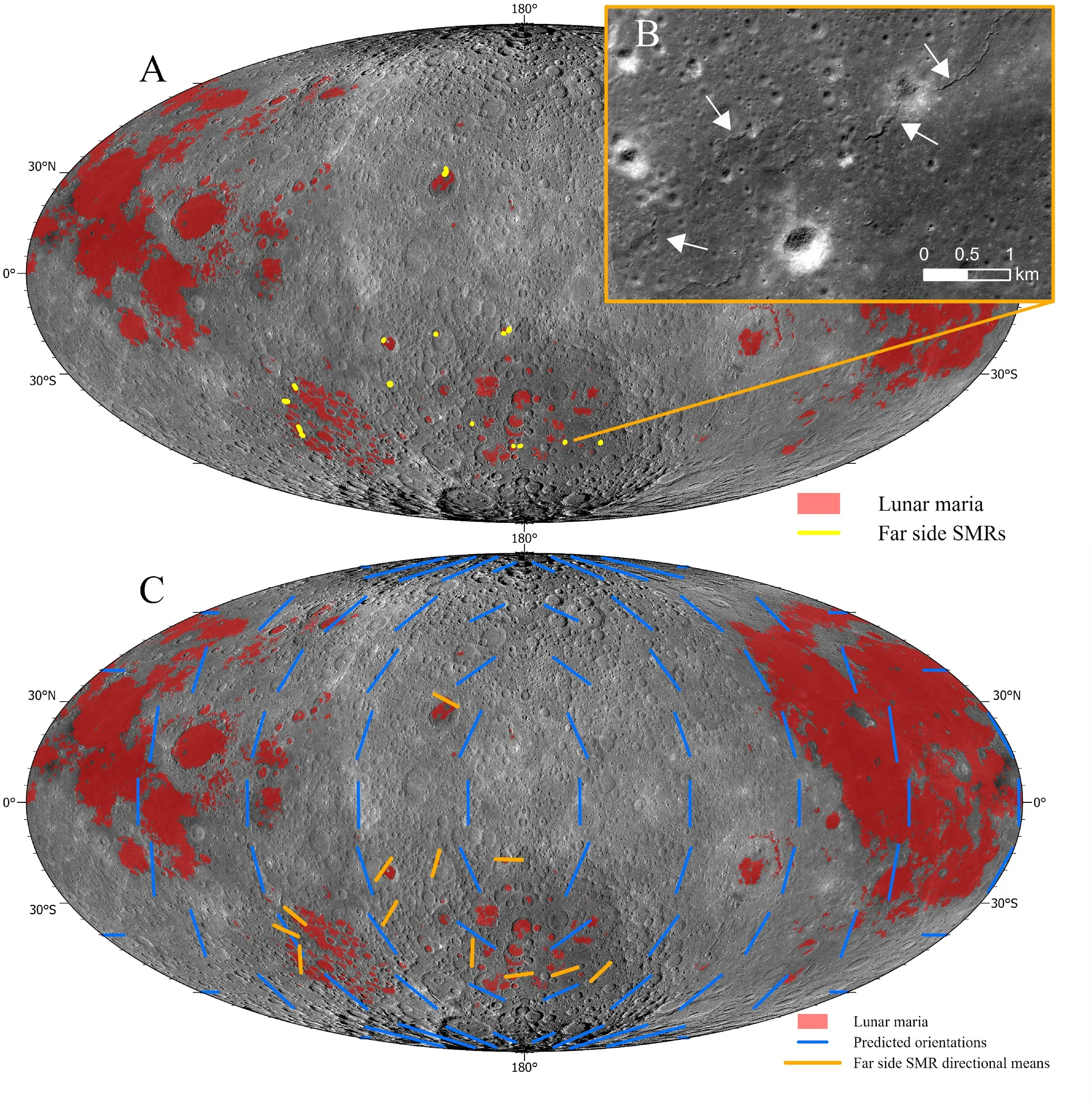
A total of 266 SMR segments have been mapped across the lunar farside within impact basin-confined mare deposits. The majority of the ridges are concentrated in the southern hemisphere, with clusters observed in the central SPA Basin, Tsiolkovskiy Crater, Bolyai Crater, Aitken Crater, Isaev Crater, and Mare Moscoviense.
The distribution of SMRs appears to be influenced by the geological history of the regions.
The SPA Basin, being one of the oldest impact structures on the Moon has a relatively thinner crust which may have allowed stress-induced tectonic features to develop more prominently. Areas with past volcanic activity, such as Mare Moscoviense, exhibit signs of tectonic deformation because of the gradual cooling and contraction of underlying basaltic lava deposits.
Farside SMRs are smaller in scale measuring approximately 1.1 to 1.7 km (0.68 to 1.05 miles) in length and around 55 to 96 m (180 to 315 feet) in width, unlike large-scale wrinkle ridges commonly found in the nearside maria. The orientation of farside SMRs does not always align with the expected patterns from global contraction, suggesting that additional localized stressors such as variations in crustal thickness and past impact events, may be playing a role in their formation.
The clustered nature of the ridges also raises questions about their formation timeline if they are remnants of ancient tectonic activity or have formed more recently. The relatively undegraded morphology of these structures suggests that they are relatively young, likely forming within the last 100 million years. It implies that tectonic processes on the Moon did not cease billions of years ago but have continued in some form up to the present day.
Age determination and activity timeline
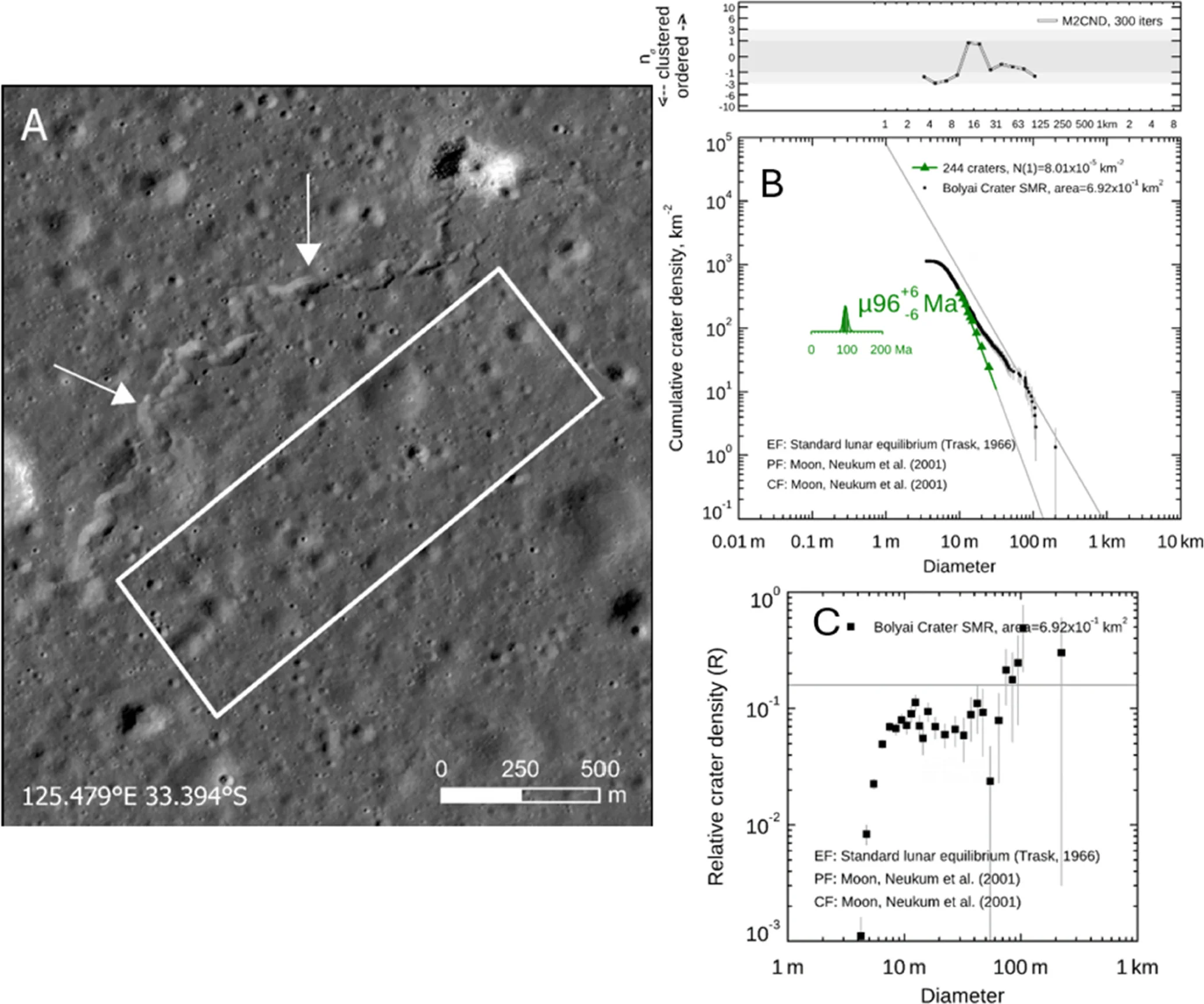
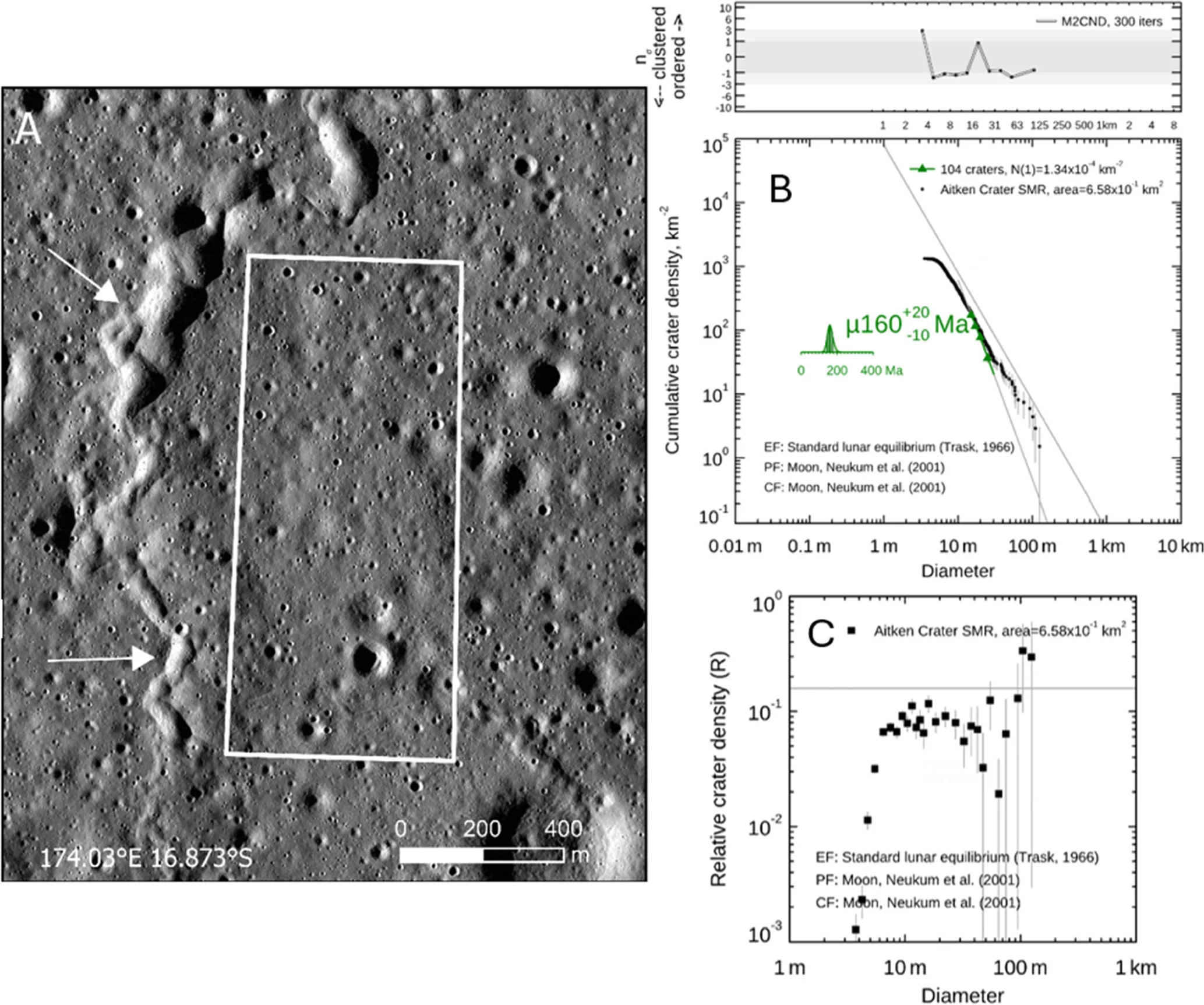
Researchers used crater size-frequency distribution (CSFD) measurements and diffusion age estimation of tectonically altered impact craters to establish the timeframe of SMR formation.
The methods analyze the density and size distribution of impact craters on or near the ridges which allows scientists to estimate how long these surfaces have been exposed to space weathering. The results indicate that SMRs have formed or been reactivated within the last 100 million years, with some estimated to be as young as 27 million years.
The study identified multiple impact craters that have been crosscut by SMRs, with the smallest observed crosscut crater measuring 6.2 m (20.3 feet) in diameter. Since impact craters accumulate at a known rate on the lunar surface, their presence, absence, or deformation provides a reliable timeline for tectonic activity. The SMRs cut through relatively small, young craters which confirms that the tectonic features have been active in geologically recent history.
The youngest estimated activity ages for SMR clusters are, South Pole–Aitken Basin (approximately 110 million years), Bolyai Crater (approximately 27 million years), and Aitken Crater (approximately 38 million years).
The findings align with earlier research on lunar lobate scarps which have shown evidence of seismic activity in the last 300 million years. The relatively young age of SMRs suggests that tectonic processes responsible for shaping the Moon are not just remnants of its early history but are still occurring and can be linked to global contraction and tidal forces.
The presence of recently formed SMRs indicates that the Moon’s surface is not static. The contraction of the Moon because of cooling along with tidal forces exerted by Earth’s gravity continues to generate stress and faulting within the lunar crust. It has direct implications for understanding lunar seismic activity which could pose a challenge for future human exploration and infrastructure on the Moon.
Fault structure and dislocation modeling
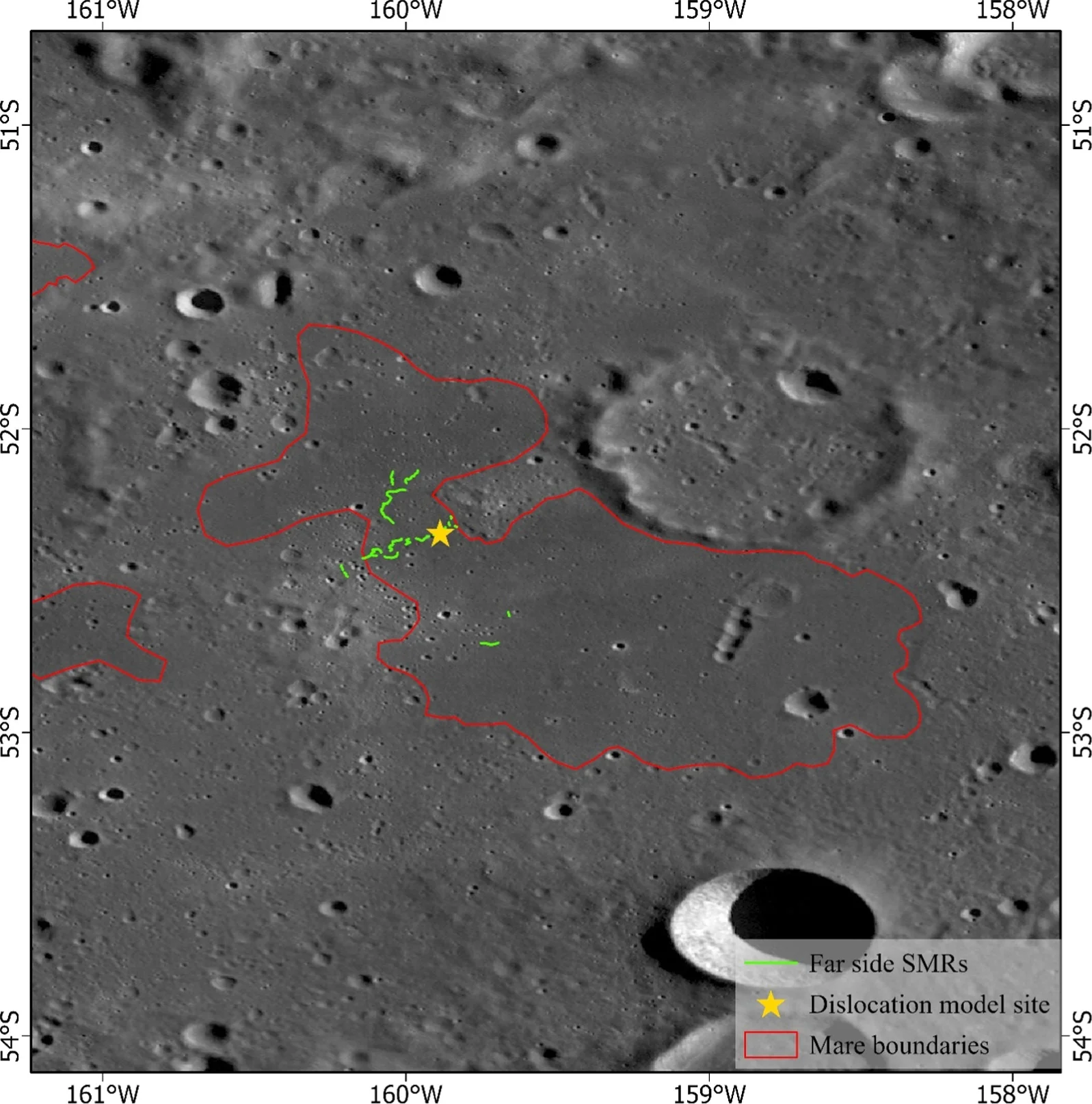
Researchers determined that SMRs are formed by shallowly rooted thrust faults using elastic dislocation modeling. The faults extend at depths ranging from 52 to 100 m (171 to 328 feet) and exhibit slip displacements between 7 and 45 m (23 and 148 feet). The dip angles range from 30° to 45°, meaning they are relatively steep compared to larger lunar thrust faults.
SMRs do not display a broad topographic arch unlike the prominent wrinkle ridges found in the nearside maria. The morphology of SMRs closely resembles lobate scarps which are formed by low-angle thrust faults. The study found that SMR-forming faults are among the smallest thrust faults identified in the upper lunar lithosphere indicating that these structures may be limited to the regolith and the uppermost layers of basalt.
Elastic dislocation modeling helps scientists understand the depth, extent, and mechanical behavior of these fault systems by simulating the movement of faults and the resulting surface deformations. The approach allows researchers to test different fault parameters and determine which best fits the observed SMR topography. The modeling results confirm that these faults are relatively shallow and that their activity is likely tied to ongoing compressional stresses acting on the lunar crust.
There is strong evidence that some of these faults may still be experiencing minor slip events given the young geological age of these features and their similarity to lobate scarps which have been linked to ongoing lunar seismicity.
Future missions equipped with seismometers could help detect moonquakes originating from these structures, confirming their present-day activity.
Formation mechanisms and implications for future missions
The formation of SMRs is believed to be driven by a combination of global contraction, orbital recession, and solid-body tides. The Moon contracts and generates stress within the crust as its interior cools over time. The stresses are combined with the gravitational influence of Earth and the Moon’s orbital evolution and create compressional forces that reawaken pre-existing faults and form new ones.
The presence of SMRs within narrow mare deposits suggests that localized stress concentrations may contribute to their development. In areas where the lunar crust is thinner or where previous volcanic activity has weakened the surface, stress may accumulate more easily and can lead to the formation of these ridges. The clustering of SMRs in impact basins also implies that past geological events have played a role in shaping their distribution.
The discovery of recently active tectonic structures on the lunar farside holds important implications for upcoming missions. The presence of active faults suggests that shallow moonquakes could still occur, posing potential hazards for long-term lunar habitation and infrastructure development. Seismic activity associated with these faults could affect structures built on the Moon’s surface, making site selection for future lunar bases an important consideration.
The upcoming missions including NASA’s Artemis program and planned robotic landers may help further investigate these structures by deploying seismometers to detect moonquakes. Understanding the frequency and intensity of seismic activity will provide the main data for the Moon’s internal and tectonic processes.
High-resolution imaging and subsurface radar could reveal more details about fault structures which will help to refine models of lunar tectonism.
References:
1 Recent Tectonic Deformation of the Lunar Farside Mare and South Pole–Aitken Basin, C. A. Nypaver, T. R. Watters and J. D. Clark, THE PLANETARY SCIENCE JOURNAL – January 21, 2025 – https://doi.org/10.3847/PSJ/ad9eaa – OPEN ACCESS

Rishika holds a Master’s in International Studies from Stella Maris College, Chennai, India, where she earned a gold medal, and an MCA from the University of Mysore, Karnataka, India. Previously, she served as a Research Assistant at the National Institute of Advanced Studies, Indian Institute of Science, Bengaluru, India. During her tenure, she contributed as a Junior Writer for Europe Monitor on the Global Politics website and as an Assistant Editor for The World This Week. Her work has also been published in The Hindu newspaper, showing her expertise in global affairs. Rishika is also a recipient of the Women Empowerment Award at the district level in Haryana, India, in 2022.

I have looked at the photographs in the above article, and didn’t see no usual volcanic debris around the craters.
I typed: moon craters thunderbolts project
in my web browser
I also found this link:
https://watchers.news/2015/07/10/our-electrically-scarred-moon/
Did you know, the Moon gets lightning scarred as well (as Earth and other astronomical bodies in our solar system. And craters can be produced by lightning. Would you like me to share a link by independent scientists?
https://www.youtube.com/watch?v=XwhtHUiAOjM
They didn’t do it for money, they are honest truth seekers-finders. I am so honoured to be acquainted with some of their work.
“As telescopes advanced in their resolving power, the structure of lunar craters was found to be anomalous.
Flat floors and central peaks characterize a significant percentage of lunar craters. The majority of those that remain are well-defined, conical holes with clean sides and no evidence of debris surrounding them. Rather, they appear melted with slumping walls in some cases.
If the conductive surface carries a negative charge, an arc will travel, sometimes eroding elongated craters, like those under discussion.
Electromagnetic forces between Birkeland currents constrained to a surface will force them into alignment. Ionic winds can lift material and carry it along in the direction of the current flow, thus explaining the “rays” associated with the Messier craters.
An interesting note is that there is no magnetosphere on the Moon, but some areas possess an “impressed” magnetic field.”
https://www.thunderbolts.info/wp/2011/09/12/skipping-moon-stones/
Thank you for your good work!
With Respect
Thank you, Eva. Yes, we are familiar with their work.