
Series of explosions and exhalations at Telica volcano, Nicaragua
Volcanic activity at Telica volcano in Nicaragua increased on January 11, 2025, with 91 gas and ash emissions observed by January 14, reaching heights of up to 200 m (656 feet).
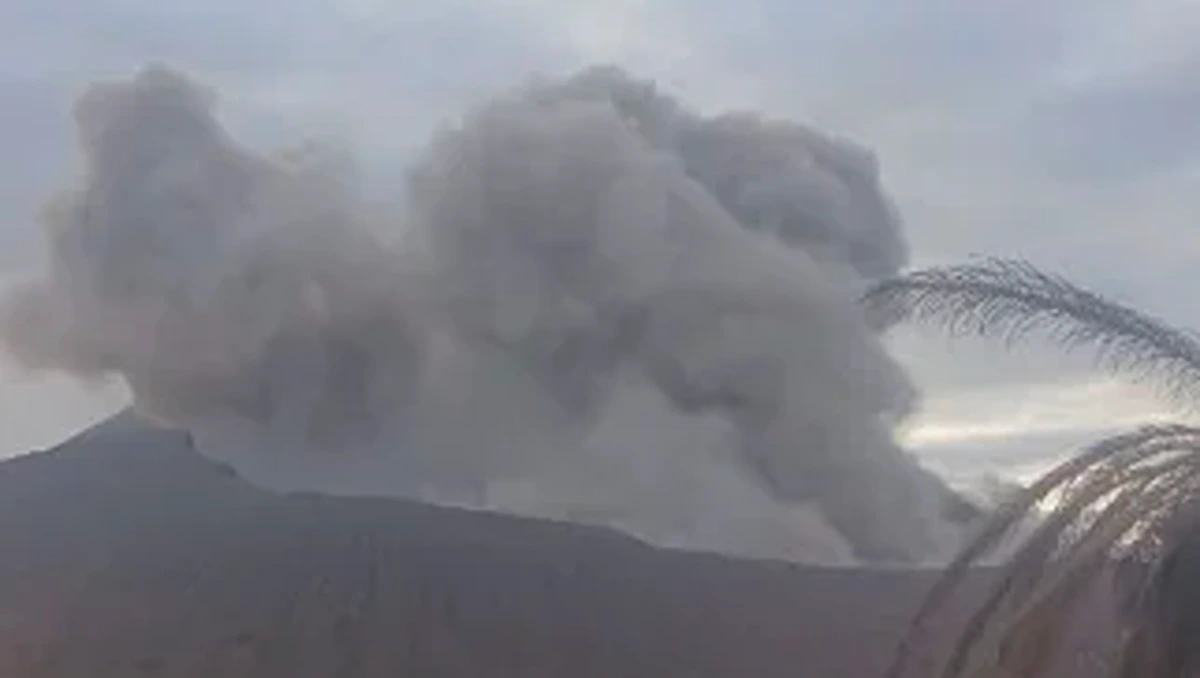
Image credit: INETER
The Instituto Nicaragüense de Estudios Territoriales (INETER) reported an increase in activity at Telica Volcano, beginning at 15:53 LT (21:53 UTC) on January 11, 2025, with 91 gas and ash emissions over the next three days.
INETER recorded 40 emissions from January 11 to 22:40 UTC on January 13. Activity included the release of ash, gas, and water vapor with ash plumes reaching 150 m (490 feet) above the summit. The emissions dissipated rapidly toward the north and southwest.
The volcano experienced 4 small explosions and ejected ash and gas between 04:14 and 05:55 UTC on January 14. The events were accompanied by ballistic rock fragments that traveled approximately 50 m (164 feet) from the summit along the volcano’s slopes.
The most recent exhalation released gas, steam, and ash forming a column of 200 m (656 feet) above the summit at 15:42 UTC on January 14.
INETER volcanologists warned of the possibility of continued emissions in the coming hours or days. The potential for larger ash columns and falling ash in nearby communities persists.
Residents are advised to cover water and food supplies, keep flashlights and damp cloths readily available, and avoid approaching or climbing the volcano to mitigate risks.
INETER also recommended that the public and tourists avoid approaching or climbing Telica Volcano because of safety concerns.

The Telica Volcano is one of Nicaragua’s most active volcanoes and is characterized by its steep-sided cone and a double crater measuring 700 m (2 297 feet) in width and 120 m (394 feet) in depth. The last eruption took place on March 30, 2022.
Historical data reveals frequent activity since the 16th century.
References:
1 Telica volcano – Nicaragua – INETER – Accessed on January 14, 2025
2 Telica – GVP – Accessed on January 14, 2025

Rishika holds a Master’s in International Studies from Stella Maris College, Chennai, India, where she earned a gold medal, and an MCA from the University of Mysore, Karnataka, India. Previously, she served as a Research Assistant at the National Institute of Advanced Studies, Indian Institute of Science, Bengaluru, India. During her tenure, she contributed as a Junior Writer for Europe Monitor on the Global Politics website and as an Assistant Editor for The World This Week. Her work has also been published in The Hindu newspaper, showing her expertise in global affairs. Rishika is also a recipient of the Women Empowerment Award at the district level in Haryana, India, in 2022.
Published in the last 24 hours
- Scientists directly observe how submarine landslides unfold in western Canada Epicenter
- Odisha evacuated 983,642 people before Phailin crossed near Gopalpur on 12 October 2013 with winds of 200-210 km/h gusting to 220, and 44 died, against 9,885 in the 1999 super cyclone. Cyclone Akvan crossed the same coast on 20 November 2026. Epicenter
- Lava fountains reached 1,900 feet (580 m) at Kīlauea Iki in 1959, the highest ever recorded at Kīlauea, as USGS forecasts episode 57 fountaining at Halemaʻumaʻu for November 22-26. Epicenter
- Novarupta in Alaska erupted about 3 cubic miles of magma in roughly 60 hours from 6 June 1912, 30 times Mount St. Helens in 1980, and strong northwesterly winds lifted that same loose ash on 16 November 2026, prompting an NWS SIGMET. Epicenter
