
Asteroid A11dc6D (2024 UQ) impacts Earth over eastern Pacific Ocean — 10th predicted Earth impactor on record
A small asteroid, currently designated A11dc6D, impacted Earth’s atmosphere over the eastern Pacific Ocean at 10:54 UTC on October 22, 2024. This marks the 10th recorded instance of an asteroid being detected prior to impacting Earth, and the third occurrence of such an event this year. The asteroid was later officially named 2024 UQ.

Satellite image of asteroid 2024 UQ (A11dc6D) impacting Earth over eastern Pacific Ocean on October 22, 2024. Image credit: NOAA/GOES-West, RAMMB/CIRA, The Watchers
According to data provided by the Center for Near-Earth Object Studies (CNEOS), A11dc6D entered Earth’s atmosphere at a location far off the western coast of Mexico and the Baja California Peninsula, approximately 2 660 km (1 653 miles) from Los Angeles, California. The entry point was precisely at 30.0°N latitude and 136.0°W longitude.
Asteroid A11dc6D was detected by the ATLAS (Asteroid Terrestrial-impact Last Alert System) survey, U.S. just several hours before its impact. ATLAS is designed to detect smaller asteroids that might impact Earth with little warning, providing alerts just hours or days in advance of a potential impact.
Preliminary measurements indicate the object was about 1 m (3.3 feet) in diameter, which is typical for small asteroids that tend to disintegrate in Earth’s atmosphere before reaching the surface.
Upon entering Earth’s atmosphere, A11dc6D reached its peak brightness at an altitude of 38.2 km (23.7 miles). Entry velocity was estimated at approximately 12.6 km/s (7.8 miles/s).
The impact of A11dc6D released an estimated 0.15 kilotons of energy, comparable to a small conventional explosion. The total radiated energy from the event was recorded at 4.5 x 10¹⁰ joules. While this is not enough energy to cause significant damage, impacts such as this prove the importance of tracking even small Near-Earth Objects (NEOs).
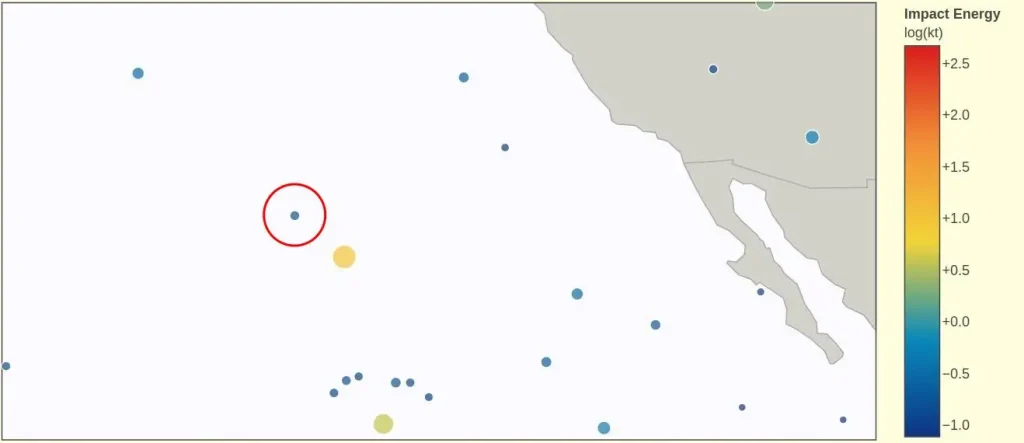

The detection of asteroid A11dc6D marks the 10th successful prediction of an asteroid impact on record and 3rd so far this year, marking a significant advancement in early detection capabilities.
Among the most notable is 2008 TC3, which impacted the Nubian Desert in Sudan on October 7, 2008. This asteroid, about 4 m (13.1 feet) in diameter, released 1 kiloton of energy upon entering Earth’s atmosphere. What makes this impact particularly significant is the recovery of over 600 meteorites, with a total weight of approximately 11 kg (24 pounds). The materials collected from this event have provided valuable insights into the composition of asteroids.
Another high-energy impact occurred with 2019 MO, which impacted Earth over Puerto Rico on June 22, 2019. This asteroid was larger, at 5 m (16.4 feet) in diameter, and released 6 kilotons of energy—one of the highest recorded in such events. While no meteorites were recovered due to the impact occurring over water, this event was still significant for its detection and tracking by radar.
One of the more scientifically valuable impacts was 2018 LA, which entered Earth’s atmosphere over Botswana on June 2, 2018. This asteroid, about 3 m (9.8 feet) in diameter, released 0.4 kilotons of energy. The event led to the recovery of at least 24 meteorites, which were later identified as being ejected from the asteroid Vesta. The meteorites contained Howardite-Eucrite-Diogenite (HED) materials, which are of great interest to scientists studying the early solar system.
Asteroid 2024 BX1 impacted Earth’s atmosphere over Berlin, Germany, on January 21, 2024. This asteroid, estimated to be between 0.7 and 1.6 m (2.23 – 5.2 feet) in diameter, did not release a significant amount of energy, but around 200 meteorites were recovered, with a total weight of 1.8 kg (3.9 pounds). This made it one of the more notable recent impacts for meteorite recovery, providing further material for study.
Most recently 2024 RW1 entered Earth’s atmosphere over Luzon, Philippines at 16:39 UTC on September 3, 2024. This asteroid, measuring between 1.1 and 2.4 m (3.6 – 7.9 feet) in diameter, released 0.2 kilotons of energy. While the energy release was moderate compared to other impacts, the event created a spectacular fireball. However, no meteorites were reported to have been recovered from this impact, likely due to the location over water.
Find more details and links to videos in the table below:
Predicted Earth impactors
Updated at 11:20 UTC on May 16, 2026| Object / Type | Discovery date (UTC) | Impact date (UTC) | Impact location | Dimensions (~) | Energy released (kt) | Notes |
|---|---|---|---|---|---|---|
| 2008 TC3 (Apollo) | October 6, 2008 at 06:39 | October 7, 2008 at 02:46 | Nubian desert, Sudan | 4 m (13.1 feet) | 1 | 600 meteorites found. Total weight 11 kg. |
| 2014 AA (Apollo) | January 1, 2014 at 06:18 | January 2, 2014 at 03:06 | Atlantic Ocean | 3 m (9.8 feet) | 0.5 – 0.1 | – |
| 2018 LA (Apollo) | June 2, 2018 at 08:22 | June 2, 2018 at 16:44 | Botswana/South Africa | 3 m (9.8 feet) | 0.4 | At least 24 meteorites found. Ejected by asteroid Vesta. Howardite-Eucrite-Diogenite (HED) type material |
| 2019 MO (Apollo) | June 22, 2019 at 07:24 | June 22, 2019 at 21:25 | Puerto Rico | 5 m (16.4 feet) | 6 | Possibly Alinda asteroid. NEXRAD weather radar detected falling meteorites over water. |
| 2022 EB5 (Apollo) | March 11, 2022 at 19:24 | March 11, 2022 at 21:22 | Jan Mayen Island, Norway | 1 m (6.4 feet) | 2 | – |
| 2022 WJ1 (Apollo) | November 19, 2022 at 04:53 | November 19, 2022 at 08:27 | Ontario, Canada | 1 m (3.2 feet) | – | Most meteorites fell in water. |
| 2023 CX1 (Apollo) | February 12, 2023 at 20:18 | February 13, 2023 at 02:59 | Normandy, France | 1 m (3.2 feet) | – | Over 22 meteorites. |
| 2024 BX1 (Apollo) | January 20, 2024 at 20:48 | January 21, 2024 at 00:33 | Berlin, Germany | 0.7 – 1.6 m (2.23 – 5.2 feet) / ~140 kg | – | About 200 meteorites. Total weight 1.8 kg. |
| 2024 RW1 (Apollo) | September 4, 2024 at 05:43 | September 4, 2024 at 16:39 | Luzon, Philippines | 1.1 – 2.4 m (3.6 – 7.9 feet) | 0.2 | – |
| 2024 UQ | October 22, 2024 | October 22, 2024 at 10:54 | Eastern Pacific Ocean | 1 m (3.2 feet) | 0.15 | – |
| 2024 XA1 | December 3, 2024 at 05:55 | December 3, 2024 at 16:15 | Siberia, Russia | 70 cm (2.3 feet) | – | – |
| 2026 JN4 | May 15, 2026 at 08:08 | May 15, 2026, at 13:44 | Arafura Sea region | 0.65 – 1.4 m (2.1 – 4.5 feet) | – | – |
Update
08:50 UTC, October 24
More details have emerged about this asteroid as well as its official designation as 2024 UQ.
According to the Minor Planet Center (MPC), the first detection of this fast-moving object was reported by H. Weiland of ATLAS-HKO (T05) on October 22 (UTC). Shortly after its posting on NEOCP, automated monitoring systems by JPL (Scout) and ESA (Meerkat) identified a high probability of impact with Earth.
The predicted impact time was several hours before the object was submitted to MPC. M. Micheli (ESA/NEOCC) later identified a potential flash in the GOES (GLM) satellite imagery, corresponding to the approximate time and location of the expected impact.
Micheli subsequently found precovery detections in the Catalina Sky Survey (703) images. USG reported the event to the JPL’s Fireball database, confirming the atmospheric entry at 10:54:48 UTC on October 22.
References:
1 Fireball and bolide data – CNEOS – Accessed October 23, 2024
2 MPEC 2024-U49 : 2024 UQ – Minor Planet Center – Accessed October 24, 2024

I'm a dedicated researcher, journalist, and editor at The Watchers. With over 20 years of experience in the media industry, I specialize in hard science news, focusing on extreme weather, seismic and volcanic activity, space weather, and astronomy, including near-Earth objects and planetary defense strategies. You can reach me at teo /at/ watchers.news.

Commenting rules and guidelines
We value the thoughts and opinions of our readers and welcome healthy discussions on our website. In order to maintain a respectful and positive community, we ask that all commenters follow these rules.