
Meteorite damages homes in Koblenz, Germany after bright fireball
A bright fireball crossed the sky over western Europe at 17:55 UTC (18:55 local time) on March 8, 2026, producing meteorites that struck residential buildings in Koblenz, Rhineland-Palatinate, Germany. Several fragments penetrated roofs in the city’s Güls district and damaged houses, while meteorites were recovered shortly after the event. No injuries were reported.
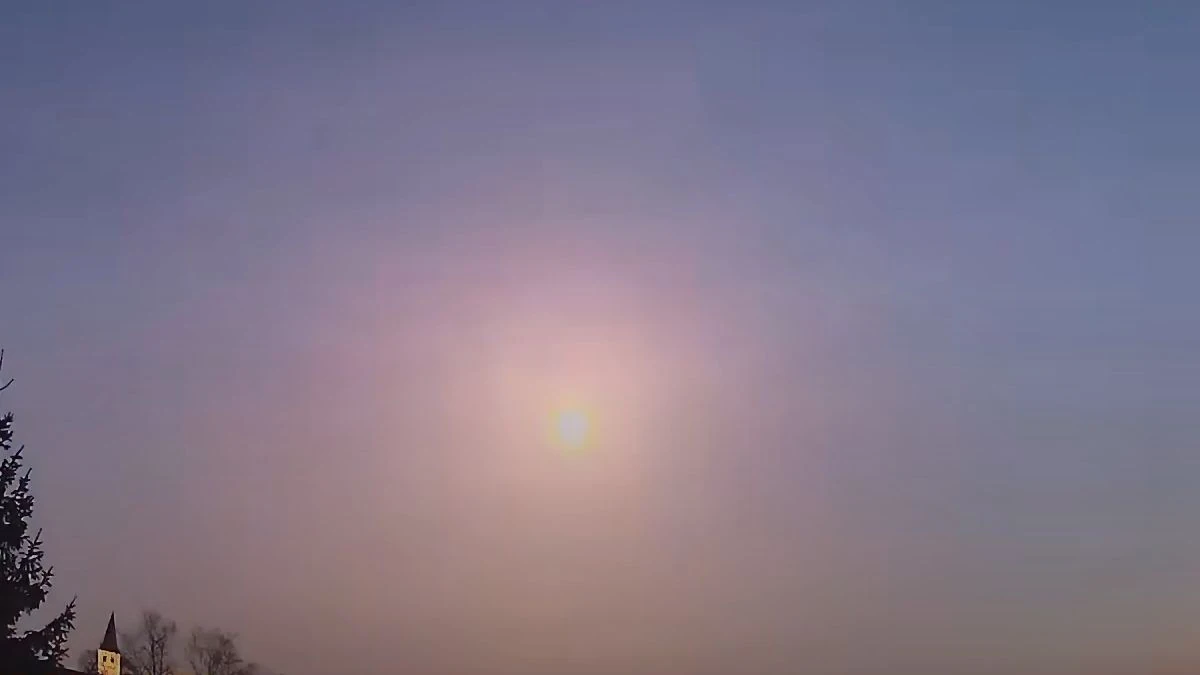
All-sky camera capture of the fireball observed over western Germany at 17:55 UTC on March 8, 2026, which produced meteorites recovered near Koblenz. Credit: AllSky7/Bernd Klemt
Witnesses across western Germany and neighboring countries reported seeing a luminous object crossing the sky shortly before fragments reached the ground near Koblenz. Sightings were reported across Germany as well as neighboring regions of Luxembourg, the Netherlands, and Switzerland.
Authorities later confirmed that meteorite fragments struck buildings in the Güls district of Koblenz, where at least one stone penetrated roof tiles and created a hole in a residential building. The impact scattered debris inside the structure but did not cause injuries.
Emergency services inspected the affected building shortly after the incident. Local reports indicate the hole created in the roof was approximately the size of a football.


The International Meteor Organization (IMO) reported rapid recovery of meteorite fragments in the Koblenz region shortly after the fireball, confirming that part of the incoming meteoroid survived atmospheric entry and reached the ground.
Meteoroids entering Earth’s atmosphere often fragment due to aerodynamic pressure and heating during atmospheric entry. When surviving fragments reach the surface, they are classified as meteorites, which may fall over an elongated area known as a strewn field. The distribution of fragments from the Koblenz event has not yet been fully mapped.
Meteorites capable of damaging buildings are rare but documented. Germany has recorded several observed meteorite falls, including the Neuschwanstein meteorite fall in 2002, which produced fragments recovered near the Germany–Austria border. On April 25, 2023, a meteorite approximately 6.7 cm (2.6 inches) in diameter pierced through the roof of a family home in the state of Schleswig-Holstein.

Laboratory analysis of the recovered fragments from the Koblenz fall will allow scientists to determine the meteorite’s classification and chemical composition. Such analysis can also provide information about the meteoroid’s origin within the solar system.
Further classification of the recovered meteorites is expected after laboratory examinations are completed.
References:
1 Fireball event 1467-2026 – IMO – Accessed March 9, 2026
2 Meteorit knallte durchs Dach ins Schlafzimmer – Bild – March 9, 2026

Teo Blašković founded The Watchers in 2011 and edited it until 2026, covering seismic and volcanic activity, extreme weather, space weather and near-Earth objects. Articles on this page are his archive.
Published in the last 24 hours
- Hawaii's largest freshwater lake was 200 feet deep at 10 a.m. on June 2, 2018. By that afternoon, lava from Kilauea had boiled it away Epicenter
- Flying glass cut a teacher in Russia but none of her 44 pupils, because when a meteor flashed across the sky in 2013, she told them to get under their desks Epicenter
- A South Dakota man put the widest and heaviest hailstone on US record in his freezer, and a power cut melted part of it before NOAA measured it at 8 inches across and nearly 2 pounds in 2010 Epicenter
- Black kites and brown falcons in northern Australia have been seen snatching smoldering sticks from wildfires, flying them into unburned grass and dropping them, starting new fires that send lizards, rodents and insects running straight toward the waiting birds Epicenter
