
Unusual shaking patterns during 2024 Whitehouse Station Earthquake — New Jersey’s strongest earthquake since 1783
A magnitude 4.8 earthquake hit Tewksbury Township, New Jersey, on April 5, 2024, causing vibrations throughout the northeastern United States. Surprisingly, the most vigorous shaking was observed in New York City, far from the epicenter.

Image credit: TW/SAM, Google
- Researchers discovered that the earthquake’s rupture direction directed seismic energy northeast, resulting in an odd pattern.
- Using Lg waves, they discovered a fault system that may change our understanding of earthquake dangers in the region.
On April 5, 2024, at 14:23 UTC, a rare magnitude 4.8 earthquake, known as the 2024 Whitehouse Station Earthquake, rocked Tewksbury Township, New Jersey as the state’s strongest earthquake since 1783. Millions felt the earthquakes, with reports ranging from Virginia to Maine.
The epicenter was located 7.7 km (4.8 miles) ESE of Califon (population 1 080), 13.3 km (8.2 miles) NW of Bridgewater (population 44 464), and 16.3 km (10.2 miles) NNW of Bradley Gardens (population 14 206). According to the USGS, the quake was caused by oblique reverse and strike-slip faulting at a shallow depth of 4.7 kilometers (2.9 miles).
By the evening of the same day, 18 aftershocks had been reported, the most significant measuring M3.8.
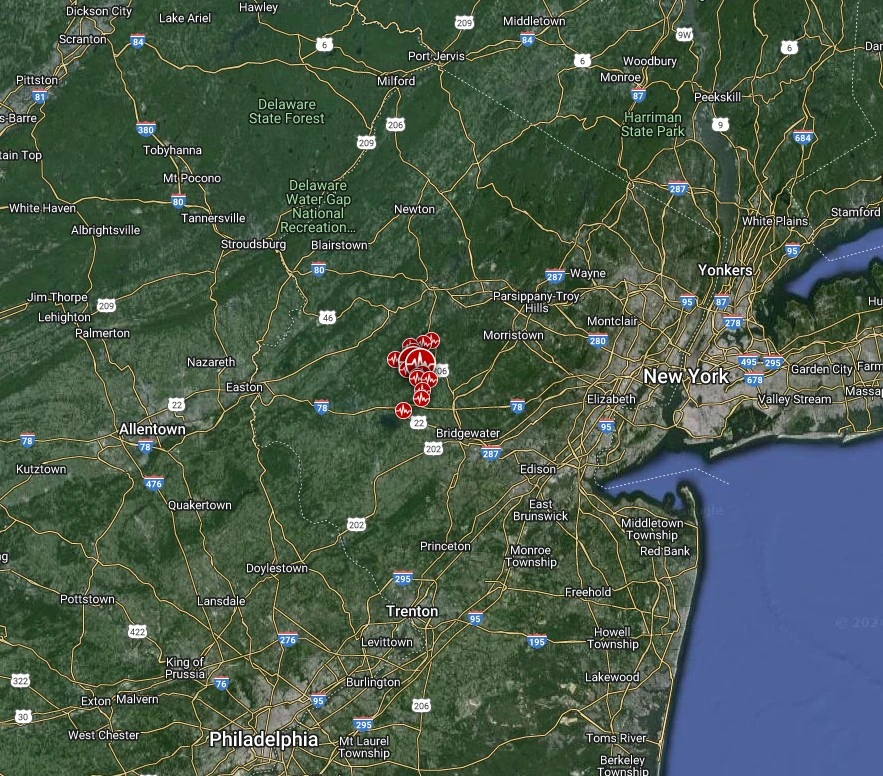
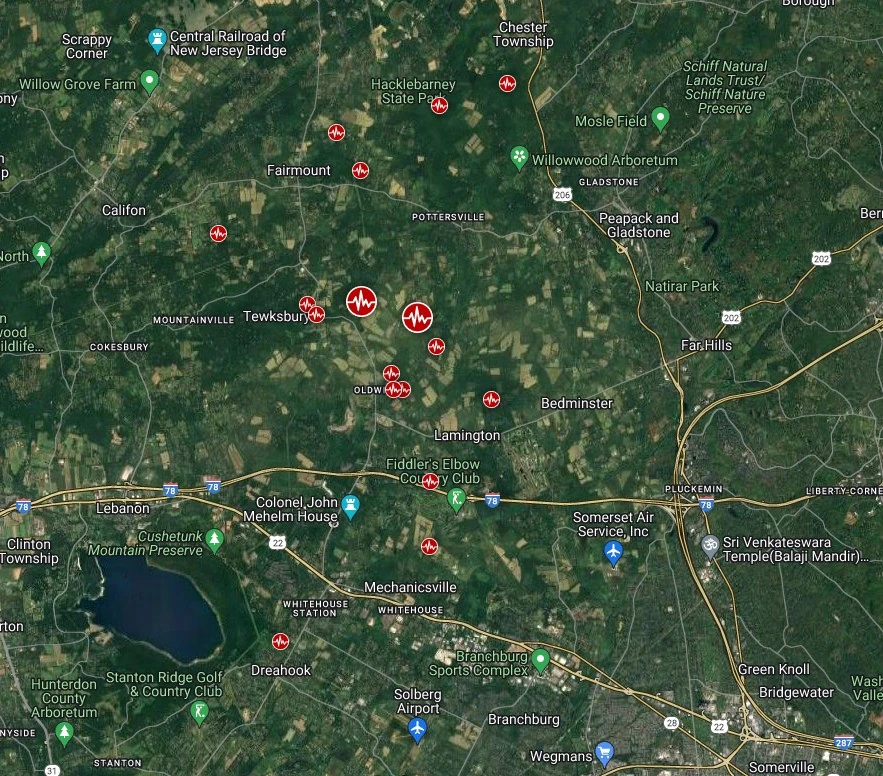
The quake significantly impacted regions such as New York City and Readington Township, where the historic Taylor’s Mill was severely damaged.
Reports were also received from Bridgewater, Basking Ridge, and Bradley Gardens. Around 30 residents in Newark were forced to vacate their homes for safety assessments, while Amtrak and commuter rail lines were temporarily halted owing to the vibrations.
Since then, a team of scientists led by YoungHee Kim of Seoul National University has been investigating the earthquake’s unusual shaking pattern, in which New York City residents, 65 km (40.3 miles) away, reported stronger shaking than those near the epicenter.
Kim and her colleague and co-author Won-Young Kim of Lamont-Doherty Earth Observatory of Columbia University became curious about the strange pattern of shaking after visiting the epicenter area of the earthquake just eight hours after the mainshock.
“We expected some property damages—chimneys knocked down, walls cracked or plasters fallen to the ground—but there were no obvious signs of property damages,” the researchers said. “Police officers within a couple of kilometers from the reported epicenter calmly talked about the shaking from the mainshock. It was a surprising response by the people and houses for a magnitude 4.8 earthquake in the region.”
This rupture orientation, combined with the effective transmission of seismic waves in the eastern United States, accounts for the extensive claims of shaking.
According to YoungHee Kim and her team, the breach spread east-northeast, directing seismic energy away from the epicenter and towards New York City.
This explains why 11 000 individuals near the epicenter experienced significant shaking while almost 17 million people further away reported milder shocks.
Additionally, the geological nature of the East Coast facilitates the propagation of seismic waves across great distances, as highlighted by USGS geophysicist Paul Caruso.
The researchers have not yet attributed the earthquake to a particular fault but the locations of the mainshock and aftershocks suggest that the area’s well-known Ramapo fault system was not active during the earthquake.
Sangwoo Han of the School of Earth and Environmental Sciences, Seoul National University, Seoul, and Oliver Boyd from the United States Geological Survey (USGS) conducted different studies to get a closer look at the earthquake, which provided necessary information.
“The findings could help us identify new earthquake sources and rethink how stress and strain are being accommodated in the eastern United States,” Boyd said. “This can help us study, for example, mechanisms related to how the crust responds to the stress of a mainshock in the region, and how productive aftershock sequences can be in the eastern United States.”
References:
1 Rupture Model of the April 5, 2024, Tewksbury, New Jersey, Earthquake Based on Regional Lg‐Wave Data – Sangwoo Han, Won‐Young Kim, Jun Yong Park, Min‐Seong Seo, YoungHee Kim – The Seismic Record 2024; 4 (3): 214–222 – September 18, 2024 – https://doi.org/10.1785/0320240020
2 Preliminary Observations of the April 5 2024 Mw 4.8 New Jersey Earthquake – Oliver S. Boyd, William D. Barnhart, James Bourke, Martin Chapman, Paul S. Earle, Guo‐chin Dino Huang, Jessica A. Thompson Jobe, Won‐Young Kim, Frederik Link, Mairi Litherland, Andrew Lloyd, Maureen D. Long, Sara McBride, Andrew J. Michael, Walter D. Mooney, Gregory S. Mountain, Sissy Nikolaou, Alexandros Savvaidis, Felix Waldhauser, Cecily J. Wolfe, Clara Yoon – The Seismic Record 2024;; 4 (4): 240–250 – https://doi.org/10.1785/0320240024
3 Closer Look at New Jersey Earthquake Rupture Could Explain Shaking Reports – Seismological Society of America – October 1, 2024
4 Rare M4.8 earthquake hits New Jersey — the strongest since 1783, U.S. – The Watchers – April 6, 2024

Harsha Borah is an experienced content writer with a proven track record in the industry. Harsha has worked with LitSpark Solutions and Whateveryourdose, honing skills in creating engaging content across various platforms. A gold medalist in a state-level writing competition organized by Assam Tourism, Harsha’s travelogue on Tezpur was widely appreciated. Harsha’s article, "The Dark Tale of the Only Judge in India to Be Hanged," ranks second on Google and has garnered over 11 000 views and 8 900 reads on Medium. Outside of writing, Harsha enjoys reading books and solving jigsaw puzzles.

Commenting rules and guidelines
We value the thoughts and opinions of our readers and welcome healthy discussions on our website. In order to maintain a respectful and positive community, we ask that all commenters follow these rules.