
M4.9 earthquake near Edgefield becomes strongest inland earthquake on record in Louisiana
An M4.9 earthquake struck near Edgefield in northwestern Louisiana, United States, at 11:30 UTC on March 5, 2026, becoming the strongest inland earthquake recorded in the state. The United States Geological Survey (USGS) reported the event at a depth of 11.1 km (6.9 miles), while the European-Mediterranean Seismological Centre (EMSC) estimated a depth of 10 km (6.1 miles). The earthquake was widely felt across northern Louisiana and parts of neighboring Texas.
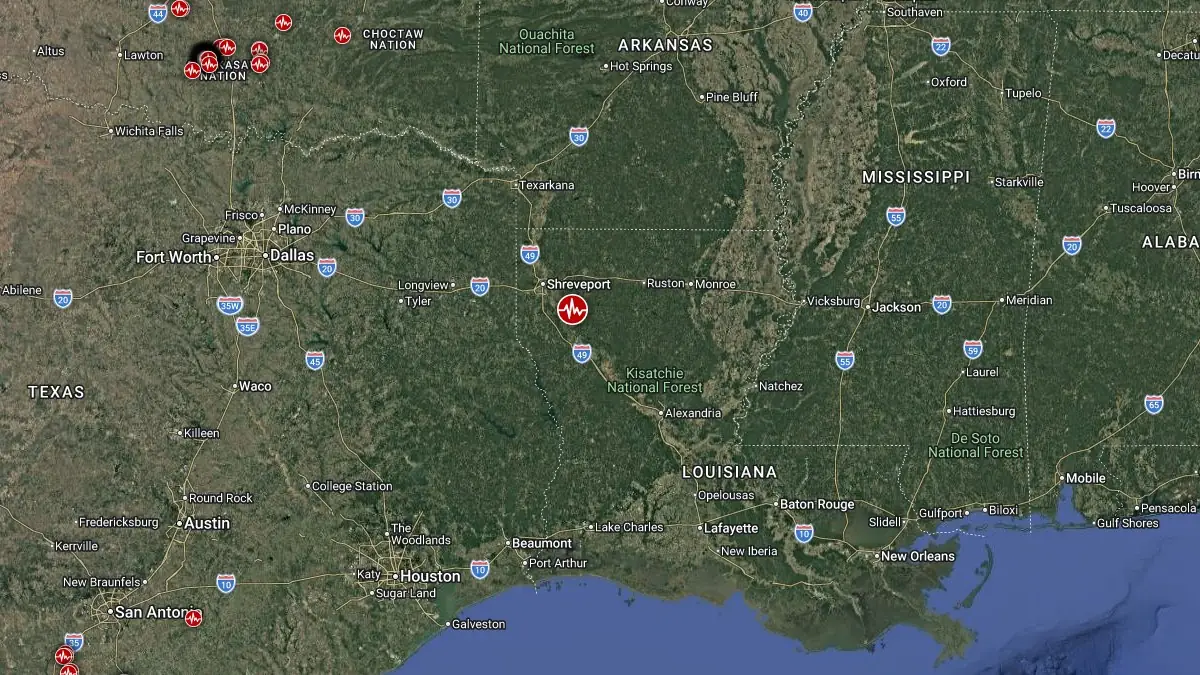
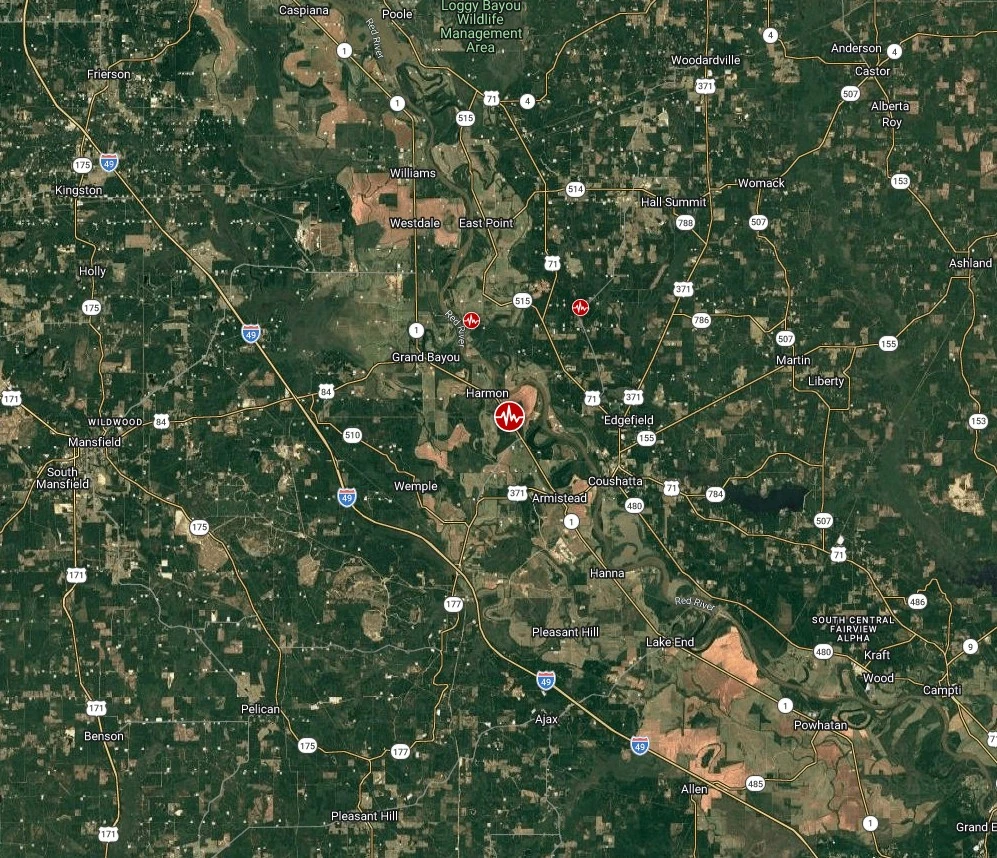
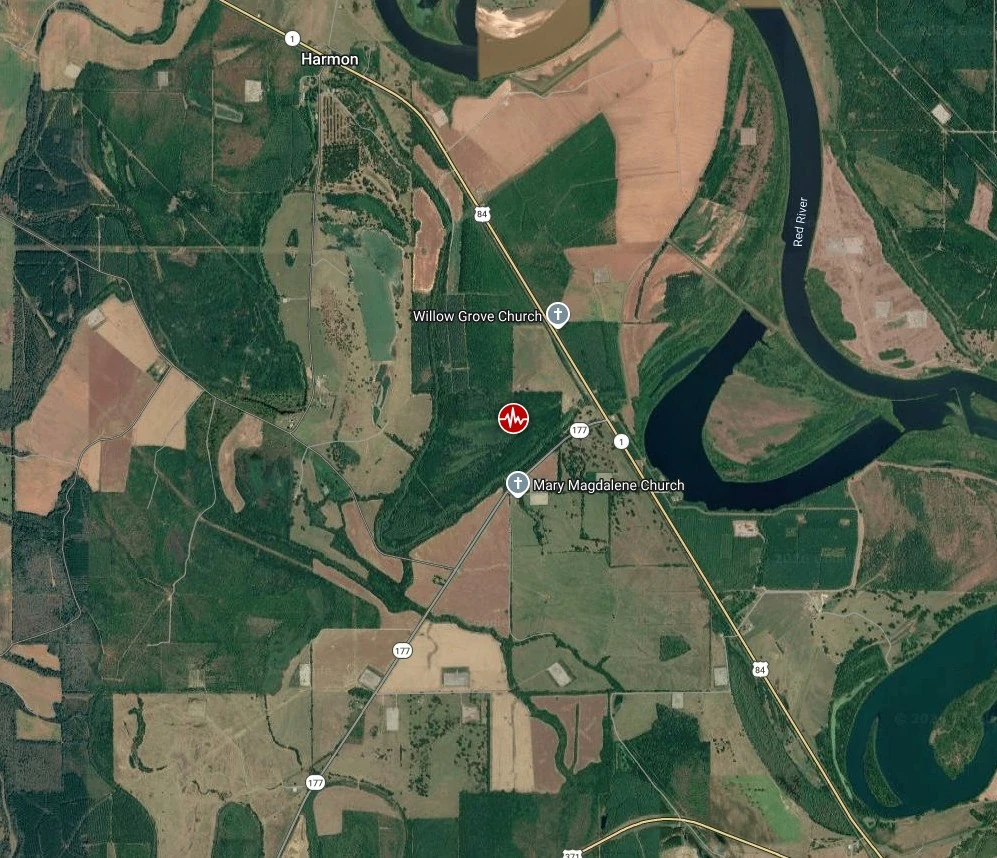
Epicenter of M4.9 2026 Red River Parish, Louisiana earthquake. Credit: TW/SAM, Google
The earthquake occurred at 05:30 local time (11:30 UTC) at a depth of 11.1 km (6.9 miles), according to the USGS. It is also the second strongest earthquake recorded in Louisiana.
The epicenter was located 7.3 km (4.5 miles) WNW of Coushatta (population 1 852) and 43.7 km (27.2 miles) NW of Natchitoches (population 18 365).
USGS estimates indicate that about 1 000 people experienced strong shaking, 22 000 moderate shaking, and approximately 2 626 000 people light shaking
Earthquakes are rare in Louisiana, and strong ones rarer still. Before March 5, the strongest quake ever recorded on Louisiana land was a M4.2 in October 1930 — a record that stood for nearly a century.
The only event to exceed the new M4.9 overall is the M5.3 that struck offshore Grand Isle in 2006, which remains the strongest in state history. In fact, four of Louisiana’s five largest quakes on record originated in those same offshore Gulf waters near Grand Isle, not on land.
Louisiana has numerous mostly inactive subsurface faults, including growth faults and salt-dome-related faults, particularly in the southern region, with over 100 suspected surface faults identified across the state.
In southeast Louisiana, the Baton Rouge–Denham Springs (BR-DS) fault system is made up of several south-dipping normal faults that extend deep underground, in some cases reaching more than 6 km (3.7 miles) below the surface.
Four primary faults make up the system in the Lake Pontchartrain area, where measurable offsets have been documented in structures such as the Highway 11 bridge and portions of the Lake Pontchartrain Causeway. The BR-DS system is believed to connect to deeper geological structures associated with the ancient margin of the Gulf Coast basin.
The March 5 epicenter, however, lies in a geologically distinct zone to the northwest — the Haynesville-Bossier Shale, a major natural gas production area straddling northwest Louisiana and east Texas.
While the cause of the quake remains under investigation, some media reports have linked it to hydraulic fracturing activity in the region, citing 10 smaller earthquakes recorded in the Haynesville-Bossier Shale zone since December 4, 2025.
Induced seismicity from fluid injection and gas extraction is a well-documented phenomenon in the south-central United States. The USGS acknowledges that in some parts of the region, a significant majority of recent earthquakes are thought by seismologists to have been human-induced.
However, establishing a causal link between a specific industrial activity and a specific earthquake requires dedicated investigation. No such study has been published for the March 5 event, and no official authority has confirmed fracking as the cause.
References:
1 M4.9 earthquake Louisiana, United States – USGS – March 5, 2026
2 M4.9 earthquake Louisiana, United States – EMSC – March 5, 2026

I am an Assistant Editor and Severe Weather & Science Journalist at The Watchers, specializing in real-time severe weather coverage, geophysical event reporting, and research-driven scientific analysis. You can reach me at rishav(at)watchers(.)news.

Commenting rules and guidelines
We value the thoughts and opinions of our readers and welcome healthy discussions on our website. In order to maintain a respectful and positive community, we ask that all commenters follow these rules.