
Models show multiple incoming CMEs, G3 – Strong or higher geomagnetic storm forecast
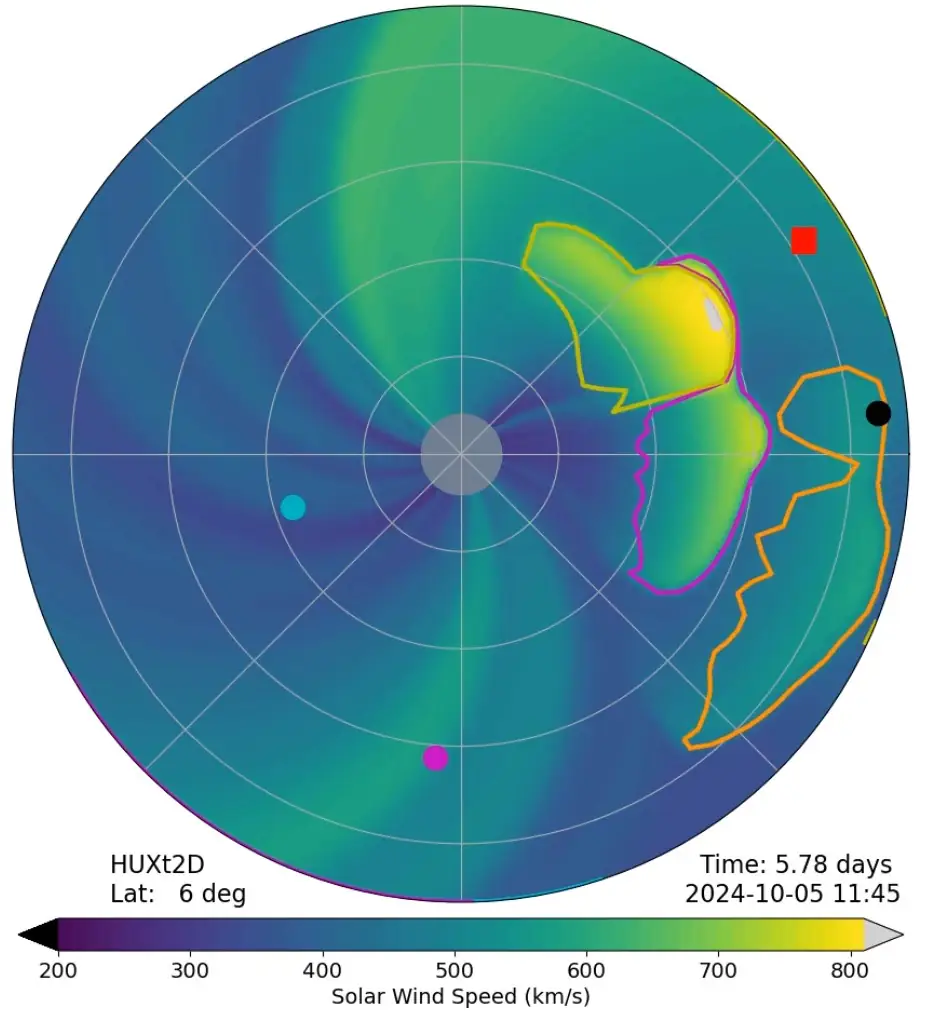
At least three coronal mass ejections (CMEs) are expected to strike Earth from October 5 to 7, 2024, prompting a G3 – Strong Geomagnetic Storm Watch, with the possibility of G4 – Severe geomagnetic storm conditions.

Image credit: University of Reading
Forecast models show at least 3 coronal mass ejections (CMEs) are heading toward Earth, with impacts expected on October 5, 6, and 7. As a result, A G3 – Strong Geomagnetic Storm Watch is in effect.
The first CME was produced by an X7.1 solar flare at 22:20 UTC on October 1, expected to arrive late October 4 to early October 5. This one is expected to be much weaker than the second CME — produced by the X9.0 flare — thus far the strongest of Solar Cycle 25, at 12:18 UTC on October 3.
The Sun also produced several other M-class flares and Earth-directed CMEs since then, including M6.2 whose CME is expected to produce a glancing blow on October 7.
With this, the geomagnetic field has a chance of reaching G3 – Strong geomagnetic storming levels, possibly G4 – Severe levels over the next two to three days.

It’s worth noting that even weaker CMEs can have an enhanced impact at this time of year due to the Russell-McPherron effect. This seasonal phenomenon occurs around the equinoxes when the Earth’s magnetic field is more likely to connect with the interplanetary magnetic field carried by solar wind.
This increases the efficiency with which solar wind energy, even from weaker CMEs, is transferred into Earth’s magnetosphere. As a result, the collective effect of the three approaching CMEs could amplify geomagnetic disturbances, potentially leading to stronger storms throughout the forecast period.
The Russell-McPherron effect is most prominent around the equinoxes, which occur in March and September. The effect typically lasts for several weeks on either side of the equinoxes, roughly extending from mid-March to early April for the spring equinox and mid-September to early October for the autumn equinox.
During these periods, the alignment of Earth’s magnetic field with the interplanetary magnetic field makes it easier for solar wind energy to flow into Earth’s magnetosphere, enhancing the potential for geomagnetic disturbances.
Combine this with several incoming CMEs and our weakened geomagnetic field and we get a really good chance for severe geomagnetic storming.
Update
07:52 UTC on October 8
The CME produced by the X9.0 solar flare on October 3 impacted Earth on October 6, producing G3 – Strong geomagnetic storming.
The auroras spread across more than 20 U.S. states, including Alaska, Maine, Vermont, Minnesota, North Dakota, Washington, Wisconsin, New York, South Dakota, Idaho, Montana, Wyoming, Pennsylvania, Ohio, Illinois, Virginia, Kentucky, Missouri, Kansas, North Carolina, Mississippi, and California.
Read more:
References:
1 Forecast Discussion – NOAA/SWPC – Issued at 12:30 UTC on October 4, 2024
2 Geomagnetic storms this weekend – SpaceWeather – October 4, 2024
3 Major X9.0 solar flare erupts from Region 3842 — the strongest of Solar Cycle 25, Earth-directed CME produced – The Watchers – October 3, 2024
4 Major X7.1 solar flare erupts from Region 3842, producing likely Earth-directed CME – The Watchers – October 3, 2024

I'm a dedicated researcher, journalist, and editor at The Watchers. With over 20 years of experience in the media industry, I specialize in hard science news, focusing on extreme weather, seismic and volcanic activity, space weather, and astronomy, including near-Earth objects and planetary defense strategies. You can reach me at teo /at/ watchers.news.

Commenting rules and guidelines
We value the thoughts and opinions of our readers and welcome healthy discussions on our website. In order to maintain a respectful and positive community, we ask that all commenters follow these rules.