
Antikythera mechanism mystery deciphered with gravitational wave research
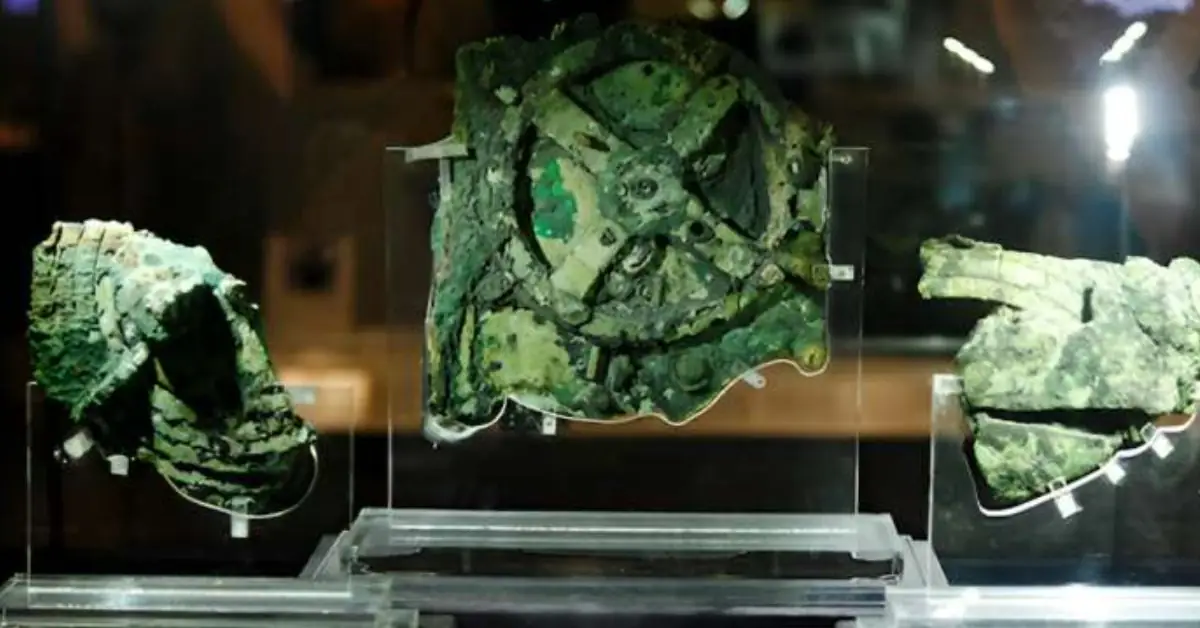
Image credit: National Archaeological Museum, Athens, Greece
Gravitational wave researchers from the University of Glasgow used modern statistical approaches to solve questions about the ancient Antikythera mechanism. Their results provided new insights into its precise design and function, offering information on how ancient Greeks tracked astronomical phenomena with unparalleled precision.
Gravitational wave researchers at the University of Glasgow utilized cutting-edge statistical modeling approaches to gain new insights into the operation of the Antikythera system, the world’s oldest known analog computer. This ancient Greek artifact, known for its astronomical accuracy and elaborate design, piqued scientists’ interest more than a century ago.
Divers discovered the Antikythera mechanism in 1901 while examining a shipwreck near the Aegean island of Antikythera. Despite being smashed into bits and highly corroded, the shoebox-sized device revealed a complicated system of gears, prompting researchers to conclude that it served as a mechanical computer. It dates back to the second century BCE and was used to predict eclipses and compute planet positions with remarkable accuracy.
Recent technological advancements have ensured a more thorough and detailed investigation to comprehend the mechanism. In 2020, new X-ray pictures of one of its rings, the calendar ring, uncovered previously unknown facts about uniformly spaced holes under the ring. The ring’s deteriorated state led to confusion among the researchers regarding the number of holes that existed. Initial estimation revealed a range between 347 to 367.
“We present a new analysis of the positions of holes beneath the calendar ring of the Antikythera Mechanism, as measured by Budiselic et al. (2020). We significantly refined their estimate for the number of holes that were present in the full ring. Our 68%-credible estimate for this number, taking account of all the data, is 355.24 +1.39 −1.36,” the researchers stated.
The University of Glasgow team, fascinated by these findings used statistical techniques frequently used in gravitational waves analysis to answer this age-old riddle. This study has been described in detail in The Horological Journal. Professor Graham Woan of the University’s School of Physics and Astronomy was one of the authors of the study which used Bayesian analysis to quantify uncertainty and compute the likely number of holes based on the placements of the remaining fragments.
According to Professor Woan, the calendar rings contain either 354 or 355 holes which aligns it more to the Lunar Calendar than to the Egyptian Solar Calendar (which requires 365 holes.) This finding greatly narrows the options offering a better knowledge of the mechanism’s design and function. Bayesian Analysis, which is the method of using probability to scan through imperfect data, was crucial in establishing these conditions.
Concurrently, Dr Joseph Bayley, a research associate at the University’s Institute for Gravitational Research, employed methods for analyzing data from the Laser Interferometer Gravitational-Wave Observatory (LIGO) gravitational wave detectors. These detectors detect tiny ripples in space that are caused by astronomical events such as black hole collisions. Bayley’s use of Markov Chain Monte Carlo and layered sampling methods confirmed the notion that the calendar ring had 354 or 355 holes with astonishing precision, indicating that the holes were positioned with an average radial variation of only 0.028 mm.
Dr. Bayley pointed out the ancient Greeks’ extraordinary craftsmanship, noting that building such a device required precise measurement techniques and a very steady hand. This newfound respect for the mechanism’s development shows us the great technological talents possessed by its designers.
“Using all the data, the 354-hole hypothesis is about 229 times more probable than 360 holes, which they also considered, and vastly more probable than 365 holes,” the researchers concluded.
Woan and Bayley’s dual approaches produced a comprehensive probabilistic set of data, which increased our understanding of the Antikythera system. Their findings provide solid proof that the ring was used to track the Lunar Calendar, emphasizing the tremendous technological knowledge of the ancient Greeks.
Professor Woan noted the symmetry of utilizing modern technology to investigate an antique gadget that let people detect astronomical movements nearly two millennia ago. This study has provided substantial contributions to the historical and scientific understanding of this unique relic.
References:
1 An Improved Calendar Ring Hole-Count for the Antikythera Mechanism – Graham Woan and Joseph Bayley – The Horological Journal – July 2024
2 Gravitational wave researchers cast new light on Antikythera mechanism mystery – University of Glasgow – June 27, 2024

Harsha Borah is an experienced content writer with a proven track record in the industry. Harsha has worked with LitSpark Solutions and Whateveryourdose, honing skills in creating engaging content across various platforms. A gold medalist in a state-level writing competition organized by Assam Tourism, Harsha’s travelogue on Tezpur was widely appreciated. Harsha’s article, "The Dark Tale of the Only Judge in India to Be Hanged," ranks second on Google and has garnered over 11 000 views and 8 900 reads on Medium. Outside of writing, Harsha enjoys reading books and solving jigsaw puzzles.

Commenting rules and guidelines
We value the thoughts and opinions of our readers and welcome healthy discussions on our website. In order to maintain a respectful and positive community, we ask that all commenters follow these rules.