
Massive mudflow hits Quito after extremely heavy rain, Ecuador

Image credit: Ecudrone Solutions
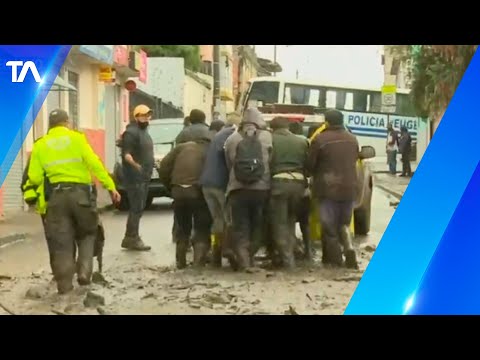
A destructive mudflow hit the La Gasca suburb of Ecuador's capital Quito (population 2.7 million) on January 31, 2022, sweeping away homes and cars, and claiming the lives of at least 24 people. At least 12 people are still missing and 48 were injured. The event took place after the area experienced its heaviest rainfall in nearly 20 years, with up to 75 mm (2.9 inches) in a very short period.
According to Quito mayor Santiago Guarderas, the downpour overwhelmed a hillside water catchment structure that had a capacity of 4 500 m3 (159 000 feet3) with more than four times that volume.
The result was a catastrophic failure that caused a 1 km (0.6 miles) long flow of mud and debris through parts of the city, including a sports field.
24 dead, dozens injured as flooding hits Ecuador capitalhttps://t.co/WjJIHJfOft pic.twitter.com/vumsE1iHoo
— AFP News Agency (@AFP) February 2, 2022
"People who were playing couldn't get away. It grabbed them suddenly," witness Freddy Barrios Gonzalez told AFP.1 "Those who managed to run were saved but a family got buried under a river of mud. There they died."
In a preliminary statement issued on February 1, Guarderas said that 174 houses were evaluated, of which 38 have partial damage and 3 were destroyed. In addition, 15 vehicles and 22 motorcycles were affected.
Rescuer Cristian Rivera said many people in Quito had to be treated for hypothermia.
Power was lost in some parts of the city after electrical poles were brought down.

Viewer discretion advised

This area appears to have been affected by a similar mudflow in February 1975, when a mudflow originated from the Pambachupa ravine, affecting the La Mariscal neighborhood, close to La Gasca, said landslides expert Dr. Dave Petley of The Landslide Blog.2
"Perhaps surprisingly, the municipal authorities have ruled out deforestation as being a factor in this event."
References:
1 24 dead, dozens injured as flooding hits Ecuador capital – AFP
2 The disastrous 31 January 2022 mudflow in the La Gasca suburb of Quito, Ecuador – The Landslides Blog

Teo Blašković founded The Watchers in 2011 and edited it until 2026, covering seismic and volcanic activity, extreme weather, space weather and near-Earth objects. Articles on this page are his archive.
Published in the last 24 hours
- In September 1859, a solar storm lit up the night sky so brightly that gold miners in the Rocky Mountains woke up after midnight and started cooking breakfast, convinced the aurora glowing over their camp was the sunrise Epicenter
- A patch of warm Pacific water that could become the strongest El Niño in more than 70 years sits thousands of miles from any American town, yet it is already the main reason NOAA expects a wetter winter across the South and a milder one across the North
- A 19-year-old Nebraska teacher reportedly tied her pupils together with twine and led them to safety through a blizzard in January 1888 Epicenter
