
Intense earthquake swarm at Galápagos’ Fernandina volcano
A M4.3 volcano-tectonic earthquake struck beneath the La Cumbre volcano on Fernandina Island in the Galápagos archipelago, Ecuador on November 17, 2025, followed by an intense earthquake swarm.
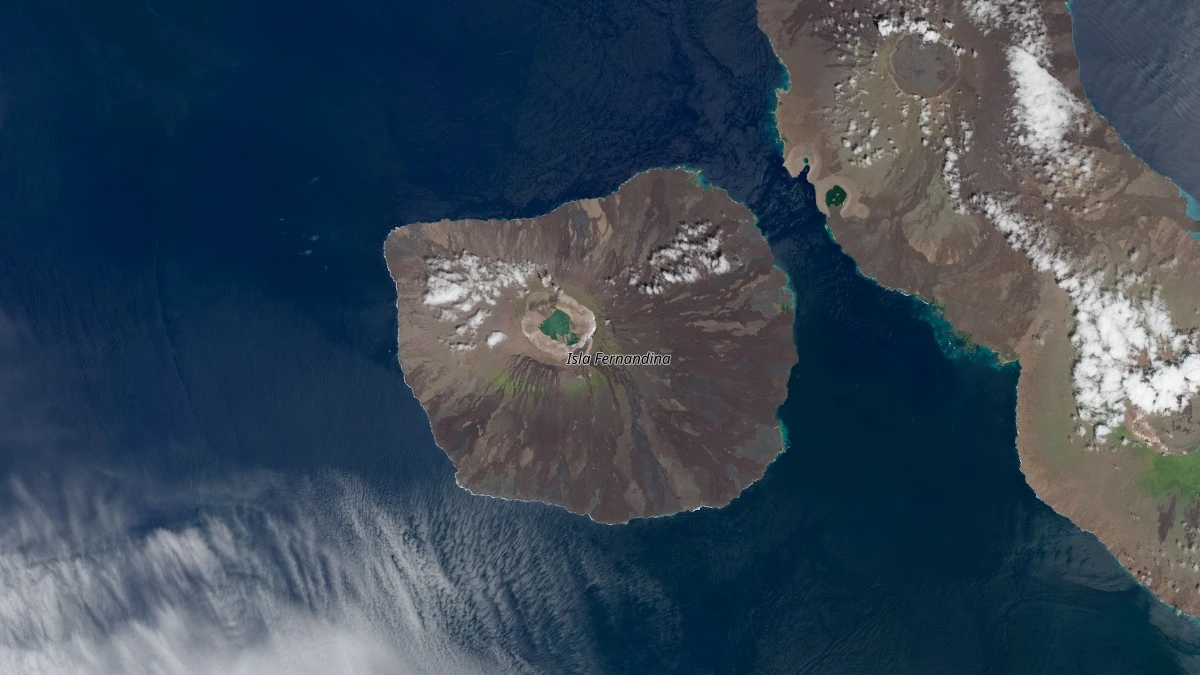
Satellite image of Fernandina Island, Galápagos acquired on November 21, 2025. Credit: Copernicus EU/Sentinel-2, The Watchers
The Geophysical Institute – National Polytechnic School (IGEPN) recorded the M4.3 quake under Fernandina volcano at 05:06 UTC on November 17, followed by an intense seismic swarm beginning at 14:00 UTC.
According to the Global Volcanism Program (GVP) weekly report for November 12–18, the number of volcano-tectonic events rose significantly after November 12, with activity peaking following the M4.3 earthquake. The swarm consisted of numerous low-magnitude earthquakes located at shallow depths below the edifice.
Fernandina Island is uninhabited, and no settlements exist within the volcano’s immediate hazard zone. The closest populated island is Isabela, located about 10 km (6 miles) to the east.
While the current seismic activity poses no direct threat to inhabitants, it suggests a possible magma movement within the volcano’s plumbing system.
Fernandina is a volcanic island in the Galápagos Islands, around 1 000 km (621 miles) west of the coast of mainland Ecuador. It has produced nearly 30 recorded eruptions since 1800, with recent activity occurring along radial or circumferential fissures around the summit crater.
La Cumbre is among the most active volcanoes of the Galápagos hotspot. Its most recent eruption occurred from March 3 to May 9, 2024, when lava flows reached the sea. Satellite analyses estimated erupted-lava volumes at about 44 million m3 (1.5 billion ft3) by April 3, 2024.

Rishav Kothari is Editor-in-Chief of The Watchers, where he runs the newsroom and covers earthquakes, volcanoes, severe weather and space weather.
Published in the last 24 hours
- Weather radar tracked meteorites falling into Cape Cod Bay after a 1.1-kiloton fireball over Massachusetts on 30 May 2026; researchers have now traced its orbit almost out to Jupiter. Epicenter
- 10 named storms, one hurricane for the first time since 1925: Why has the Atlantic been so quiet in 2026 Epicenter
- Amazon fire hotspots rise 82.6% in October 2026 as El Niño intensifies Epicenter
- In 2005, a driver near Russia's Chulyshman River picked up a stone to wedge under his car wheel and kept it for 20 years; the Meteoritical Bulletin has now approved it as the Altai Republic's first meteorite. Epicenter
